
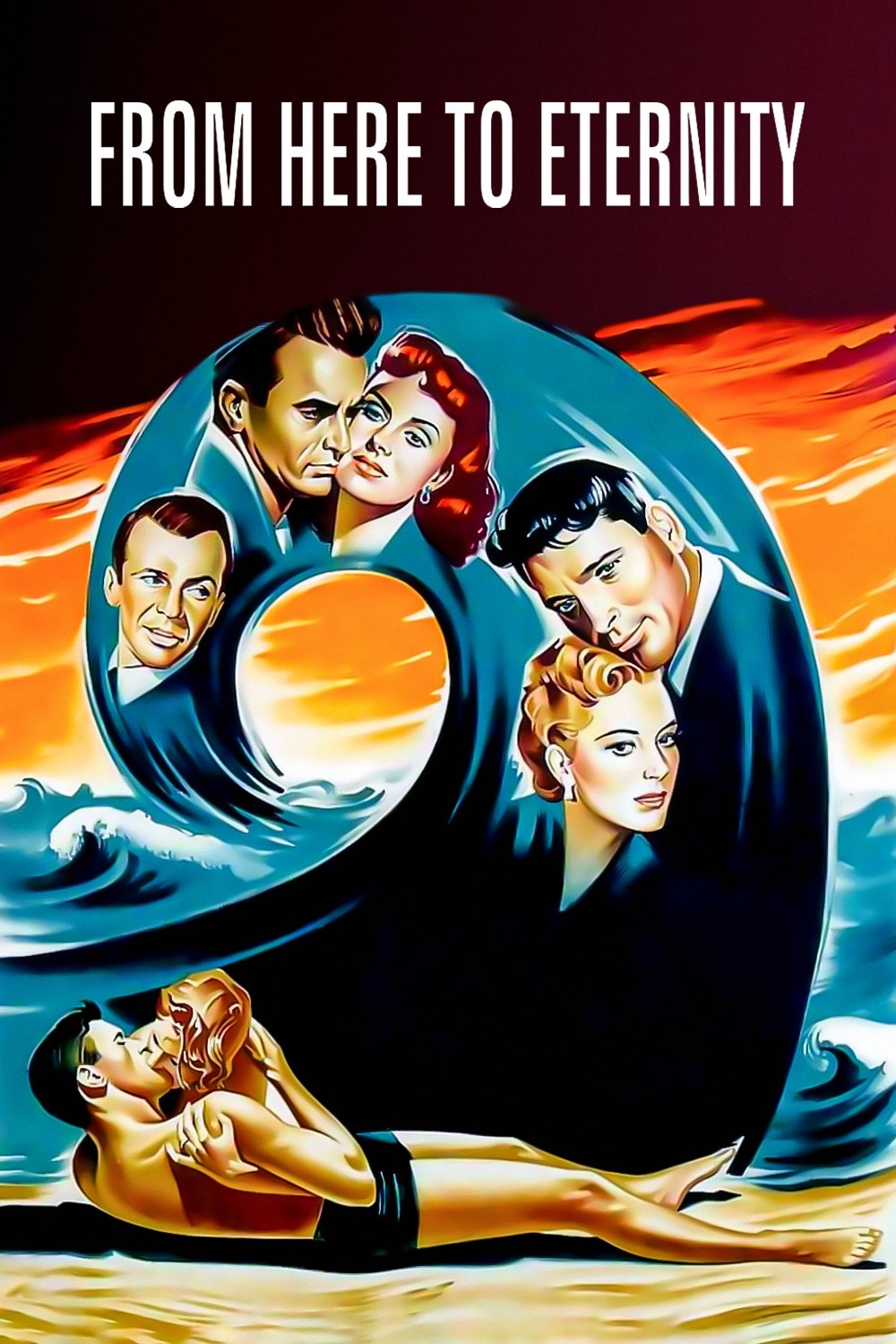
Plot Summary
“From Here to Eternity” swept me up from the first frame—a classic, yet its world still breathes with tension and hidden desire. Directed with remarkable restraint by Fred Zinnemann, this 1953 romantic drama doesn’t just chronicle the final days before the Japanese attack on Pearl Harbor; it immerses me in the struggles of men and women wrestling with loyalty, love, and survival on an Army base in Hawaii. While the film unfolds like a sprawling canvas, I was surprised by how deftly it juggles multiple personal dramas. Through the eyes of Private Robert E. Lee Prewitt, I witnessed the uneasy dance between individual conviction and institutional pressure. Prewitt, a principled bugler and former boxer, refuses to re-enter the boxing ring for his company’s glory, which earns him both the respect of a few and the antagonism of many. Sergeant Warden’s magnetism, coupled with his secret affair with his captain’s wife Karen Holmes, adds a steamy, dangerous undertone I found surprising for the era. The film infuses even minor scenes with a longing for connection that I felt as much as observed. Most striking is the way the shadow of war looms—virtually unspoken, yet always present—infusing every choice with a sense of impending loss. If you haven’t yet seen it, I’ll avoid detailing any heart-wrenching turns, but suffice to say: the complexities between love, duty, and sacrifice are anything but simple here.
Key Themes & Analysis
What lingers with me each time I return to this film is how “From Here to Eternity” uses its lush black-and-white cinematography to wrap its characters in ambiguity. Shadows loom, faces half-lit, mirroring the internal conflicts tearing at Prewitt and Warden. For me, Zinnemann’s direction is a study in subtlety—he understands that the biggest wars aren’t always on the battlefield, but within the self. The camera rarely moves in for close-ups, yet I always feel the unspoken anguish in every glance between characters. The theme of institutional oppression versus personal morality pulses through every storyline. When Prewitt refuses to fight, I saw not just a stubborn soldier but an everyman insisting on the right to live by his own code, no matter the cost. I didn’t just watch Warden and Karen’s affair; I felt the risk, the defiance, and the tragedy inherent in their need for escape. The love scenes, most famously the surf-drenched kiss between Deborah Kerr’s Karen and Burt Lancaster’s Warden, still simmer with sensuality and fatalism. That scene, in particular, captures for me how the film dares to show sexuality as something both transcendent and dangerous—a dynamic Hollywood rarely acknowledged so openly in the 1950s.
Each performance draws me in with different shades: Montgomery Clift invests Prewitt with a stubborn purity that I found deeply moving, while Frank Sinatra’s Maggio electrifies every scene with raw vulnerability. His struggles—both comic and tragic—act as a counterpoint to Prewitt’s stoicism. I’m constantly struck by how earnest and modern Clift feels, especially when surrounded by more traditionally “Hollywood” personas. Deborah Kerr, often typecast, here brings a fierce sensuality and emotional intelligence that upends the stereotype of the suffering wife. Zinnemann balances these characters so expertly that I always feel each is fighting for dignity in their own way. The supporting roles, too, have a crackling realism—Jack Warden’s Cpl. Buckley and Ernest Borgnine’s Sgt. ‘Fatso’ Judson threaten, try to bond, or wound the others, always under the claustrophobic gaze of military discipline. Technical elements serve the story: the Academy Award-winning editing gives the film a tautness I rarely find in ensemble melodramas of this vintage.
But beyond the technicalities, I felt the film’s deeper pain: no one escapes the consequences of their choices, and even momentary happiness must be paid for in regret or sacrifice. Zinnemann’s moral ambiguity—he refuses to assign blame too easily—made “From Here to Eternity” feel radical to me, even now. Its central thesis, as I interpret it, is that human longing collides inevitably with institutional demands, often leaving trauma in its wake. While its social commentary on class, rank, and gender pretenses is gentle by today’s standards, I’m always impressed by how each subplot ultimately circles back to the question of whether there is still room for decency, passion, and hope in a system built for obedience.
My Thoughts on the Cultural Impact & Legacy
Few films have seeped into the American imagination as thoroughly as this one. I suspect it’s because “From Here to Eternity” refuses to romanticize war or military life—the uniforms, the rituals, the mess halls, all serve as both backdrop and prison. For me as someone who curates and considers cinema’s evolving language, this movie marked an inflection point in how Hollywood treated adult subjects. Gone are the melodramatic gestures of so many earlier “message” pictures; in their place, I find restraint and a willingness to leave questions open, daring the viewer to make sense of them. When I watch Prewitt on screen, I understand how his private battles became a touchstone for later antiheroes—before the world welcomed Brando or Newman, there was Clift’s moral stubbornness. The very idea of the army as a place of both sacrifice and oppression sowed the seeds for later war films that questioned authority and portrayed psychological wounds as central.
The film’s enduring power is also rooted in those images that have become cultural shorthand: the famous beachside kiss, the panic during the Pearl Harbor assault, the lonely bugle playing “Taps.” These moments, as I see them, have taken on a mythic weight. I notice echoes of “From Here to Eternity” in everything from Coppola’s stylized militarism to television’s measured takes on trauma and masculinity. As a critic, I’m continually aware that the film’s frank depiction of adult passion—censored in places even for its time—paved the way for Hollywood’s slow abandonment of the Production Code. Personally, my reverence for its legacy only grows: it’s a movie that draws me back every few years, challenging me to rethink how love, loyalty, and loss might be portrayed on screen. There is a strange, melancholic comfort in revisiting Zinnemann’s Hawaii, knowing its heartbreak will never fully fade. “From Here to Eternity” matters to me not just as a historical artifact, but as a living blueprint for complex, grown-up storytelling.
Fascinating Behind-the-Scenes Facts
Delving into the film’s background, I discovered stories that reinforced my admiration for everyone involved. What struck me most was how the casting nearly fell apart: Frank Sinatra’s role as Maggio almost never happened. Sinatra was not Columbia’s first choice; only after an aggressive lobbying campaign—mythologized and parodied in “The Godfather”—was he cast, reportedly persuaded by wife Ava Gardner’s intervention and an intense, personal plea. Watching Sinatra’s bite-sized physicality and outsized emotion, I see why the part had to be his; he went on to win an Oscar, revitalizing his flagging career.
Another revelation for me lay in the famous beach scene between Burt Lancaster and Deborah Kerr. That rolling-in-the-surf kiss truly was as uncomfortable as it looks luscious; with waves crashing over them and sharp volcanic sand sticking everywhere, both actors were left bruised and battered, even as the camera rendered the scene timelessly erotic. That raw, blustery energy is palpable when I rewatch it—it’s not just performance, but endurance on display. Also, I’m fascinated by how Montgomery Clift, not a boxer in real life, endured intensive months-long training to sell Prewitt’s pugilism. Clift’s meticulous approach led to on-set tension and physical injuries, but ultimately resulted in some of the most authentic fight scenes in early postwar Hollywood. That commitment makes Prewitt’s struggles all the more believable to me.
Why You Should Watch It
- For its nuanced exploration of the moral and emotional dilemmas of military life, which transcends the typical war movie narrative by focusing on deeply human conflicts
- If you value powerhouse performances—especially from Montgomery Clift, Deborah Kerr, and Frank Sinatra—you’ll find each role searingly alive, with each actor pushing beyond typecasting
- The technical innovation and artistry, particularly in its groundbreaking treatment of adult themes and iconic cinematography, have shaped countless films that followed
Review Conclusion
Every time I return to “From Here to Eternity,” I’m reminded of why certain classics remain urgent decades on. This is not simply a war film or a romance, but a portrait of ordinary people straining against the constraints of duty, secrecy, and desire. Zinnemann’s direction, the raw performances, and the film’s unsparing depiction of longing and loss never fail to move me. For its indelible imagery, its willingness to question authority, and its embrace of messy, unsolvable conflicts, I gladly award it a star rating of 4.5 out of 5. It’s a film I measure others against—one I recommend not just for its past glory, but for how unsettling and alive it still feels today.
Related Reviews
- “A Place in the Sun” (1951) – I see this film as a cousin to “From Here to Eternity” in its portrayal of conflicted outsiders and doomed romance. Its use of method acting, personal tragedy, and societal critique makes it an essential companion for those fascinated by Clift’s magnetism.
- “The Best Years of Our Lives” (1946) – For me, William Wyler’s masterpiece similarly redefined what postwar drama could be. Its exploration of veterans’ struggles to readjust to civilian life complements the way Zinnemann questions military culture and personal cost.
- “The Bridges of Toko-Ri” (1954) – If you’re drawn to the bittersweet, anti-glamorous approach to romance and military life, this story of love and loss during the Korean War shares the adult themes and emotional ambiguity that I find so compelling in “From Here to Eternity”.
- “On the Waterfront” (1954) – In my mind, Kazan’s gritty look at personal rebellion and institutional corruption is a natural follow-up for viewers wanting more of the tension between moral conviction and societal pressure that defines Zinnemann’s film.
For readers looking to go deeper, these perspectives may help place the film in a broader context.
🎬 Check out today's best-selling movies on Amazon!
View Deals on Amazon