
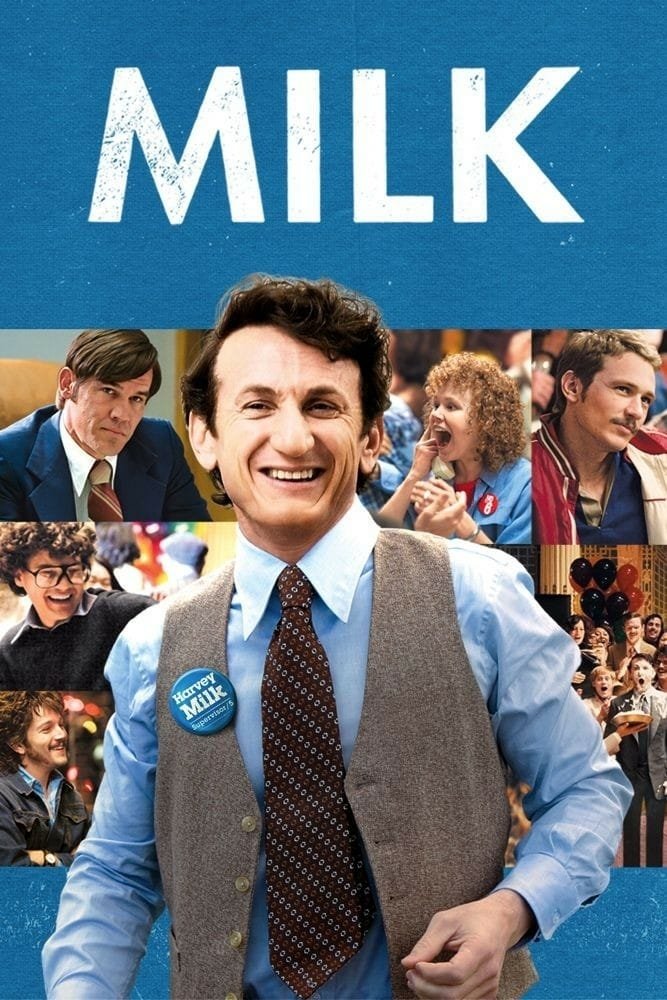
Plot Summary
I still remember the moment I sat down to watch “Milk,” uncertain of how Gus Van Sant would navigate this crucible of a story. My anticipation stemmed from a deep respect for any director brave enough to dive into both the tumultuous personal journey and the seismic political upheaval of Harvey Milk’s life. “Milk” is so much more than a straightforward biopic; I found its narrative unfolding like a tidal wave, balancing activism with the raw pulse of human fragility.
Without venturing into explicit spoiler territory, what resonated with me was the way the story starts in the early 1970s—decades before LGBTQ+ rights were considered more than a distant hope. The film trails Harvey Milk as he transforms from a closeted insurance salesman to the first openly gay elected official in California. This trajectory is not a smooth hero’s ascent but instead, a bruising march through moments of both hard-won joy and bruising heartbreak. The screenplay doesn’t sanitize the battleground; each supporting character, from Milk’s partners to his campaign manager, is drawn into a mosaic of hope, pain, and resilience.
What I especially appreciated was how Van Sant refuses to let the audience stay at a distance. The pacing never feels rushed or artificially dramatized; instead, it breathes with the same urgency as the era itself. If you aren’t already familiar with Harvey Milk’s fate, consider this a point where major spoilers might arise should you go searching—though the film, in my view, isn’t defined so much by its ending as by the inexorable spirit found in every step of Milk’s journey.
Key Themes & Analysis
Peeling back the film beyond facts and figures, I felt immediately pulled into the enduring tension between personal vulnerability and public heroism. The most powerful motif, from my perspective, is the persistent need for visibility—Milk’s mantra that “hope will never be silent” vibrates through nearly every scene. I saw the film as a meditation on collective courage, but also on the quiet, often solitary backstories behind social change. What I found especially haunting is the film’s honesty: Milk’s victories are always tinged with the knowledge that each public achievement places his private life in stark, sometimes dangerous relief.
Gus Van Sant’s direction, for me, is an act of empathy. He carefully deploys handheld camera work and archival footage to evoke a documentary-like immediacy, blurring the edges between reenactment and lived experience. This stylistic authenticity grounds the film’s more operatic moments, lending a palpable sense of place to the Castro district and beyond. I was fascinated by how Van Sant manages to make each street march, every rally speech, feel defiant and immediate—even for viewers far removed from the time period.
Sean Penn’s portrayal of Harvey Milk is unlike anything I’d seen from him before. There’s a buoyancy and warmth balanced with a deep well of fear, especially in scenes set against rising threats from foes both institutional and personal. Penn inhabits Milk not as a legend, but as a man propelled by hope, anxiety, and overflowing compassion. The supporting cast—James Franco, Emile Hirsch, Josh Brolin—all breathe life into their roles, never settling for mere caricature. I was especially struck by Brolin’s turn as Dan White, delivering a haunted and dangerously conflicted performance. The chemistry and tension between these characters anchor the film’s larger political ruminations in lived, bodily stakes.
Perhaps the technical aspect that stayed with me the longest is Danny Elfman’s score—restrained where it needs to be, surging at the right emotional peaks. The production design, with its era-specific flourishes, doesn’t distract; instead, it quietly reminds viewers of the everyday world surrounding a momentous social struggle. The cinematography’s earthy palette infuses sunlight into difficult moments, reinforcing my sense of hope flickering even in the bleakest times.
My Thoughts on the Cultural Impact & Legacy
I’m always thinking about the intersection between cinema and activism. For me, “Milk” has become an essential touchstone—partly because it reshaped my expectations for what a political drama could achieve. It’s not just a chronicle of one activist’s journey, but a vivid document of an era where lives and rights hung in the balance. This film changed how I, as a curator, approach stories about social progress and resistance; it’s a reminder that films can persuade hearts and mobilize minds.
Even years later, the echoes of “Milk” linger in contemporary queer cinema and political storytelling. I see traces of its DNA in everything from narrative structure to casting choices—movies and TV shows now routinely center LGBTQ+ characters not in tragedy, but in states of striving and celebration. At a time when representation in media is a subject of heated debate, “Milk” stands as both a blueprint and a challenge: How do we tell stories that are honest about the costs of progress without descending into defeatism? For me, the answer is grounded in authenticity and ensemble performance, both of which “Milk” delivers in abundance.
I’ve also noticed the film’s influence on how newer generations understand the history and stakes of queer activism. For many viewers I’ve spoken to, “Milk” remains a first point of contact—the foundational mythos that both inspires and complicates. Personally, I return to it not just for history, but to remind myself of how resilient communal bonds can be, especially when the future feels uncertain. That’s why “Milk” still resonates for me: it’s less a requiem than a stubborn, exultant hymn to hope, justice, and uncompromising authenticity.
Fascinating Behind-the-Scenes Facts
Peeking beneath the surface of “Milk,” I found production stories that are almost as compelling as what made it on screen. My favorite tidbit is how Sean Penn immersed himself in the Castro district even before cameras rolled. Penn spent time with longtime friends and associates of Harvey Milk, adopting not just the activist’s speech patterns but also his generous, magnetic manner. Local residents reported seeing Penn maintaining character even off set, a technique that helped root his performance in lived truth rather than pure mimicry.
I was genuinely surprised to learn that the filmmakers were given unprecedented cooperation from the city of San Francisco. They shot much of the pivotal street sequences in the very neighborhoods where history unfolded, often enlisting actual community members as extras. This direct engagement imbued the recreation of rallies and marches with energy that a studio lot could never replicate.
The casting process, to me, represents a stroke of serendipity. Several of the supporting actors—most notably Emile Hirsch—researched their roles by befriending the real-life counterparts of their characters. Hirsch, who played activist Cleve Jones, shadowed Jones to better internalize his rebellious verve and optimism. It’s these granular details that breathe authenticity into every layer of the finished film.
Why You Should Watch It
- Sean Penn’s performance is a masterclass in transformation, delivering emotional depth without ever tipping into sentimentality.
- The film’s depiction of collective activism and hope remains radically timely—and necessary—in light of ongoing fights for equality.
- Gus Van Sant’s direction turns a historical narrative into living, breathing cinema that will leave you reflecting on the courage required in everyday acts of resistance.
Review Conclusion
Looking back on my experience with “Milk,” what stays with me most is a sense of gratitude—for its candor, its artistry, and for the renewed hope it unlocks with every rewatch. Gus Van Sant delivers one of the most truthful and invigorating films ever made about collective struggle and uncompromising individuality. On both an artistic and emotional level, it’s a work I keep returning to.
For all these reasons, I rate “Milk” 4.5 out of 5. It’s a work of empathy and activism I can’t recommend more highly, whether you’re seasoned in the genre or just beginning to explore it.
Related Reviews
- “Philadelphia” (1993): Like “Milk,” this emotionally charged drama challenges audiences to confront prejudice and the societal stakes of queer visibility. Tom Hanks’s nuanced performance and the film’s focus on legal justice echo similar struggles seen in “Milk,” making it a natural companion piece.
- “Dallas Buyers Club” (2013): This film’s raw depiction of one man’s battle for dignity in the face of discrimination and systemic neglect is cut from the same cloth as “Milk.” Matthew McConaughey’s transformation into Ron Woodroof reminds me of Sean Penn’s immersive turn and the way both films thread personal defiance into sweeping social commentary.
- “The Times of Harvey Milk” (1984): This Oscar-winning documentary digs even deeper into the real-life events dramatized in “Milk.” I always recommend pairing it with Van Sant’s film to appreciate both the cinematic and documentary approaches to Milk’s legacy.
- “Pride” (2014): Although set in 1980s Britain, this uplifting drama about LGBTQ+ activists uniting with striking miners is spiritually aligned with “Milk.” Its message about diverse communities coming together in solidarity offers a broader context for understanding activism and hope.
For readers looking to go deeper, these perspectives may help place the film in a broader context.
🎬 Check out today's best-selling movies on Amazon!
View Deals on Amazon