
Plot Summary
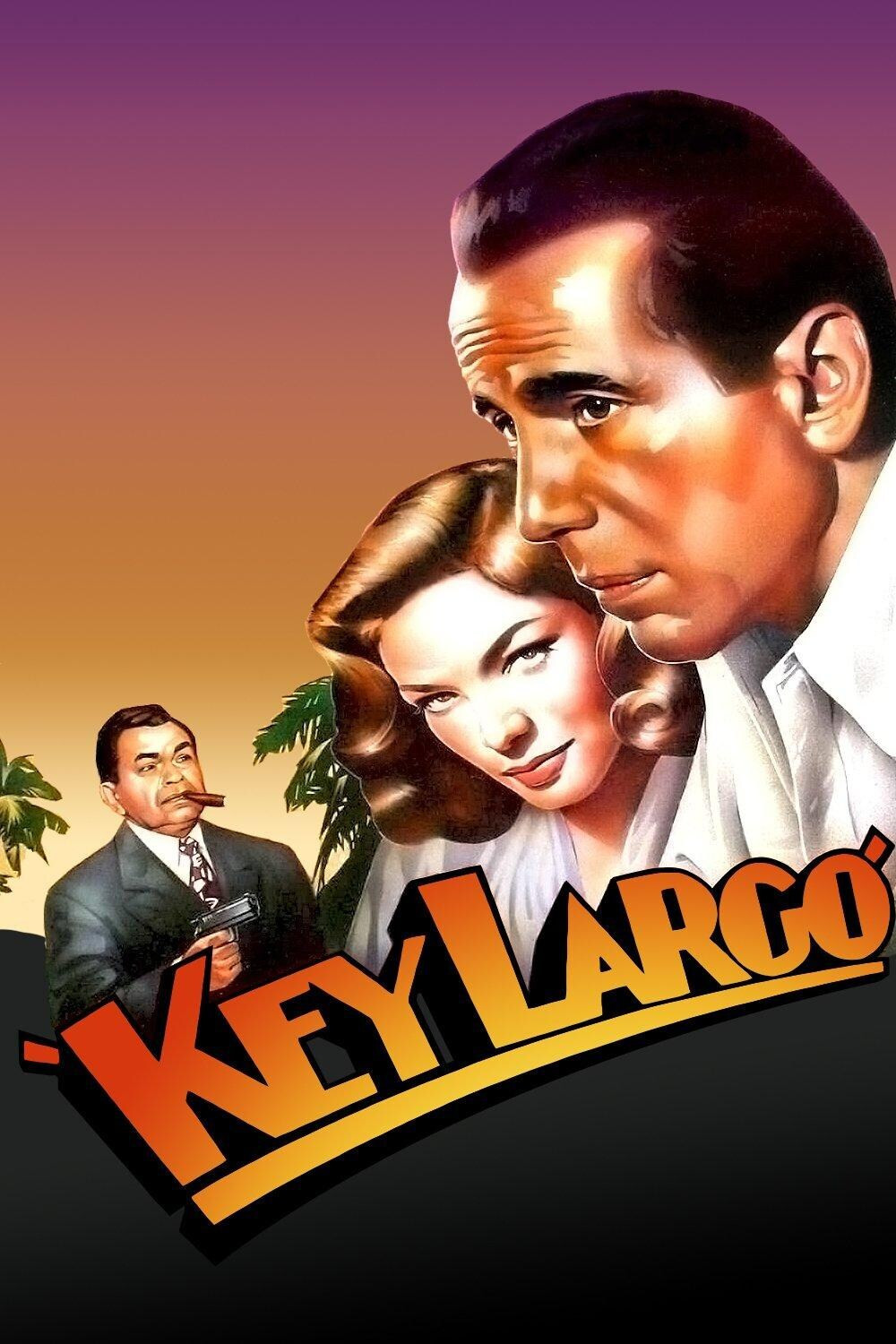
From the very first moments of Key Largo, I find myself caught between dread and anticipation, immersed in the stifling atmosphere that John Huston skillfully conjures. As someone who’s always drawn to films that create tension less through spectacle and more through subtle interactions, this classic 1948 noir immediately gives me a sense of anxious claustrophobia. Watching Frank McCloud, played by Humphrey Bogart, arrive at a weather-beaten Florida Keys hotel, I am fully aware that he’s not just walking into a reunion—he’s stepping into a hornet’s nest of danger hiding beneath the lazy rhythm of tropical heat. The story’s premise is relatively simple: McCloud plans to pay his respects to the family of a fallen comrade, only to discover that the hotel—run by the war hero’s widow (played by Lauren Bacall) and her ailing father-in-law (Lionel Barrymore)—has been overtaken by a group of gangsters led by Edward G. Robinson’s chilling Johnny Rocco.
Throughout the first half of the film, every exchange feels layered with menace and regret. When the threatened hurricane arrives and traps everyone inside, I feel the anxiety in my chest mirror theirs. There’s little physical violence at first, yet the threat simmers constantly, heightened by Rocco’s unpredictable brutality. It’s this blend of emotional stress and forced proximity that, for me, makes Key Largo’s plot so compelling. Key Largo isn’t about the crime itself, but the collapse of civility under pressure. As the storm rages outside, so does the psychological tempest inside the hotel.
Major spoiler warning for the remainder of this section. If you want to avoid spoilers, you might want to skip ahead. For those who stay, I think what lingers from Key Largo are not just the film’s climactic confrontations, but also its moral dilemmas. The story constantly asks McCloud—and, by extension, me—what it means to act when facing evil. Is heroism inaction in the name of survival, or is it risking everything for others? The tension as McCloud is forced to make his final decision is both emotionally raw and thematically profound. All these plot elements come together in a way that, to me, makes the conclusion resonate long after the credits roll.
Key Themes & Analysis
What strikes me time and again is how Key Largo transforms a standard thriller setup into a meditation on bravery, disillusionment, and the shadow of war. Huston’s direction is razor-sharp, pushing me to question the very nature of courage. I interpret Frank McCloud as a man worn down by his experiences—one who’s seen enough violence to understand both its necessity and its futility. Instead of simply being a stoic hero, Bogart’s character seems, to me, exhausted by the weight of expectations, particularly in the eyes of Nora (Lauren Bacall), who quietly urges him to stand up to Rocco.
The hotel becomes a microcosm of American society in transition after World War II. There’s a palpable sense of moral uncertainty: the old guard, represented by James Temple (Lionel Barrymore), wants clear lines between good and evil, but the world inside feels muddy and unresolved. Watching Barrymore’s fierce yet physically vulnerable performance, I’m reminded how generational ideals clash when confronted with relentless modern cynicism. Edward G. Robinson’s Rocco isn’t just a gangster; in my view, he embodies a warped kind of American ambition—a hunger that thrives on power at any cost. His presence dominates every scene, oozing bravado that barely hides his own insecurities.
What distinguishes Key Largo for me is how Huston orchestrates tension through claustrophobic framing and a nuanced use of shadow and light. The camera lingers on faces, picking up every tremor of fear, doubt, and defiance. The storm outside is mirrored in the swirling psychology inside. The cinematography (by Karl Freund) works hand in hand with the narrative, wrapping me in a world where each character’s struggle feels amplified by the oppressive air. I’m especially entranced by the way silence is wielded as a weapon: a lingering look, a glass shattered in anger, or simply the audible whistle of wind outside the sealed windows.
One sequence that never fails to spark analysis in my mind is Gaye Dawn’s (Claire Trevor) forced performance for Rocco. The humiliation and desperation in her song serve as a kind of moral nadir — a visual and emotional gut-punch that, for me, lays bare the cruelty of those in power and the resilience (however battered) of those subjugated. I see this as a brutally honest depiction of vulnerability and the human spirit’s refusal to completely yield, even when broken.
The acting, to my tastes, is uniformly revelatory. Bogart and Bacall, in particular, command attention not through melodrama but through restrained, deeply felt turns. Their chemistry, tested by the film’s tension, never strains credibility. Robinson’s Rocco, meanwhile, sets a gold standard for onscreen villainy—flagrantly self-absorbed, erratic, and oddly charming in his depravity. The supporting cast, from Barrymore’s gruff compassion to Trevor’s heartbreaking fragility, feels fully realized and indispensable. Every character’s choices ripple outward, creating a moral complexity that’s rare even by today’s standards.
Ultimately, I interpret Key Largo as a story about finding one’s capacity for action amidst paralyzing fear, and the cost—emotional, moral, and physical—of stepping up against predatory power. Huston, for me, doesn’t provide easy answers, and that’s exactly why this film haunts me long after watching.
My Thoughts on the Cultural Impact & Legacy
Looking back, I’m struck by how Key Largo continues to shape both noir sensibilities and the wider American cinematic landscape. From a personal perspective as both a film lover and someone fascinated by the evolution of genre cinema, I see Key Largo as a major watershed moment—a film that synthesized the moral ambiguity of post-war America with the high-wire suspense of classic noir. For me, what elevates it beyond mere entertainment is the way it captured the shifting psychology of a nation in transition, grappling with its own postwar uncertainty and the rise of organized crime as a symbol of internal decay.
As a curator watching the ripple effects through decades of thrillers, dramas, and even independent cinema, I view Key Largo as pivotal in developing ensemble storytelling in American movies. Huston’s approach to character interplay and moral tension set a blueprint that countless filmmakers would go on to emulate, from Sidney Lumet’s confined dramas to Quentin Tarantino’s dialogue-driven suspense. I find it impossible to imagine films like “Dog Day Afternoon” or “Reservoir Dogs” existing in the same way without the atmospheric groundwork laid by Key Largo’s close-quarters intensity and layered performances.
On a deeply personal level, what resonates most about Key Largo is its refusal to offer easy redemption, its willingness to force viewers like me to sit with discomfort, and its faith in quiet moral courage as a transformative force. This film taught me that heroism is as much about listening and waiting as it is about acting. In an era of spectacle, it’s a reminder that cinema can be enduringly powerful when it chooses to whisper rather than shout. That’s why, every time I return to Huston’s storm-battered hotel, I find new depths—and new questions—to explore.
Fascinating Behind-the-Scenes Facts
My passion for film history often sends me digging for backstories, and Key Largo’s production is a treasure trove of intrigue. One of the most compelling facts I discovered revolves around Claire Trevor’s Academy Award-winning performance. Trevor, cast as the tragic and alcoholic Gaye Dawn, was only given the script for her pivotal musical number—where her character is forced to sing for Rocco—moments before shooting. I find it remarkable that, thrown into the scene with virtually no rehearsal, Trevor drew on raw nerves, channeling her real anxiety and vulnerability into what I feel is one of the most wrenching performances of the era. It’s a moment whose authenticity is hard to match, and knowing this backstory only magnifies its impact for me.
Another story that fascinates me is the dynamic between the film’s leads. Having watched other Bogart-Bacall collaborations, I always appreciate the subtle shifts in their onscreen chemistry. What I love is that Bogart and Bacall filmed Key Largo during a tumultuous period in Hollywood history—marked by blacklisting fears and personal uncertainty—which, I believe, deepened the gravity and restraint of their interactions. Their offscreen tension and mutual respect seem to bleed into every nuanced exchange, giving weight to even the film’s quietest moments.
On a technical level, I’m endlessly impressed by how the filmmakers simulated the hurricane. The crew ingeniously employed techniques such as wind machines and massive water tanks to achieve the tempestuous, deeply convincing onslaught of weather that batters the hotel. Knowing that these effects were accomplished without today’s digital wizardry only makes me appreciate the resourcefulness and physical labor poured into every minute of screen time. For me, this commitment to immersive realism is a testament not just to Huston’s vision, but also to the ingenuity of classic Hollywood as a whole.
Why You Should Watch It
- The towering performances by Humphrey Bogart, Lauren Bacall, and Edward G. Robinson create some of classic cinema’s most riveting dynamics.
- Key Largo’s blend of psychological tension, sharp dialogue, and confined setting delivers a suspenseful experience that keeps me thinking long after.
- The film’s deep moral questions about courage, action, and integrity are as relevant and resonant today as they were in 1948.
Review Conclusion
I never come away from Key Largo feeling unchanged. Its unique blend of atmospheric tension, indelible performances, and philosophical depth sets it apart, not just as a quintessential noir but as a drama that asks more of me every time I watch. John Huston masterfully transforms a single stormy night into a crucible for character, courage, and conscience. The way the actors channel their own anxieties and strengths, layered atop a screenplay laced with insight and ambiguity, ensures the film’s enduring hold. For me, it’s not just a piece of history—it’s a work that continues to shape my understanding of cinema’s power to probe the human soul. 4.5/5.
Related Reviews
- The Petrified Forest (1936): As another tightly-wound thriller in a confined location, this film’s existential themes and tension-driven dynamic between criminal and civilian remind me of Key Largo’s nuanced approach. If you’re drawn to ensemble suspense and moral ambiguity, this is an essential follow-up.
- In a Lonely Place (1950): For viewers who connect with noir’s psychological depth, Nicholas Ray’s work with Bogart explores the fragility of identity and trust in a post-war landscape, making it an ideal thematic companion.
- Cape Fear (1962): While technically more of a thriller than a straight noir, this film’s simmering menace within a claustrophobic environment and riveting villainy (from Robert Mitchum) will resonate with anyone who found Key Largo’s suspense addictive.
For readers looking to go deeper, these perspectives may help place the film in a broader context.
🎬 Check out today's best-selling movies on Amazon!
View Deals on Amazon