
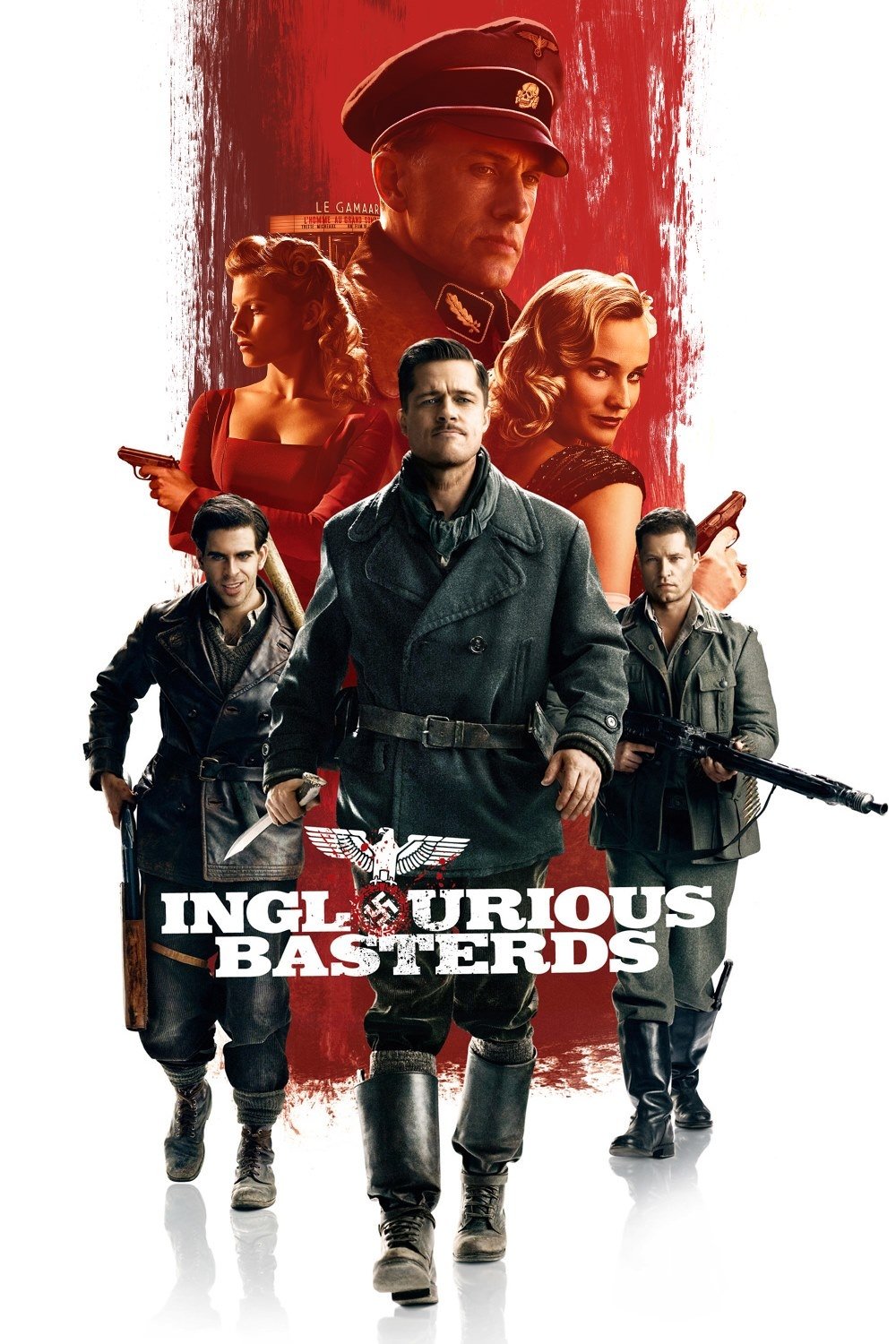
Plot Summary
From the moment I first watched Quentin Tarantino’s Inglourious Basterds, I felt completely swept up in its unpredictable narrative tapestry. Describing the film’s plot without revealing its many twists and razor-sharp turns is a delicate task, but I’ll do my best to walk that line. Set during the Nazi-occupied France of World War II, the story weaves together the paths of several outsiders and insurgents—each with their own stakes, secrets, and ambitions. At the heart of the narrative, I found the ragtag, fiercely anti-Nazi squad known as the ‘Basterds’—led by Brad Pitt’s unforgettable Lt. Aldo Raine. Equal parts vengeance and gallows humor, their mission is to deliver terror to the enemy. Parallel to this, there’s Shosanna, a cinema owner haunted by her violent past and determined to exact her own brand of justice. All these characters spiral towards an audacious, history-bending confrontation that Tarantino orchestrates with signature boldness.
If you haven’t yet experienced the film and want to avoid major spoilers, I’d advise caution going forward—the story’s power truly lies in its surprises. Still, what I can say is that every thread—whether following the Basterds’ guerrilla campaign or Shosanna’s simmering plot—converges in a dizzyingly tense climax. For me, the narrative structure—divided into distinct, almost novella-like chapters—echoes classic pulp fiction while relentlessly subverting expectations. It kept me off-balance, made me laugh at the unlikeliest moments, and constantly challenged my sense of what war movies are supposed to deliver.
Key Themes & Analysis
What immediately struck me about Inglourious Basterds was how skillfully Tarantino blends genres—war epic, spaghetti western, revenge thriller, and dark comedy merge into something altogether unique. I found myself constantly absorbing the film on multiple levels, especially its meditation on storytelling as both a weapon and an act of resistance. The characters use stories—whether fabricating identities, reciting legends, or staging performances within the narrative—to survive, deceive, and ultimately change the course of history. For me, this foregrounded the cinema’s power not just as entertainment, but as a tool of social and personal transformation.
The theme of revenge, naturally, runs through every frame. What I found particularly compelling was Tarantino’s refusal to let this remain simple or morally tidy. While it’s easy, on paper, to root for violent justice against the film’s monstrous antagonists, I noticed the director’s lens lingering uncomfortably on the costs and consequences of violence—on all sides. Moments of triumph quickly curdle into grotesque spectacle, and I was often left asking myself what exactly was being avenged, and at what price?
Turning to the film’s cinematography, my attention was immediately drawn to Robert Richardson’s lush, painterly visual style. He bathes the film in textures that evoke 1940s cinema while imbuing every scene—whether claustrophobic tavern or grand theater—with its own distinctive mood. The infamous opening scene, for example, is not just memorable for its writing or performances. The smart composition and gradually tightening shots build almost unbearable suspense, underscoring the brutality lurking beneath everyday politeness. The way Richardson frames light through windows, or the slow tracking of shots during standoffs, makes even dialogue-heavy scenes feel explosive.
As for Tarantino’s direction, I believe this to be one of his most confident and sophisticated efforts. The manipulation of tone is simply bravura. He moves from comedy to horror and back again within a single scene, yet I never felt jarred or lost. The confidence with which he deploys slow-burn tension—especially in extended dialogue sequences—reminded me how rare it is for a mainstream director to trust the patience and intelligence of his audience so thoroughly.
Of course, none of this would land without the cast. Christoph Waltz’s performance as Hans Landa is, in my opinion, one of the greatest villainous turns in modern cinema. Waltz moves from charm to chilling menace within the span of a single sentence, often using language as a weapon just as lethal as any gun. Brad Pitt, on the opposite end of the spectrum, delivers broad, practically cartoonish bravado that never feels less than charismatic—he elevates Raine into both a comic force and an icon. Meanwhile, Mélanie Laurent’s Shosanna brought a sense of emotional fragility and underlying rage, grounding the film’s larger-than-life ambitions with something intimate and true. Each performance, whether major or supporting, shapes the world with razor-sharp specificity—every character feels intensely alive.
My Thoughts on the Historical & Social Context
When I think about why Inglourious Basterds made such a cultural impact in its time, I always return to the context of its release in 2009. The late 2000s were a period where mainstream American cinema seemed especially eager to interrogate and re-express genres long left to myth—nowhere more so than war movies. Having grown up on conventional World War II films that lionized Allied heroism and focused on historical accuracy, I found Tarantino’s deliberate break from realism exhilarating.
The 2000s audience was primed for films that didn’t just dramatize the past but powerfully reimagined it. With the world’s ongoing wars and a political climate marked by disillusionment, films like this functioned less as comforting time capsules and more as urgent, unruly provocations. Watching “Inglourious Basterds” at that moment, I sensed a sort of collective hunger—not just to remember history, but to process trauma and injustice through the filter of fiction. Tarantino’s willingness to rewrite history—ostensibly giving narrative power and agency back to the oppressed—strikes me as both wish fulfillment and a chilling reminder of the realities such vengeance can never undo.
More personally, the film seems to hold a mirror up to both Hollywood and Western society’s own mythmaking traditions. I saw echoes of propaganda and the seductive pull of cinematic fantasy everywhere: the ways the characters watch movies, use film as a weapon, and even the film’s own bold manipulation of truth. In a world increasingly aware of how stories shape politics and memory, this level of self-awareness still feels startlingly prescient to me.
Even today, when I revisit the film, I find new resonance with ongoing conversations about justice, power, and representation. The notion of giving voice—albeit a violently cathartic one—to those erased by history hits differently in a post-#MeToo and Black Lives Matter world. Tarantino’s film may not offer real-world solutions, but it dares to ask what it would look like if history itself could be avenged on behalf of the forgotten. For all its wild spectacle, this is a question that lingers with me long after the credits roll.
Fact Check: Behind the Scenes & Real History
What truly fascinates me about Inglourious Basterds is the labyrinthine journey it took from conception to screen and the deep interplay between its fiction and the reality it riffs on. For instance, I learned that Tarantino spent nearly a decade developing the script, at one point feeling so unable to end the story satisfactorily that he considered abandoning it altogether. That perfectionism, I think, is visible in how complete and cohesive even the wildest narrative threads feel.
One casting secret that I always find especially interesting is Tarantino’s search for the right Hans Landa. He was so convinced that only a polyglot actor could do justice to the character’s manipulative brilliance that he nearly scrapped production several times. Christoph Waltz’s late audition apparently arrived just in time, and his performance brought not just linguistic proficiency (flawlessly switching between German, French, English, and Italian), but a chillingly playful sense of evil that became central to the film’s DNA. Reading about this, I can’t help but think how different—and how much poorer—the film would have been without Waltz’s gifts.
On the historical front, it’s immediately clear to me that the film is not interested in strict accuracy. The squad of Jewish-American commandos, for example, is a complete fabrication—no such unit ever operated in Nazi-occupied Europe. Similarly, the film’s final act is, by design, a gleeful rewriting of history. Yet there are grains of reality woven through: the real “Operation Kino” borrows its name and some inspiration from Allied missions targeting Nazi leadership, and the atmosphere of dread and division in occupied France is meticulously rendered, even as the plot careens into pulp fantasy. Knowing this, I see the film less as historical drama and more as a feverish counter-myth, rewriting history with both a wink and a snarl.
I can’t discuss this film without mentioning Tarantino’s technical and stylistic flourishes, either. For example, the use of languages—switching often mid-conversation, with the attendant dangers that slip-ups entail—is more than a gimmick. I realized on rewatch that these linguistic games are not just about realism; they weaponize words, creating tension out of the very act of communication. This, to me, elevates some of the most suspenseful scenes, reminding the viewer that in wartime, identity and survival hinge on what you say, when, and in which tongue.
Why You Should Watch It
- The film reinvents the World War II genre with Tarantino’s signature blend of audacity, humor, and emotional risk
- Christoph Waltz’s Oscar-winning performance delivers a master class in villainy, elevating every scene he touches
- Its provocative use of revisionist history challenges audiences not just to remember the past, but to question the stories we tell about justice, revenge, and power
Review Conclusion
Whenever I revisit Inglourious Basterds, I’m reminded why it stands as my favorite Tarantino work and one of the decade’s most daring pieces of popular cinema. The film’s willingness to subvert conventions, its wicked sense of humor, and its deep-rooted belief in the power of storytelling all feel as fresh to me today as they did at its release. If bold performances, audacious direction, and a willingness to challenge both audience and genre appeal to you, this film will not just entertain—it will unsettle, provoke, and stay with you. For its fearless fusion of style, substance, and subversion, I give it a 4.5/5 stars.
Related Reviews
- Jojo Rabbit (2019): I see rich parallels between “Inglourious Basterds” and Taika Waititi’s satirical take on Nazi Germany. Both films use a blend of black comedy and farcical courage to tackle trauma and resistance from a fresh, even mischievous angle.
- The Dirty Dozen (1967): When I think of squad-based World War II stories that balance high-octane violence with dark ensemble comedy, this classic always comes to mind. Its influence on Tarantino’s Basterds is direct, and the tone is unmistakably irreverent.
- Pan’s Labyrinth (2006): Guillermo del Toro’s film isn’t set in WWII France, but its bold combination of historical trauma, fairy-tale inversion, and the blurring of reality and fantasy echoes everything that excites me about Tarantino’s approach. If you’re fascinated by films that dare to rewrite brutal history in cinematic terms, this one resonates deeply.
If you want to explore this film beyond basic facts, you may also be interested in how modern audiences respond to it today or whether its story was inspired by real events.
🎬 Check out today's best-selling movies on Amazon!
View Deals on Amazon