
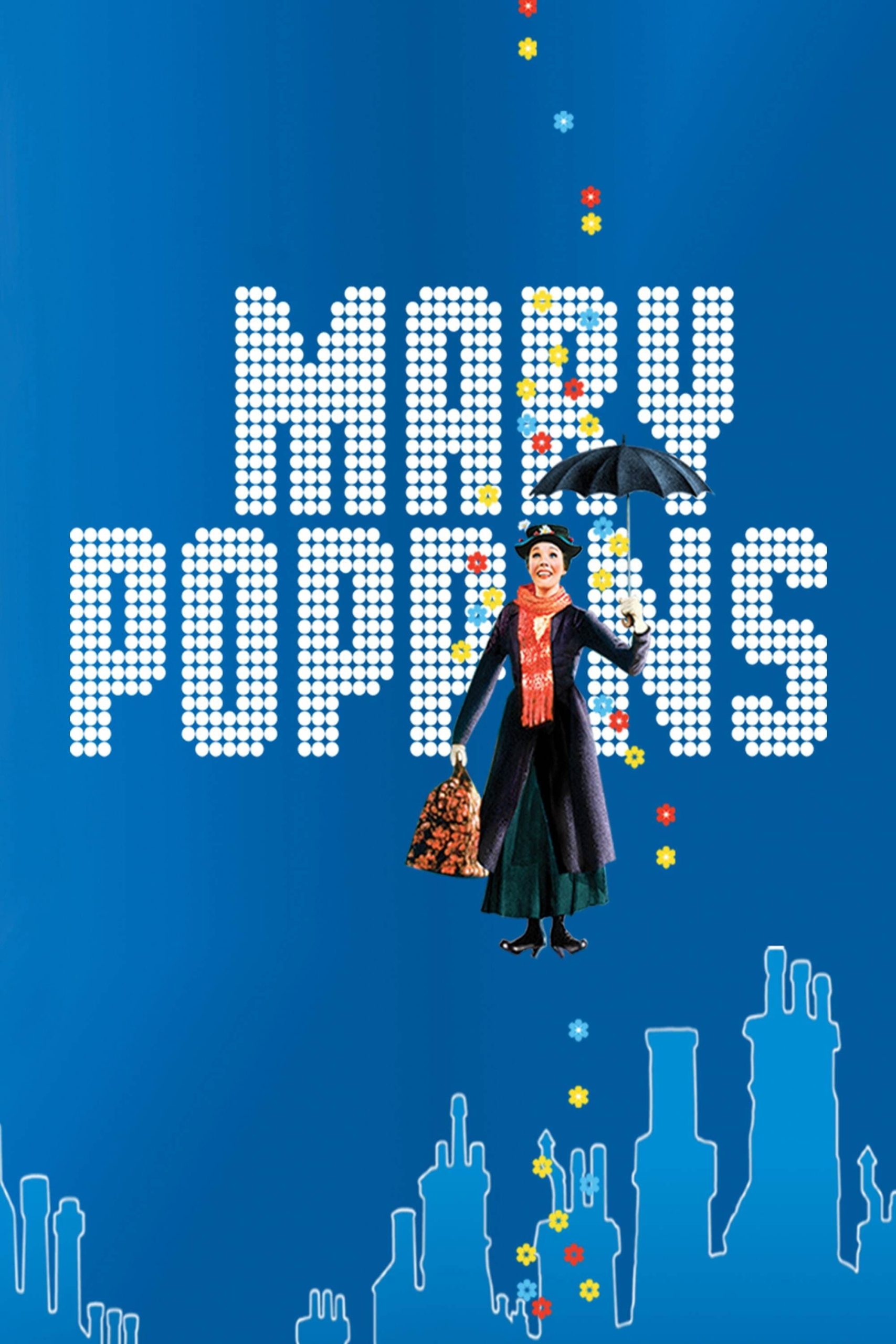
Plot Summary
Stepping into the world of Mary Poppins, I am instantly whisked away to a prim, chimneyed Edwardian London bursting with whimsy and longing. My first experience with the film didn’t prepare me for just how seamless the fantastical mingles with the mundane. I follow the Banks family, whose world is as tightly buttoned as Mr. Banks’ waistcoat—until the eccentric, effortlessly magical Mary Poppins floats in with the wind. She’s a figure who straddles imagination and order, unraveling the knots of the Banks household with a spoonful of adventure and just the right dose of irreverence.
As I traverse Bert’s chalk landscapes and dance upon the rooftops, I notice how the children, Jane and Michael, grapple with their father’s rigid expectations and society’s conventions. The plot radiates warmth without dissolving into saccharine sweetness, mainly because Mary Poppins herself never loses her sense of enigma. I love that the film invites viewers—both the children and the adults in the audience—to break free from monotony and cautiously embrace joy. For those who haven’t seen it, just know: the true magic isn’t only in what Mary Poppins does, but how she changes those around her.
Warning: Spoilers beyond this point are minimal, but certain character resolutions are mentioned for thematic analysis.
Key Themes & Analysis
What has always riveted me about Mary Poppins is its balancing act between escapist fantasy and pointed social commentary. Superficially, it’s an airy musical, but I find its layers surprising upon rewatch. The film explores themes of parental neglect and the search for meaning—particularly through Mr. Banks, who starts as an avatar for order and convention, only to be challenged by the inexplicable and the spontaneous.
When I look at Julie Andrews’ performance, I’m struck by her restraint blended with impishness. Her Mary is never a broad cartoon; instead, she’s a figure who commands awe and reminds us that caregiving is both an act of love and rebellion. This portrayal stands in beautiful contrast to Dick Van Dyke’s Bert, whose charm and physicality ground the film’s flights of fancy. I have often marveled at how Van Dyke’s unselfconscious slapstick and surprising wisdom give the movie an uncommon warmth—despite the often-mocked Cockney accent. Both leads elevate the story beyond mere musical spectacle into a showcase about the liberating power of imagination.
The cinematography, especially in the animated sequence where live-action performances cavort with cartoon animals, felt revolutionary to me the first time I saw it. The mixture of animation and film was not just a gimmick but a way to manifest the boundless imagination Mary brings into the Banks’ lives. In every scene, director Robert Stevenson’s steady hand is evident. His direction allows the film’s tone to stay buoyant even as it navigates more bittersweet moments—like the children’s yearning for parental affection or Mrs. Banks’ distracted activism, which satirizes but never trivializes her suffragette spirit.
My analysis can’t ignore the music. Songs like “Feed the Birds” or “Let’s Go Fly a Kite” are not only catchy, but carry emotional depth. I’m always moved by how “Feed the Birds” frames empathy and kindness not as childlike foolishness but as virtues with real-world power. The choreography during “Step in Time” is exuberant and chaotic, almost anarchic, suggesting to me that sometimes we learn the most when social rules collapse, revealing what truly matters.
Mary Poppins doesn’t preach—rather, it gently upends our expectations. After yet another viewing, I left pondering how adulthood is often defined by emotional distance, yet this film’s sense of play and possibility is what ultimately heals and unites the Banks family.
My Thoughts on the Historical & Social Context
Every time I revisit Mary Poppins, I can’t help but read it against the backdrop of its release in 1964—a moment of profound transformation in America and Britain alike. The world was on the cusp of the countercultural revolution; change was seeping into every fold of culture, from politics to pop music. I find it fascinating that, on its surface, the film seems to offer comfort through nostalgia for Edwardian England. Yet, underneath, it’s actually quietly rebellious.
While the Banks household is the picture of prewar order and discipline, I see Mary Poppins herself as a disruptor. In 1964, with traditional family structures already changing and women questioning their prescribed roles, the film’s very structure speaks to a society in flux. Mrs. Banks’ activism is gently lampooned but never dismissed—a nod, perhaps, to second-wave feminism. I can’t separate the film from the reality that, in its own polite way, it introduces new equations of power and love within the family. Even the presence of magic feels symbolic: it’s the creative potential and critical thinking that ’60s audiences were beginning to value over strict conformity.
I’m always struck by how the film both reflects and critiques its era. Mr. Banks’ rigid worldview mirrors the anxieties of postwar fathers clinging to lost stability, while Mary Poppins embodies an almost utopian hope for societal transformation. The film’s exuberance is a counterpoint to Cold War anxieties—offering a playful means of escape, but also permission to imagine a different order of things at home and beyond.
For me, that’s what makes Mary Poppins still relevant today. Even now, as we wrestle with changing family structures, work-life boundaries, and our relationship with tradition, the film’s insistence that “a spoonful of sugar” really can make the medicine go down feels radical. It’s less about nostalgia and more about the lasting need for empathy, wonder, and change—values I think every era can stand to revisit.
Fact Check: Behind the Scenes & Real History
I’m endlessly fascinated by the production lore behind Mary Poppins—so much so that I sometimes feel the making of the film is almost as magical as the narrative itself. Here are three behind-the-scenes facts that continue to intrigue me:
- Julie Andrews was cast after Walt Disney saw her on Broadway in “Camelot,” but she nearly didn’t accept the role, holding out for the part of Eliza Doolittle in “My Fair Lady” (a role she ultimately did not get, as Audrey Hepburn was cast instead). I’m convinced her mix of English poise and unforced mischief is what propelled the film into the realm of the iconic—her screen presence is both ethereal and down-to-earth.
- The film’s hybrid animation/live-action sequences pushed the limits of what was technically possible in the early 1960s. The famous chalk pavement scene, where actors interact seamlessly with animated animals, was achieved through a painstaking process involving sodium vapor (“yellow screen”) techniques—a precursor to green screen. Every time I watch it, I’m keenly aware of the dizzying amount of innovation and hours behind that effortless wonder.
- The real P.L. Travers, author of the “Mary Poppins” books, was notoriously dissatisfied with Disney’s interpretation—to the extent that she wept at the premiere, objecting to the sentimentality, the animation, and the softened edges of her original character. This tension between creator and studio, between the literary and commercial, reminds me that no adaptation is ever entirely “faithful”—and that the magic of movies often resides in these creative collisions.
Those production struggles, bold casting choices, and technological feats make me appreciate every frame of Mary Poppins that much more. Knowing the real stories behind the film’s creation only deepens my sense of its place in cinematic history.
Why You Should Watch It
- A performance by Julie Andrews that defines the role of the magical caregiver and delicately balances authority with charm.
- The inventive blend of live-action and animation, still visually spectacular and emotionally uplifting after six decades.
- Timeless themes of family, imagination, and compassion that speak as strongly to adult viewers as to children.
Review Conclusion
I treasure Mary Poppins not just for its memorable songs or technically dazzling set pieces, but for what it stirs in me every time I watch it. The film manages to be subversive without ever losing its gentle touch; it questions the status quo while inviting viewers to share in joy and possibility. Julie Andrews’ debut is nothing short of revelatory, and the supporting cast brims with both comedic and emotional resonance. The daring of the production team shows in every whimsical detail, from the dancing penguins to the heart-tugging refrain of “Feed the Birds.”
After many viewings, I find myself returning to it for the sly hopefulness it exudes: change is possible, family can be reimagined, and kindness holds transformative power. My rating: 5/5 stars. For sheer inventiveness, emotional resonance, and enduring relevance, I consider Mary Poppins a film everyone should experience at least once—ideally more.
Related Reviews
- Bedknobs and Broomsticks (1971): Like Mary Poppins, this film blends live-action performances with animation, and Angela Lansbury’s magical portrayal echoes Andrews’ blend of authority and charm. I recommend it for anyone drawn to children’s fantasies that are laced with historical and social commentary, as well as technical innovation.
- Chitty Chitty Bang Bang (1968): This musical, bursting with imagination and eccentric British sensibilities, carries the whimsy and family dynamics that captivated me in Mary Poppins. Dick Van Dyke returns in a leading role, and the film’s playful narrative about invention and belonging makes for a meaningful companion viewing.
- The Sound of Music (1965): I see this as a logical next step for viewers entranced by Julie Andrews’ compelling screen presence. Both films engage with themes of nontraditional caretaking and societal upheaval, heightened by unforgettable music and lush filmcraft.
- Paddington (2014): While decades apart, Paddington captures a similarly earnest, optimistic take on London family life disrupted by an unusual outsider. The blend of comedy, heart, and the navigation of cultural norms feels like a modern echo of Mary Poppins’ most resonant moments.
If you want to explore this film beyond basic facts, you may also be interested in how modern audiences respond to it today or whether its story was inspired by real events.
🎬 Check out today's best-selling movies on Amazon!
View Deals on Amazon