
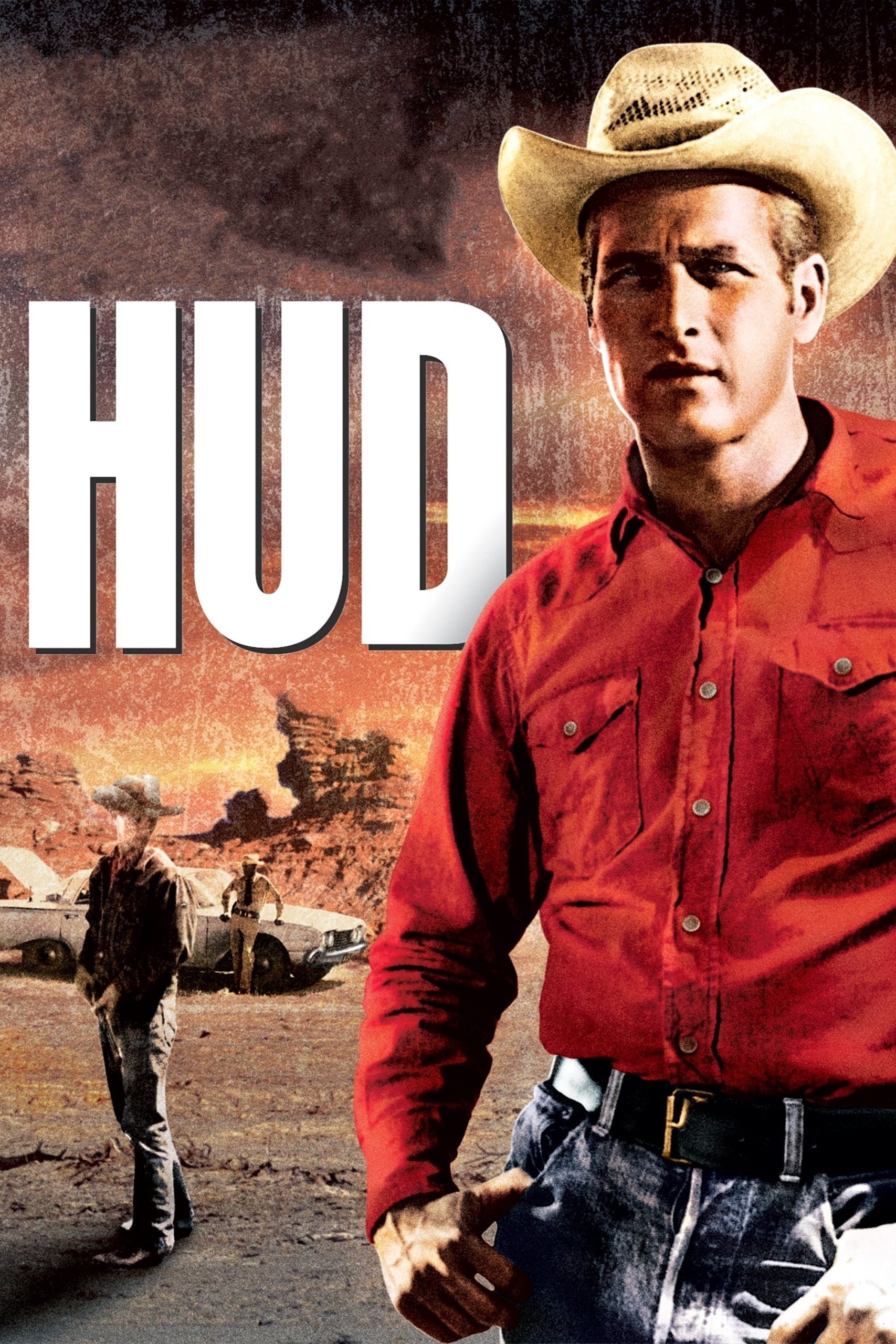
Plot Summary
When I first watched “Hud”, I felt immediately drawn into the brooding landscape of rural Texas, so starkly captured by director Martin Ritt’s keen eye for both the sweep and isolation of the American frontier. The film, set against an unforgiving backdrop of dust, cattle, and wide-open skies, follows the Bannon family as they grapple with internal tensions and the threat of ruin. Hud Bannon, played with magnetic cynicism by Paul Newman, emerges as a deeply flawed antihero—a man whose charm is matched only by his self-destructive arrogance. His father, Homer, stands as the weary steward of their cattle ranch, holding firmly onto values that the modern world threatens to erode. The story revolves around a looming crisis that threatens their livestock and livelihood, and, by extension, the fabric of their entire existence.
I find that the simplicity of the narrative is deceiving: it’s not really about cattle or ranching, but about the clashing ideals and generational divides between Hud, Homer, and Lonnie, Hud’s young nephew. Alongside these men is Alma, the resilient housekeeper whose quiet dignity and emotional strength offer a counterpoint to Hud’s reckless bravado. If you want to avoid spoilers, rest assured that while the events escalate into tragedy and reckoning, the film’s real impact lies in the powerful questions it poses about morality, family loyalty, and the price of self-interest.
Key Themes & Analysis
Watching “Hud” now, I am struck by how boldly it interrogates the very idea of the American hero. Paul Newman’s performance captivates not because Hud is likable, but because he is glaringly authentic—a man driven by ego, pleasure, and a fierce refusal to conform. Ritt doesn’t ask me to empathize with Hud so much as he challenges me to understand the appeal of his lawlessness and what it costs everyone around him. The film’s key theme, for me, is the corrosion of integrity in the pursuit of personal gain.
Visually, the film is a masterpiece. Cinematographer James Wong Howe’s black-and-white compositions infuse every shot with a kind of epic bleakness. The dust and glare of the West aren’t just atmospheric—they’re psychological, reflecting the gritty conflicts between generations and morals. Howe’s use of shadow and depth of field makes the ranch feel vast and yet deeply claustrophobic, echoing the characters’ increasingly suffocating choices. I find myself especially moved by the way lonely figures are framed against empty horizons, visually echoing the film’s meditation on alienation and belonging.
From an acting perspective, I continually revisit Patricia Neal’s portrayal of Alma. Her understated resilience and dry wit provide the moral anchor of the film. Neal turns Alma into the heart of the drama; her scenes with Newman crackle with tension and the sense of futures denied. Similarly, Melvyn Douglas as Homer brings a weary, principled authority that stands in direct opposition to Hud’s heedless charm. Douglas’s performance is powerful not because he lectures, but because his disappointment is palpable in every silent glance and hunched shoulder.
What resonates most for me is how “Hud” refuses easy answers. I see every character compromised, tested to their limits. The film makes me question whether family ties, tradition, or even goodness itself are enough to survive when everything you know is stripped away. Martin Ritt’s direction is pointedly unsentimental: he delivers a bleak assessment of American masculinity, the myth of the West, and the temptation to put oneself first at any cost.
My Thoughts on the Historical & Social Context
Placing “Hud” in its 1963 context, I can’t help but see it as a reflection of a country on the cusp of enormous change. The early Sixties was a period loaded with tension between old and new America—civil rights agitation, changing gender norms, and deep anxieties about what it meant to be a man or an heir to a legacy. The Bannon ranch feels to me like a microcosm of national uncertainty, caught between the pull of traditional values and the push toward self-determination.
For me, the film’s handling of generational conflict is its most relevant social commentary. Hud repudiates his father’s code of conduct in favor of a ruthless pragmatism that felt eerily prescient, even decades later. I see in Hud a mirror for the kinds of individualism that have since come to dominate our culture, especially when ethics are sacrificed in the name of personal advancement. There’s a bitterness in Homer’s realization that the world he’s guarding may not survive another generation—a fear, I think, that must have resonated deeply with viewers in the Sixties as old social orders gave way to new, uncertain ones.
In my own experience, returning to “Hud” today, I can’t help but notice how presciently it speaks to current anxieties: the erosion of communal responsibility, the uncertainty of inheritance, the price of unchecked ambition. Watching Hud, I’m compelled to question how far we’ve actually come from the film’s stark warnings. The absence of easy redemption or happy resolution feels bracingly honest, and for me, that honesty is what makes the film essential viewing for anyone grappling with questions about morality and modernity.
Fact Check: Behind the Scenes & Real History
Digging into the history of “Hud,” I’m fascinated by some of the deliberate choices made during production and the remarkable backstories behind the film’s distinctive style. Here are some of the most striking facts I discovered:
- The decision to shoot in black and white was a creative gamble. Despite the increasing popularity of color films in the early 1960s, Martin Ritt and cinematographer James Wong Howe insisted on monochrome to capture the bleak, parched landscape of Texas and to underscore the film’s moral ambiguity. Their collaboration paid off—Howe won his second Academy Award for his work here. I find this choice almost radical for its time; it emboldens the film’s tone and pushes the emotional desolation right to the viewer’s face.
- The casting of Patricia Neal as Alma came after a notable struggle. Executives were reportedly concerned she was too sophisticated for a role grounded in rural hardship. Ritt, Newman, and screenwriter Irving Ravetch had to advocate strongly for her, believing she brought a much-needed intelligence and resilience to the character. Neal’s Oscar-winning performance vindicated their faith in her.
- While the film is adapted from Larry McMurtry’s novel “Horseman, Pass By,” there was significant divergence from the source material. The filmmakers shifted the narrative focus onto Hud, transforming him from a peripheral character into the lead and altering his moral arc considerably. When I read the novel after watching the film, I was struck by how much darker and less sympathetic Hud becomes on screen, a testament to both the era’s shifting sensibilities and the filmmakers’ willingness to challenge their audience.
Why You Should Watch It
- If you appreciate films that upend the myth of the American West and force you to confront uncomfortable moral questions, “Hud” is unforgettable in its interrogation of heroism and personal responsibility.
- For those who value exceptional craftsmanship in acting and cinematography, the performances and imagery in this film are among the most powerful I’ve ever seen in American cinema.
- If you’re drawn to stories about families on the edge of change—where love, disappointment, and hope knuckle against survival—this film offers a deeply personal, gripping experience.
Review Conclusion
Reflecting on “Hud,” I find myself both unsettled and inspired. The film doesn’t let me off the hook: every character, every shot, every decision is layered with meaning and consequence. I treasure its refusal to romanticize either its setting or its flawed protagonist. The performances—especially by Newman, Neal, and Douglas—have etched themselves into my memory, as has the film’s bold, raw visual language. If you’re searching for a film that demands both an emotional and intellectual response, “Hud” stands among the finest. I happily award it 4.5 out of 5 stars—an indelible masterpiece whose relevance only grows with time.
Related Reviews
- The Last Picture Show (1971) – I highly recommend this film for its similarly nuanced depiction of rural Texas and its exploration of the slow death of small-town life and old values. Like “Hud,” it balances nostalgia with the hard truths of generational transition and lost innocence.
- Giant (1956) – This epic, set in the same rugged region, dives into family discord, the clash between tradition and progress, and shifting social structures. Its intergenerational storytelling and grand, lonely landscapes echo many of the themes I found most compelling in “Hud.”
- Five Easy Pieces (1970) – Though set in a different milieu, this character-driven drama resonates with “Hud” in its focus on restless, self-destructive protagonists confronting the limits of freedom and the burdens of a troubled inheritance.
- There Will Be Blood (2007) – While much darker, the film’s portrait of ambition, family, and American identity struck similar chords for me. Both movies reckon with what is lost when ambition trumps humanity and the American Dream turns into a nightmare.
If you want to explore this film beyond basic facts, you may also be interested in how modern audiences respond to it today or whether its story was inspired by real events.
🎬 Check out today's best-selling movies on Amazon!
View Deals on Amazon