
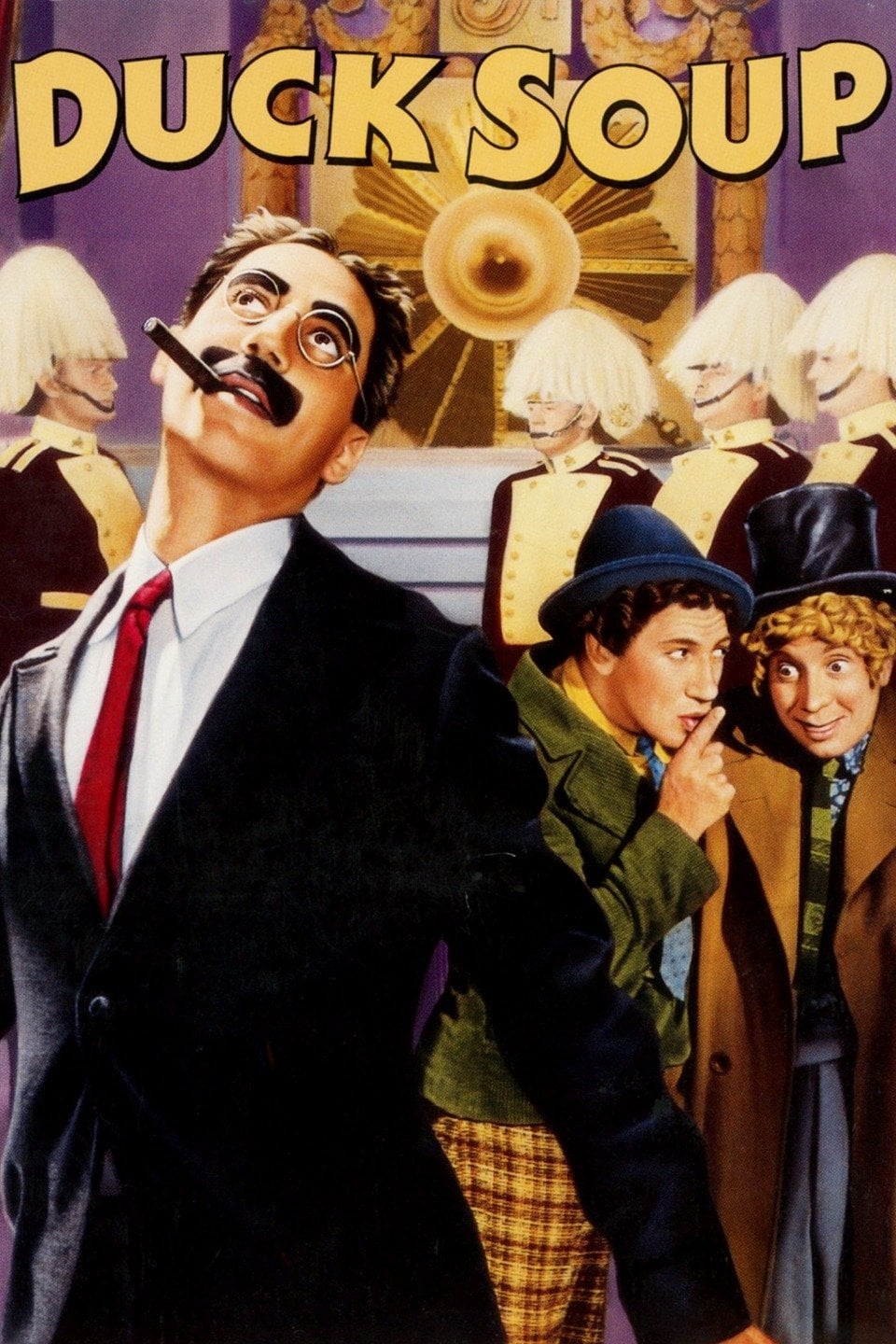
Plot Summary
When I first sat down to watch Duck Soup, I braced myself for the anarchic, whirlwind energy that only the Marx Brothers—under the singular direction of Leo McCarey—could deliver in a political satire. Set smack in the middle of a make-believe country named Freedonia, the film’s story orbits around Groucho Marx’s character, Rufus T. Firefly, who is appointed ruler at the whims of a wealthy benefactor. Freedonia is crumbling financially and politically, teetering on the edge of collapse, and Firefly is tasked with saving the day—not through sound governance, but through chaos and comic subversion.
Rather than offering up a traditional narrative with neatly delineated arcs, Duck Soup relishes in a near-relentless barrage of set pieces and gags. Firefly’s rise is punctuated by dizzying verbal back-and-forths, absurd diplomatic blunders, and relentless sabotage attempts courtesy of spies played by Chico and Harpo Marx. The narrative is less about linear plot progression and more about building crescendos of hilarity, culminating in (spoiler alert: skip to the next section if you wish to avoid it) a raucous declaration of war whose military strategy consists mainly of pratfalls, disguises, and lampooned patriotism.
What captivated me the most wasn’t the outcome of Freedonia’s fate, but rather how the plot provided a springboard for lampooning authority, bureaucracy, and human folly. Throughout, the film gleefully forgoes the trappings of a conventional story in favor of immersing its audience in a comedic fever dream where logic is optional, and laughter is paramount.
Key Themes & Analysis
Whenever I try to articulate what makes Duck Soup special, I find myself returning to its irreverence. This film is a scathing social critique disguised as a slapstick farce, relentlessly poking holes in nationalism, bureaucracy, and the empty rituals of government. The farcical depiction of Freedonia takes on added weight for me when I consider how universal and perennial its targets are. Corrupt politicians, inept leaders, and the absurdities of war are not unique to any one era—instead, they’re recurring motifs in human history.
The film’s humor hinges on subverting expectations, upending authority, and exposing the vacuity of pomposity. I particularly admire how McCarey leans into the Marx Brothers’ strengths—Groucho’s caustic wit, Harpo’s physical comedy, and Chico’s idiosyncratic delivery—and crafts a tightly orchestrated ballet of mayhem. Each brother has their signature moment, yet together, their timing and synergy are impeccable. Duck Soup’s most famous sequences—the mirror gag and the courtroom send-up—stand as towering examples of physical and verbal comedy that still make me laugh out loud, even after repeated viewings.
From a visual standpoint, the film is less stylized than some later comedies but is never visually dull. McCarey’s direction favors brisk pacing and fluid transitions, mirroring the off-the-wall logic of the jokes themselves. The camera is almost an accomplice, tracking the chaos but never getting in the way of it. There’s a sly intelligence in how scenes are set up, especially in the way comedic tension builds before erupting into a punchline. The editing, too, is expertly tight; there’s no fat, only relentless, overlapping gags that escalate the absurdity without ever feeling repetitive.
As for the performances, it’s hard to overstate the impact of Groucho’s delivery. Groucho Marx doesn’t just break the fourth wall—he gleefully demolishes it, making every audience member a co-conspirator in his rebellion against sensibility. Chico and Harpo follow suit, their music and physical antics offering a counterpoint to Groucho’s verbal pyrotechnics. Supporting players, like Margaret Dumont, provide just the right amount of “straight” reaction—anchoring the madness in an effectively deadpan manner.
What sticks with me most, though, is the seamless marriage of social critique with unadulterated silliness. Duck Soup’s best jokes aren’t just funny—they’re incisive commentaries on the nature of power, conformity, and mindless patriotism. The film fires these critiques not as dry polemic but as irresistible, contagious laughter.
My Thoughts on the Historical & Social Context
Sitting in the 21st century and watching Duck Soup, I experience a strange sense of déjà vu. Released in 1933, at the height of the Great Depression and with the specter of fascism looming over Europe, the film’s lampooning of political authority feels as urgent now as it must have then. To me, Duck Soup is more than a product of the Roaring Thirties—it’s a time capsule bristling with subtext and defiance.
The early 1930s were a turbulent period in both America and Europe. With Franklin D. Roosevelt’s New Deal only just underway and the world still reeling from economic devastation, cynicism about politics ran rampant. I see in Duck Soup a mirror of that collective exhaustion. The film’s joy in unraveling bureaucracy isn’t just playful—it’s cathartic. Audiences of the day, I imagine, must have relished seeing the powerful brought low, even if only through farce. Parodying the drums of war and the pomp of nationalism was a subversive act at a moment when blind patriotism was being used worldwide to justify terrible violence.
From my vantage point today, Duck Soup’s lacerating wit cuts just as deep, especially as governments once again stumble through spectacle, propaganda, and populist sloganeering. Its pre-Code origins—produced before widespread studio self-censorship—mean the film isn’t afraid to be irreverent or even a touch nihilistic. I love how its refusal to take anything seriously is its serious point. Freedonia’s leaders are clueless, the public is impressionable, and war is ultimately shown to be both tragic and ridiculous. These commentaries resonate just as strongly in our current political climate as they did during the film’s first run.
Ultimately, the historical backdrop both underlines and enhances Duck Soup’s audacity. I believe it remains essential viewing precisely because it captures the spirit of resistance that art can embody—refusing to let the world’s madness go unmocked.
Fact Check: Behind the Scenes & Real History
While I’ve always been fascinated by the Marx Brothers’ madcap energy on screen, I discovered some delicious behind-the-scenes tidbits that deepened my appreciation for Duck Soup.
First, the casting of Leo McCarey as director was itself a remarkable choice. McCarey was known for his improvisational approach, which meshed perfectly with the Marx Brothers’ spontaneous style and helped elevate their material to new comedic heights. His direction facilitated one of the most seamless blends of slapstick and satire in film history.
The film’s original working title was “Firecrackers,” and there was actual debate within Paramount Studios about how overtly political its satire should be. Some studio heads were nervous about mocking international diplomacy—or even the institution of war—so openly during a perilous global moment. The Marx Brothers had to push back to retain the movie’s subversive edge. That subversion paid off, as the film’s attacks on nationalism inspired controversy and, unsurprisingly, bans in some countries (notably Italy, where Mussolini personally objected to being lampooned).
An equally interesting production fact is the now-iconic “mirror scene,” in which Harpo and Groucho perform an elaborate pantomime as if they are each other’s reflections, wasn’t even in the original script. It was reportedly inspired by earlier vaudeville routines, repurposed and perfected by McCarey and the Marxes during rehearsals. That unplanned genius added a layer of physical storytelling that transcended language, making it an instantly recognizable piece of film history.
Finally, although Freedonia is an entirely fictional setting, its name accidentally became a point of pride for a real-life town in New York State, leading to an amusing letter-writing campaign that further blurred the line between cinematic farce and real-world geopolitics. So, while Duck Soup is not based on a true story, its aftershocks reverberated in curious, delightful ways off the screen.
Why You Should Watch It
- Anarchic humor that never grows stale—the film’s comedic rhythms continue to influence comedians and filmmakers even today.
- Bold satire on politics, power, and patriotism—I don’t know of another film that so gleefully deflates inflated egos and exposes the dangers of mindless authority.
- Unforgettable ensemble performances—from Groucho’s zingers to Harpo’s pantomime, you get the very best of the Marx Brothers at their creative peak.
Review Conclusion
Every time I revisit Duck Soup, I’m struck anew by how little comedy has changed—and how much courage it takes to laugh at what scares us most. This is not just a relic of the past, but a living, breathing document of rebellion, wit, and imagination. It’s a film I recommend not just for its historic value, but for its timelessness: its ability to land a punchline with equal force nearly a century later.
If I had to distill my admiration into a rating, it’s an enthusiastic 5/5 stars. Duck Soup isn’t just a comedy; it’s a revolution in celluloid form—one that keeps me coming back for another glorious dose of laughter and subversion.
Related Reviews
- A Night at the Opera (1935) – For anyone who relishes Duck Soup’s blend of verbal wit and physical comedy, this Marx Brothers follow-up is irresistible. Their antics within the highbrow world of opera push social satire even further, and I find their subversion of “respectable” institutions every bit as sharp.
- Dr. Strangelove or: How I Learned to Stop Worrying and Love the Bomb (1964) – Stanley Kubrick’s black comedy about Cold War absurdity channels the same fearless spirit of political satire, exposing the madness of bureaucratic power with ruthless, hilarious efficiency. It’s a perfect companion if you appreciate the ways Duck Soup lampoons the rituals of war.
- Kind Hearts and Coronets (1949) – This British dark comedy carries over Duck Soup’s irreverence by lampooning the British class system. The blend of biting, intelligent humor with inventive plotting offers a similarly satisfying takedown of social hierarchies and hypocrisy.
- To Be or Not to Be (1942) – Ernst Lubitsch’s wartime comedy leans into political satire, blending slapstick, dark wit, and anti-fascist courage. I see it as an excellent bridge between Duck Soup’s anarchic spirit and more direct wartime commentary.
If you want to explore this film beyond basic facts, you may also be interested in how modern audiences respond to it today or whether its story was inspired by real events.
🎬 Check out today's best-selling movies on Amazon!
View Deals on Amazon