
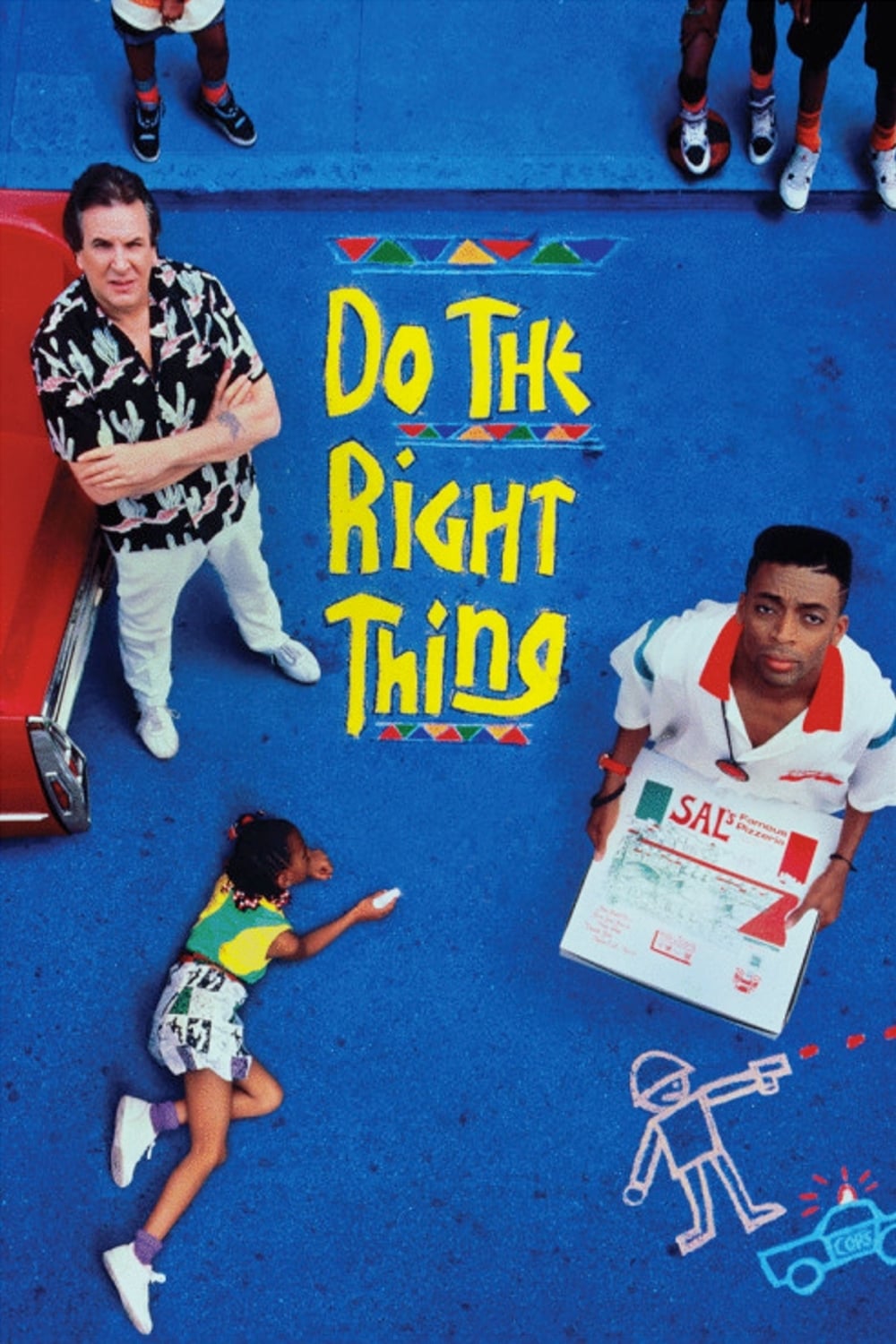
Plot Summary
From the very first frame, I was pulled into the electric rhythm of Spike Lee’s Brooklyn. Watching “Do the Right Thing” felt less like observing a story and more like being pressed up against a window, peering into the life of a vibrant but unsettled community. The film’s events unfurl over the course of the hottest day of the summer in the Bedford-Stuyvesant neighborhood, and as the temperature rises, so do the simmering frustrations and unspoken resentments among its diverse residents.
At the center stands Mookie, played by Spike Lee himself, a pizza delivery man trying to balance his role as a provider for his young son and his obligations to his employer, Sal—an Italian-American pizzeria owner whose restaurant serves as a crossroads for much of the neighborhood’s drama. Around Mookie, the block pulses with life: I met characters like Radio Raheem, whose love for Public Enemy’s “Fight the Power” thumps as loudly as his boombox, and Smiley, who quietly circulates with photos of Martin Luther King Jr. and Malcolm X. Old-timers, friends, hustlers, and families jostle throughout, lending the film a vibrant, bustling feel that I found absolutely immersive.
If you want to avoid any major spoilers, I recommend skipping to the next section. What struck me most is how Lee builds tension with a slow boil—casual encounters and everyday complaints gradually escalate, revealing longstanding grievances over race, class, and respect. When a dispute in Sal’s pizzeria finally erupts, it sets off a chain of events that force everyone, including the audience, to reckon with the question that the film boldly asks in its very title.
Key Themes & Analysis
I found “Do the Right Thing” to be a masterclass in how cinema can challenge, enlighten, and unsettle all at once. The film’s central theme—racism in daily American life—unfolds with a frankness that I rarely see in mainstream movies. What sets this film apart for me is the way it refuses easy answers. Instead, Lee portrays a spectrum of perspectives, making it impossible for me to cling to simple notions of right and wrong.
The sense of place dominates every frame. I was immediately struck by Ernest Dickerson’s cinematography, which captures the saturated reds and yellows of the summer heat, making the neighborhood feel alive and oppressive in equal measure. The camera lingers on faces—sometimes angry, sometimes sorrowful—and there’s a visual poetry to the symmetry and color that underscores the emotional volatility.
Acting, too, plays a pivotal role in drawing me into the story’s complexity. Ossie Davis as Da Mayor and Ruby Dee as Mother Sister deliver nuanced performances, grounding the film’s explosive moments with moments of quiet humanity. Giancarlo Esposito’s combustible Buggin’ Out and Bill Nunn’s unforgettable Radio Raheem became more than just characters to me—they’re avatars for the unspoken grievances and hopes that circulate every block.
Lee’s direction is unflinching. He constructs the film much like a stage play, putting conversations and conflicts front and center. When characters break the fourth wall to spit direct-to-camera monologues full of racial slurs and stereotypes, I felt jolted—in the best way. The effect is confrontational, almost daring me to examine my own biases and assumptions. I appreciated how the film resists tidy closure. Long after the credits rolled, I found myself grappling with its persistent, uncomfortable questions about justice, community, and personal responsibility.
The music, especially the omnipresent Public Enemy theme, hammers home the urgency of the story. It’s less a soundtrack and more of a call to action—an insistent beat that follows the film’s characters and lingers with me afterward.
Perhaps most impressive is how Lee seedsthe narrative with powerful dichotomies. Love and hate, violence and peace, action and passivity—all crash together in ways that feel urgently alive. Scenes oscillate between warmth and menace, humor and heartbreak. It’s this richness, I think, that makes “Do the Right Thing” more than just a film about race: it’s a deep dive into what it means to live side by side, to misunderstand, to butt up against difference, and ultimately be forced to act.
My Thoughts on the Historical & Social Context
When I think about the late 1980s—the era in which “Do the Right Thing” was released—I can’t help but recall how fraught the national conversation around race was at the time. The headlines were often dominated by stories of police brutality, racial tensions in urban centers, and the growing sense that America’s so-called melting pot was, in reality, a pressure cooker.
This film landed like a lightning bolt in that environment, sparking fierce debate among viewers, critics, and public officials alike. To me, it seemed to channel the anxieties and hopefulness of a community waiting for its voice to be heard. I was particularly struck by how Lee drew inspiration from the Howard Beach incident of 1986—a real-life case where racial violence made national news. The film doesn’t just nod to real headlines; it processes and refracts them, demanding that audiences bear witness rather than look away.
Even today, decades later, I find “Do the Right Thing” just as relevant. As social justice movements continue to demand accountability and deeper understanding, the questions the film raises—Who gets heard? Who gets justice? What does it mean to “do the right thing”?—still echo in contemporary debates. Watching the film in today’s climate, I feel its urgency all over again; the arguments in Sal’s pizzeria, the frustrations spilling out onto the street, feel heartbreakingly familiar.
What resonates most for me is how the film’s deep sense of place and character-driven storytelling push viewers—myself included—to reckon with the cyclical nature of social tensions. The film asks not only what happened but why, and what we as a society are prepared to learn or change.
Fact Check: Behind the Scenes & Real History
One fact that continues to fascinate me is the way Spike Lee fought to keep creative control over the film’s vision. Despite studio concerns about potential controversy, Lee insisted on including the film’s climactic riot sequence, refusing to dilute its impact. He later revealed that Universal executives wanted a less provocative ending, fearing that audiences would respond with violence. Lee, however, argued—and I agree—that representing conflict honestly was the very point.
I was also intrigued to learn about Dickerson’s groundbreaking use of color saturation and heat filters. To visually convey the oppressive heat that drives the plot’s tension, the crew used special techniques, like shooting with gels that heightened reds and oranges, bathing the neighborhood in an almost hallucinatory glow. This technical innovation made the environment itself feel like a character—one that’s as volatile and omnipresent as the people who inhabit it.
Another tidbit I can’t help but share: While grounded in experiences familiar to many New Yorkers, the film’s story is not a direct retelling of any specific real-life tragedy. Instead, Lee pieced together inspiration from a tapestry of New York headlines, particularly the cases of racial injustice and neighborhood tensions that were erupting in the late 80s. The result is a fictional narrative with unmistakable roots in real America—one that still feels uncannily prescient.
Why You Should Watch It
- It’s an unflinching examination of racism and human complexity that refuses to offer easy answers.
- The ensemble cast delivers riveting, unforgettable performances woven seamlessly into the film’s social tapestry.
- Technical and stylistic innovations—from color work to direct-to-camera monologues—make this a bold, original cinematic experience.
Review Conclusion
Ultimately, “Do the Right Thing” is not just a movie for me—it’s a challenge, a provocation, and a pulse-check for empathy. I found myself unsettled, moved, and inspired by its willingness to leave the audience with uncomfortable questions instead of soothing answers. If you value films that dare to speak honestly about their world, or if you’re simply hungry for truly original storytelling, this is a must-see. I give it 5 out of 5 stars for its bold artistry, raw performances, enduring social relevance, and the indelible mark it’s left on American cinema.
Related Reviews
- Fruitvale Station – Ryan Coogler’s emotional drama provides a contemporary echo of “Do the Right Thing.” I recommend it because, like Lee’s film, it dives into the complexities of race, community, and tragedy, focusing on a single day in the life of Oscar Grant and delivering a similarly intimate and urgent examination of injustice.
- La Haine – This French film, directed by Mathieu Kassovitz, resonates deeply for me as it explores youth disenfranchisement and simmering social unrest in urban Paris. The stylistic boldness and uncompromising lens on racial tension make it an essential companion piece.
- The Hate U Give – This recent drama adapts Angie Thomas’s novel about a young woman’s response to police violence in her community. I was reminded of “Do the Right Thing” in its willingness to confront the audience with uncomfortable truths through the eyes of a multifaceted protagonist.
- Ceddo – Ousmane Sembène’s film dives into clashes of tradition, faith, and colonialism in 17th-century Senegal, but what connects it to “Do the Right Thing” for me is its brave engagement with social conflict and its rich, character-centered storytelling.
If you want to explore this film beyond basic facts, you may also be interested in how modern audiences respond to it today or whether its story was inspired by real events.
🎬 Check out today's best-selling movies on Amazon!
View Deals on Amazon