
Plot Summary
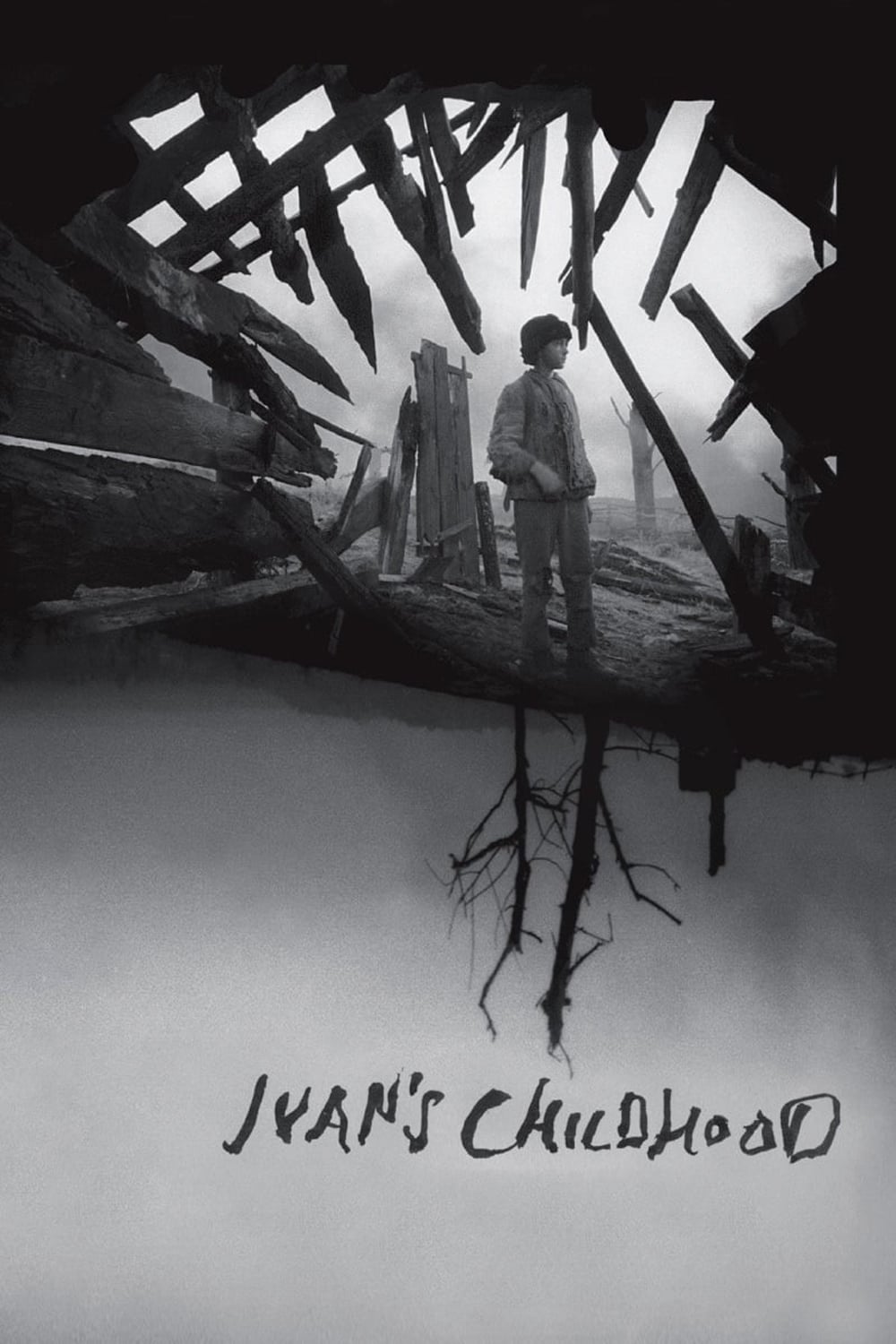
When I sat down with Ivan’s Childhood, I expected a straightforward war drama, but encountered something far more poetic. From the moment the black-and-white imagery unfurled, I was swept into the intimate world of Ivan, a young boy lost in the tides of World War II. Rather than mapping out every detail of his journey, the film invites me to travel alongside Ivan as he navigates the shadowy forests and crumbling villages of the Eastern Front. The narrative unfolds through fragmented memories and surreal dream sequences rather than a conventional linear arc, making me feel as disoriented and haunted as the protagonist himself.
Before I go any further, consider this a gentle spoiler warning: Some of Ivan’s most defining moments hinge on revelations about his family and his fate. While I won’t lay bare the film’s climax, I do think it’s important to note how Tarkovsky draws out Ivan’s yearning for lost innocence and his desperate bid for vengeance, shaping an experience that leans more on emotional resonance than plot twists. As Ivan repeatedly volunteers for dangerous reconnaissance missions behind enemy lines, I found his single-minded resolve both admirable and heartbreaking—a child’s courage forged in the furnace of unimaginable loss.
Key Themes & Analysis
As I absorbed each frame, I realized that Ivan’s Childhood is less a war film than a meditation on the trauma of war seen through a child’s eyes. To me, the heart of the film is its study of lost innocence and the devastating effects of conflict on the young and vulnerable. There’s a recurring duality in Tarkovsky’s direction: the lush, lyrical dream sequences stand in stark contrast to the muddy, desolate realities Ivan traverses. This is not a story about battles or glory, but about the psychic scars and longing for peace in a world of violence.
Every time Ivan closes his eyes, I was transported into his subconscious: scenes of sun-drenched birch forests, family moments filled with laughter, and a freedom that war has since obliterated. These interludes struck me as Tarkovsky’s defiant hope—his way to remind me that, no matter how bleak reality becomes, the human mind will fight to preserve beauty and warmth. On the other hand, the day-to-day sequences—muddy trenches, tense silence, furtive movements—speak to the pure fatigue of ongoing survival. I find it remarkable how Tarkovsky pulls me into Ivan’s headspace with minimal dialog, relying on cinematographer Vadim Yusov’s majestically expressive camera work to convey Ivan’s emotional isolation.
The film doesn’t just focus on Ivan. The adults, particularly Lieutenant Galtsev and Captain Kholin, act as surrogate guardians, their attempts at protecting Ivan undercut by the understanding that they are powerless to restore what he’s lost. Their compassion and frustration mirrored my own sense of helplessness; I couldn’t help but see them as symbolic of a society at large—well-intentioned, yet unable to redeem the innocent amid senseless destruction.
As for performances, Nikolai Burlyayev’s Ivan left me breathless. His eyes, wide with resolve and suffering, anchor the film. There’s a rawness to his presence that I rarely encounter on screen. Similarly, I noticed how Tarkovsky directed his actors with deliberate restraint, asking them to imply more than state, letting glances, pauses, and half-finished gestures reveal entire histories. It’s a masterclass in subtlety that fits perfectly with the film’s understated script.
Cinematographically, Tarkovsky crafts some of the most haunting visuals I’ve encountered in Soviet cinema. The interplay of light and shadow, the restless movement of the camera, and the lingering focus on nature—all of these serve to underscore the contrast between the world that was and the world that is. I found it especially resonant that the film repeatedly returns to motifs of water and trees, perhaps symbolizing Ivan’s longing for a past cleansed of war. Tarkovsky’s decision to use black-and-white only intensifies these motifs, stripping away distraction and forcing me to witness Ivan’s tragedy in raw, unfiltered strokes.
For me, one of the most enduring aspects of Ivan’s Childhood is how it poses a silent question: in a world that devours its children, where do we find hope? It doesn’t offer easy answers, but by embedding that question in every scene, the film lingers long after the credits roll.
My Thoughts on the Historical & Social Context
Something that stands out each time I revisit Ivan’s Childhood is how deeply rooted it feels in its own era yet how vigorously it pushes against the conventions of Soviet war films of the early 1960s. Released at a time when Soviet cinema favored tales of collective heroism or larger-than-life patriotism, Tarkovsky’s approach struck me as almost subversive. By zeroing in on Ivan’s fragile psychology and forgoing martial spectacle, the film reflects a shift in post-Stalinist Russia—a cautious embrace of the individual’s suffering, a willingness to acknowledge the private costs of national tragedy.
Watching this in the context of history, I can’t help but contemplate the generation of children who came of age in the shadow of WWII. Ivan, to me, embodies an entire population marked by trauma, orphans whose childhoods were ravaged by forces well beyond their control. The fact that Tarkovsky adapted a novel written by a former war correspondent tells me something vital: this film is rooted in real grief, not just metaphor.
In today’s world, with new conflicts displacing countless young lives, the story feels sadly prescient. The film’s portrayal of resilience laced with irrevocable loss feels as relevant now as it did more than sixty years ago. Watching Ivan, I reflected on how current global crises produce new generations of “Ivans”—children forced to grow up too soon, their innocence traded for survival. For me, Tarkovsky’s refusal to glorify war or sanitize its impact on the young stands as a timeless act of cinematic courage. In that sense, Ivan’s Childhood serves as both an artifact of Cold War anxieties and a universal warning: when we lose sight of the individual, especially the most vulnerable, we forfeit our own humanity.
Fact Check: Behind the Scenes & Real History
As I dug deeper into the making of Ivan’s Childhood, several behind-the-scenes details astonished me. First, I learned that Tarkovsky wasn’t the film’s original director. In fact, E. Abalov began shooting the project, but it was halted partway due to dissatisfaction with the footage. When Tarkovsky stepped in, he brought a radically different vision, completely reshooting the film. That creative gamble paid off—the final product barely resembles the initial work and, in my eyes, that transition is what unlocked the film’s singular voice.
Another fascinating element is the casting of Ivan himself. The part ultimately went to Nikolai Burlyayev, but not before a highly competitive search. Tarkovsky selected Burlyayev for his ability to convey rawness and vulnerability without sentimentality. Watching the film now, I can only applaud that decision—it’s hard to imagine anyone else bringing Ivan’s wounded stubbornness so convincingly to life. As an anecdote that speaks to Tarkovsky’s demanding style, Burlyayev was only twelve during filming, and the shoot reportedly took both a physical and emotional toll; Tarkovsky even clashed with the crew over how best to preserve the boy’s authenticity.
On the question of historical accuracy, I was impressed by the film’s attention to authentic detail. The story draws from actual accounts of Soviet child partisans: children who served as scouts behind enemy lines, risking everything for information. Although Ivan is a fictional character, several elements mirror real cases reported during the war. Tarkovsky’s use of landscape, ruined buildings, and authentic wartime props helps ground the dreams and tragedies in a frighteningly plausible reality. Yet, what fascinates me most is how, instead of fixating on “real events,” Tarkovsky channeled emotional truth. He didn’t just try to replicate history; he explored the soul-scarring aftermath of that history.
Why You Should Watch It
- An emotionally gripping look at war’s impact on childhood that goes beyond conventional Hollywood tropes
- Stunning cinematography that blends poetic dream imagery with gritty realism
- A masterclass in direction and acting—especially Nikolai Burlyayev’s unforgettable central performance
Review Conclusion
Every time I revisit Ivan’s Childhood, I find new layers in Tarkovsky’s blend of beauty and brutality. It isn’t just a film about surviving war; it’s a film about surviving the aftermath, about the ways memory and trauma interlace in a wounded psyche. The movie stands among my top recommendations for any serious student of cinema, not just because of its technical mastery or its evocative imagery, but because it reminds me what film can do at its most honest and humane.
My Rating: 4.5/5 stars
Related Reviews
- “Come and See” (1985) – Watching Elem Klimov’s searing depiction of a Belarusian boy’s descent into hell during WWII, I felt the same gut-punch as Ivan’s fate. The film’s refusal to shield viewers from the psychological torment of war makes it a natural companion to Tarkovsky’s vision—a must-watch for those moved by Ivan’s story.
- “The Ascent” (1977) – Larisa Shepitko’s stark, soulful portrait of Soviet partisans during the winter war left me shivering. Like Ivan’s Childhood, it offers both spiritual intensity and human fragility, using landscape and expressionist visuals to heighten every moral dilemma.
- “Paths of Glory” (1957) – Stanley Kubrick’s take on the futility of war carries a similar philosophical weight; his indictment of authority and his concern for the individual soldier’s suffering echo the themes that most haunted me in Ivan’s journey.
- “Fires on the Plain” (1959) – Kon Ichikawa’s harrowing tale of a Japanese soldier starving on the Philippines front shares Tarkovsky’s unvarnished realism and poetic approach, making it ideal for those drawn to anti-heroic, deeply personal war dramas.
If you want to explore this film beyond basic facts, you may also be interested in how modern audiences respond to it today or whether its story was inspired by real events.
🎬 Check out today's best-selling movies on Amazon!
View Deals on Amazon