
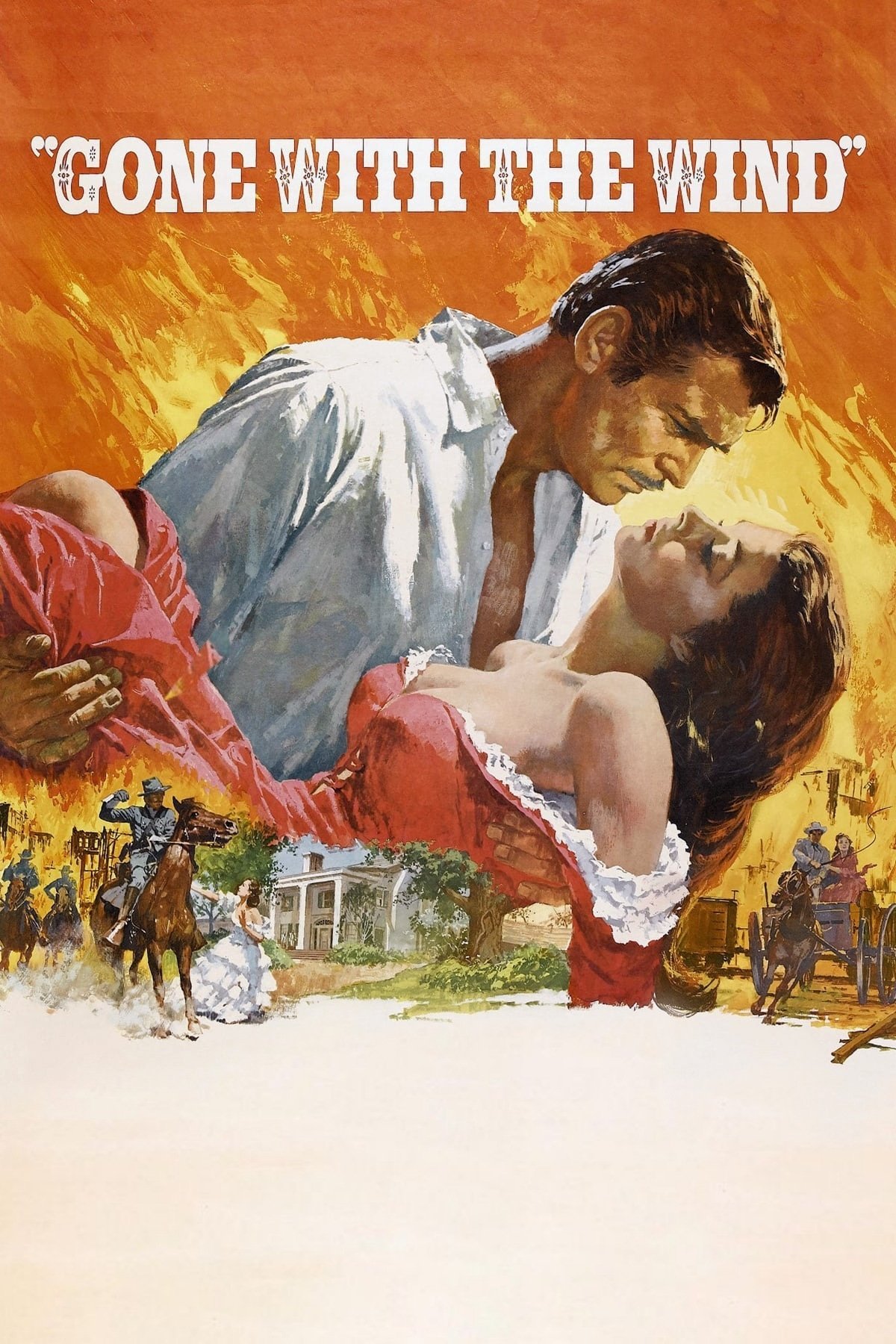
Plot Summary
The first time I watched Gone with the Wind, I was immediately drawn in by the sweeping vistas, lush costumes, and the scale of its storytelling—something that has yet to be rivaled in the modern cinematic landscape. Although I’m cautious about giving away significant plot details, I can say that the movie, directed by Victor Fleming, unfolds amidst the dramatic and tumultuous backdrop of the American South during the Civil War and Reconstruction era. At the center is Scarlet O’Hara, a character whose relentless determination both captivates and frustrates me at every turn. Her journey, complicated by the enigmatic Rhett Butler, traces not just personal heartbreak but the loss, transformation, and rebirth of a way of life.
As Scarlet navigates the shifting tides of war, love, and social change, I find the film carefully balances moments of grand spectacle with strikingly intimate character studies. The emotional core stems as much from small domestic confrontations and subtle glances between characters as it does from the epic scale of Atlanta aflame or Tarleton’s fall. For anyone unfamiliar with the story, rest assured that the plot travels rich ground: pride clashes with vulnerability, fortunes are lost and won, and every relationship is colored by the changing world around them.
Note: For readers hoping to avoid spoilers, the most pivotal events and their outcomes are left for your own discovery—much of what gives the story its persistent thrill is how unexpectedly characters reveal themselves to both each other and the audience.
Key Themes & Analysis
From my perspective, the enduring power of Gone with the Wind lies in its exploration of personal resilience contrasted against sweeping historical change. Scarlet O’Hara is more than a Southern belle; she is an emblem of adaptability, sometimes to a fault—her choices frequently trod dangerous ethical ground. I am struck each time I rewatch by how she embodies and challenges the expectations placed upon women in her society. What fascinates me is how the film uses her manipulation and ambition as both critique and celebration—she’s a survivor in a world intent on her defeat.
Visually, the film makes a profound impact. Cinematographer Ernest Haller’s use of Technicolor doesn’t just create beauty; it expresses Scarlet’s internal world and the Southern nostalgia underpinning the narrative. The famous shot of Scarlet against the burning Atlanta skyline, with rich reds and blacks, is something I never forget—it captures the ruin and the resolve that run side by side in the film.
The direction, which I recognize as a collaboration among Victor Fleming, George Cukor, and Sam Wood, gives the movie its unexpected dynamism. Fleming’s ability to move the narrative from lush estate exteriors to fraught parlor confrontations means the emotional temperature always stays high. Yet, it’s the performances—Vivien Leigh’s relentless, layered Scarlet and Clark Gable’s brooding but magnetic Rhett—that anchor the spectacle. I am consistently mesmerized by the subtle interplay in their scenes: Leigh’s expressions run the gamut from steely resolve to almost-melodramatic fragility, while Gable plays Rhett as at once cynical and heartbreakingly sincere.
The film’s central romance isn’t the escapist fantasy some expect; it’s a complex, sometimes uncomfortable negotiation of power, longing, and loss. What moves me most isn’t the traditional love story but the way the narrative refuses to offer easy resolutions. Instead, it exposes how pride and wounded egos can sabotage the possibility of happiness.
It’s also worth stating that the film’s nostalgia for antebellum grandeur is deeply intertwined with loss and denial—the sweeping camera movements over ruined plantations are both elegy and critical reflection, never fully comfortable with what is being mourned and whose voices have been silenced.
Technically, I often marvel at the film’s innovations—from the groundbreaking use of color to the sheer scale of extras, sets, and practical effects. There’s a grandeur to the “old Hollywood” orchestration, yet the film’s quieter moments hit just as hard.
My Thoughts on the Historical & Social Context
Watching Gone with the Wind always feels like traversing a complicated cultural landscape. I can’t ignore that the film was released in 1939—a time when America was on the brink of another massive upheaval, World War II. Audiences then, many only a generation removed from Civil War survivors, saw their own anxieties about change, loss, and resilience mirrored in Scarlet’s struggle. For me, that sense of an old world slipping away resonates even now, in a society still grappling with questions of identity, tradition, and who gets to write history.
I repeatedly find myself troubled by how the film frames the Old South as both beautiful and blighted. There is a seductive quality to the lavish parties and sprawling plantations, but I’m acutely aware of how little the film interrogates the realities of slavery beyond surface-level depictions. The sanitized, sometimes romanticized portrayal of the Confederacy and plantation life reflects not only Margaret Mitchell’s source material but also the prevailing ideologies and limitations of 1930s Hollywood.
From my vantage point, the fact that the Black characters are so often sidelined—confined to comic relief, unwavering loyalty, or flat archetypes—reveals more about the film’s era than about the time it seeks to depict. The performance by Hattie McDaniel as Mammy stands out as an act of resistance and dignity in a thankless context; she brings depth and presence to a role hemmed in by stereotype. I’m both moved and angered by how she steals scenes, even while never being given the narrative’s full sympathy.
Why the film mattered in 1939 becomes clear to me—it offered escapism during the tail end of the Great Depression, an epic sense of loss and hope, and comfort in the idea that endurance could lead to renewal. For today’s viewers, its very contradictions—its technical brilliance, narrative ambition, and glaring social blind spots—make it a critical touchstone in conversations about representation and the uses of nostalgia in art.
What lingers for me long after the credits is the recognition that Gone with the Wind is both a triumph of cinematic storytelling and a document of its time, reflecting the complexities and prejudices of its makers and original audience. Its relevance endures not because it offers easy answers but because it compels us to look directly at the tangled roots of American identity.
Fact Check: Behind the Scenes & Real History
I love delving into the stories behind classic films, and Gone with the Wind is positively overflowing with production lore and historical contradictions.
One fact that fascinates me every time I revisit the film’s history is the sheer ordeal involved in casting Scarlet O’Hara. Producers tested more than 1,400 actresses—an unprecedented scale for the era—before settling on Vivien Leigh, a relatively unknown British actress at the time. That risk paid off; in my view, Leigh’s performance is what truly galvanizes the whole enterprise, her charisma and ferocious energy making Scarlet unforgettable.
Another detail I frequently reflect on is the groundbreaking recognition of Hattie McDaniel, who played Mammy. McDaniel became the first Black actor to win an Academy Award—an historic moment, but bittersweet because she faced institutionalized segregation at the Oscars ceremony itself, seated separately from her castmates. Her win remains a poignant reminder of both the progress and the persistent barriers of Hollywood’s history.
On the subject of historical accuracy, I’m always struck by how the film’s romanticized vision of the antebellum South starkly diverges from historical reality. While the movie is visually lush and emotionally intense, it profoundly glosses over the brutal conditions of slavery. In reality, plantation life was marked by hardship, violence, and exploitation—elements only faintly acknowledged in the film’s glossy production.
One final bit of production trivia that surprises even devoted fans: the iconic burning of Atlanta was accomplished in a single take using old studio backlot buildings slated for demolition. The crew managed to create a visually spectacular sequence with real fire and practical effects—a high-wire act that, to me, underscores how much ingenuity and risk defined the filmmaking of that era.
Why You Should Watch It
- For its unparalleled display of cinematic craft—I find every frame a testament to what classic Hollywood could achieve in scale, color, and emotion.
- Because it invites conversation and confrontation with history—watching it, I’m drawn into urgent discussions about memory, race, and nostalgia that are still unfolding today.
- To see remarkable performances—Vivien Leigh and Hattie McDaniel in particular deliver nuanced, unforgettable characterizations that continue to inspire actors and audiences alike.
Review Conclusion
Every time I revisit Gone with the Wind, I am swept up not just by its astonishing pageantry and enduring romance, but by the contradictions at its core. Its emotional highs and devastating lows, the thrill of its visuals and the ache of its historical omissions, all make it a film I can’t stop thinking about. For its artistry, ambition, and the intense conversations it provokes, I give it a 4/5 stars. It remains, for me, a movie worth wrestling with—both as a work of breathtaking craft and as a cultural artifact that still shapes how we understand our past.
Related Reviews
- “Doctor Zhivago” (1965) – I recommend this sweeping romance for those who, like me, appreciate epic storytelling against the backdrop of historical upheaval. It blends personal longing and grand tragedy in a way reminiscent of Gone with the Wind, but set amidst the Russian Revolution.
- “The Color Purple” (1985) – For viewers drawn to stories tackling race, identity, and resilience, this film offers a more modern and nuanced exploration of similar themes, with powerful performances and a deeply personal narrative arc.
- “Giant” (1956) – If the dramatic evolution of American society and intricate family sagas appeal to you as they do to me, Giant’s exploration of Texas land barons and changing times delivers both spectacle and a probing examination of social transformation.
If you want to explore this film beyond basic facts, you may also be interested in how modern audiences respond to it today or whether its story was inspired by real events.
🎬 Check out today's best-selling movies on Amazon!
View Deals on Amazon