
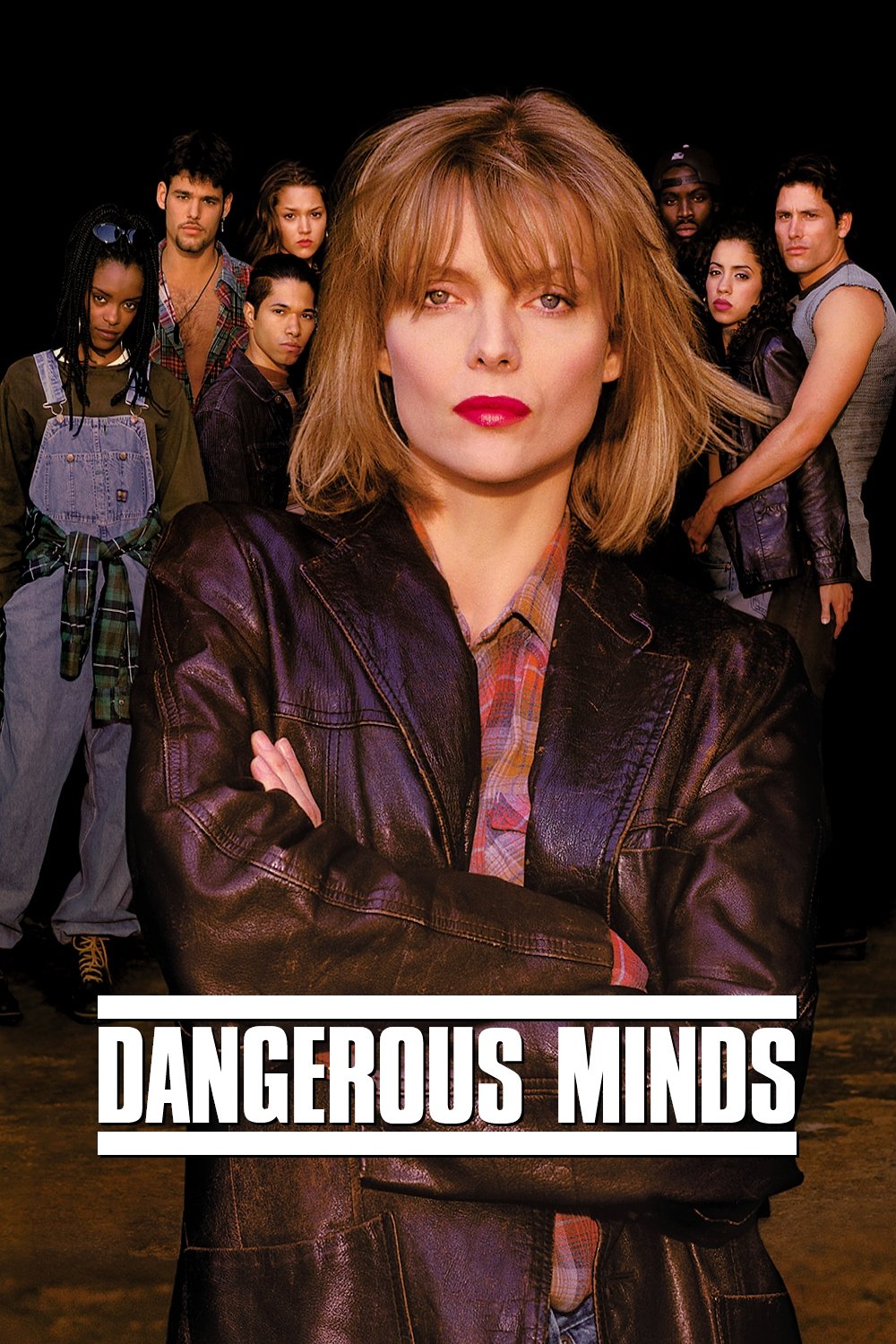
Plot Summary
Sometimes, a film takes me back to a moment in my own life—a crossroads, a sense of being an outsider, or the power of meeting that one person willing to fight for belief when belief feels impossible. That’s precisely the sensation I experienced when I first sat down with Dangerous Minds, a 1995 drama directed by John N. Smith. I was instantly drawn into the journey of LouAnne Johnson (brought to life by Michelle Pfeiffer), a former Marine who enters the stormy world of an inner-city high school. The film’s title didn’t just refer to her students; it conjured up for me the notion that “danger” might also point to the fierce hope that can shake up even the most broken environments.
As I navigated LouAnne’s first tentative steps into the classroom, the palpable friction between optimism and hopelessness set the narrative’s tone. What pulled me in wasn’t just the struggle between teacher and students, but the way each classroom interaction felt like a small war—unpredictable and real. By design, the film focuses on LouAnne’s unconventional teaching methods as she seeks to reach kids the world has written off. It’s not so much a linear story as it is a series of hard-won breakthroughs and crushing setbacks. I found myself invested in individual students’ stories: the defiance of Emilio, the vulnerability behind Raúl’s bravado, and the unspoken pain LouAnne gradually uncovers in her class.
If you’re deeply wary of spoilers, skip this next paragraph. The turning point for me isn’t found in a single revelation, but in how LouAnne’s relentless compassion chips away at the veneer of toughness her students maintain. There are harrowing setbacks—moments where loss shatters optimism and survival instincts override any desire to trust. But what lingered with me long afterward were the quieter moments: a poem shared, an apology made, a teacher who refuses to give up even when faced with overwhelming odds. As the bell rings on the film’s final act, I was left with hard-won hope instead of easy triumph, which I believe is part of why this film has stuck with me for decades.
Key Themes & Analysis
What kept me returning to Dangerous Minds isn’t flashy direction or a twist-filled plot—it’s the themes that felt both immediate and timeless. At the core, I found this film to be a meditation on the transformative power of empathy and persistence in spaces where failure feels inevitable. LouAnne’s journey threw me into deeply uncomfortable territory: a school culture so jaded that even the smallest gesture—a kind word, a new assignment—takes on seismic importance. I’ve always been fascinated by stories that put institutional complacency under the microscope, and this film’s critique of educational bureaucracy is as much a call to arms as it is a narrative device.
One of the film’s most distinctive elements for me is its unapologetic focus on identity and self-worth. I find that LouAnne’s background as a Marine is not simply a character quirk, but a metaphorical shield—her training is less about authority than it is about survival, about learning how to connect through discipline, not domination. The students, in turn, are survivors in their own right, forced to navigate poverty, violence, and neglect every day. When LouAnne introduces the poetry of Dylan Dylan as a teaching tool, using “The Dylan-Dylan War” to bridge the worlds of Bob Dylan and Dylan Thomas, I interpret this as a larger argument about finding relevance in education and the radical notion that literature can be both a mirror and a shield for youth on the margins.
Cinematically, Smith keeps the camera close and the colors muted, giving the film an almost documentary realism that I found to be both immersive and unsettling. The drab browns and blues of the classroom are periodically punctuated with brighter hues whenever students’ creativity is stoked—subtle but powerful visual storytelling that signals the emergence of hope. There’s a lack of sentimentality in the directing style that I truly appreciate; the film avoids melodrama, instead letting the actors’ performances carry the emotional weight.
Michelle Pfeiffer’s performance stands as one of the most quietly impactful turns of her career for me. Her LouAnne is tough but never invulnerable, stubborn but always self-questioning. Rather than conjuring a typical savior figure, Pfeiffer communicates the deep cost of empathy and the risk that comes with truly caring in a broken system. The supporting cast, especially Renoly Santiago as Raúl and Wade Domínguez as Emilio, bring a rawness and vulnerability that linger well after the credits roll. There’s authenticity to their portrayals that kept me emotionally invested, particularly in how they react to LouAnne’s sometimes-clumsy attempts to break through their defenses.
Collectively, these choices left me wrestling with the messiness of change. The true theme isn’t heroism, but the hard, unglamorous grind of making a difference, one student at a time. The discomfort the film generates is intentional—it asks me (and, by extension, all of us) to consider what we owe to young people who are regularly written off by the system meant to support them.
My Thoughts on the Cultural Impact & Legacy
What struck me most, especially on recent rewatches, is how Dangerous Minds shaped the wave of schoolroom drama films that followed. I remember feeling, even in the late ’90s, that something about this film had cracked the genre wide open—suddenly, gritty, hope-tinged stories set in classrooms weren’t so rare, and the “troubled teacher transforms a class” narrative became mainstream. While some critics have accused the film of oversimplifying systemic issues, I personally see its lasting resonance in the way it foregrounds uncomfortable truths instead of retreating to easy, sanitized redemption. The soundtrack, featuring Coolio’s “Gangsta’s Paradise,” injected the film into popular culture—even peers who hadn’t seen the movie could quote its lyrics, a testament to its reach well beyond movie theaters.
On a deeply personal level, I find that the film’s willingness to make audiences uneasy is its greatest strength. It pushed me to examine my own ingrained assumptions about education, privilege, and who gets the benefit of the doubt in a bureaucratic world. As someone who curates films for discussion and education, I find that Dangerous Minds opens up critical dialogue about the real challenges teachers and students face—conversations that have only grown more urgent with each passing year. The film’s legacy can also be seen in how it paved the way for nuanced depictions of at-risk youth in American cinema, moving beyond caricature to give voice to trauma, complexity, and potential.
What resonates even more powerfully for me is that Dangerous Minds never lets the viewer off the hook. There’s no final triumph or easy resolution—only the ongoing, often exhausting struggle to create moments of hope and agency. In that refusal to resolve everything neatly, I see the film’s honesty and its effectiveness as both a piece of entertainment and a call to engage with real-world issues.
Fascinating Behind-the-Scenes Facts
The making of Dangerous Minds is filled with the kind of stories that heighten my appreciation every time I watch. One tidbit that I find particularly intriguing involves the casting of Michelle Pfeiffer. Initially, the role of LouAnne Johnson was shopped to several high-profile actresses, but none truly connected with the character as Pfeiffer did. She reportedly read Johnson’s memoir before filming and met with the real LouAnne, determined to capture her quiet determination without resorting to cliché. The result is a deeply authentic portrayal born out of genuine preparation and personal investment—something I feel radiates through every frame.
Another behind-the-scenes fact that impresses me is the involvement of real students as extras and in minor roles. The production team spent time at actual California high schools, seeking out youths whose lived experience could inform the film’s authenticity. This on-the-ground research translated directly into the script’s sharp dialogue and the cast’s palpable chemistry. For me, it explains why the classroom scenes avoid theatricality—they feel lived-in, jittery, and unpredictable in the best possible way.
I’m continually fascinated by the challenges faced in securing the powerful soundtrack. Producer Jerry Bruckheimer pushed for a sound that would “reflect the genuine voice of the streets,” and this led directly to Coolio’s iconic “Gangsta’s Paradise.” The song’s meteoric rise wasn’t guaranteed—studio executives were reportedly concerned about its raw language. Yet its inclusion turned the film into a cultural phenomenon, blurring the lines between cinema and contemporary music. As someone passionate about how music can shape a film’s message, I can’t help but marvel at the risk taken here. It paid off, both in box office appeal and lasting influence.
Why You Should Watch It
- You’re seeking a film that tackles social issues with raw honesty—this movie doesn’t flinch away from uncomfortable realities inside and outside the classroom.
- You appreciate powerful, understated performances—Michelle Pfeiffer delivers one of her most nuanced roles, with an outstanding supporting cast lending real-world gravitas to every scene.
- You want a movie that sparks important conversations—it’s impossible to watch without reflecting on educational inequality, resilience, and the power of tough love.
Review Conclusion
Every time I return to Dangerous Minds, I’m reminded why it continues to hold such a unique place in my personal canon of essential films. The classroom battles, the bruising realism, and the flickers of hope all combine to form a movie that refuses easy answers. I walk away each time changed—forced to re-examine my assumptions and gratitude for those who fight for change from within broken systems. For its willingness to wrestle with hard truths, for Michelle Pfeiffer’s fearless performance, and for its enduring impact on storytelling, I give Dangerous Minds a powerful 4 out of 5 stars.
Related Reviews
- Freedom Writers (2007) – I often recommend this film to those who connect with Dangerous Minds. Its focus on a passionate teacher reaching at-risk youth, grounded in journal writing and true stories, offers a similarly gritty and inspiring look at education as a lifeline.
- Lean on Me (1989) – The journey of Principal Joe Clark in tackling an embattled high school resonates for me in its tough realism and confrontational approach. Both films shine in their commitment to portraying flawed institutions and authentic student voices.
- Coach Carter (2005) – Though centered around a basketball team, I find this film’s unwavering spotlight on discipline, self-respect, and second chances makes it thematically linked. If Dangerous Minds left you thinking about the intersection of mentorship and social inequality, you’ll find much to discuss here too.
For readers looking to go deeper, these perspectives may help place the film in a broader context.
🎬 Check out today's best-selling movies on Amazon!
View Deals on Amazon