
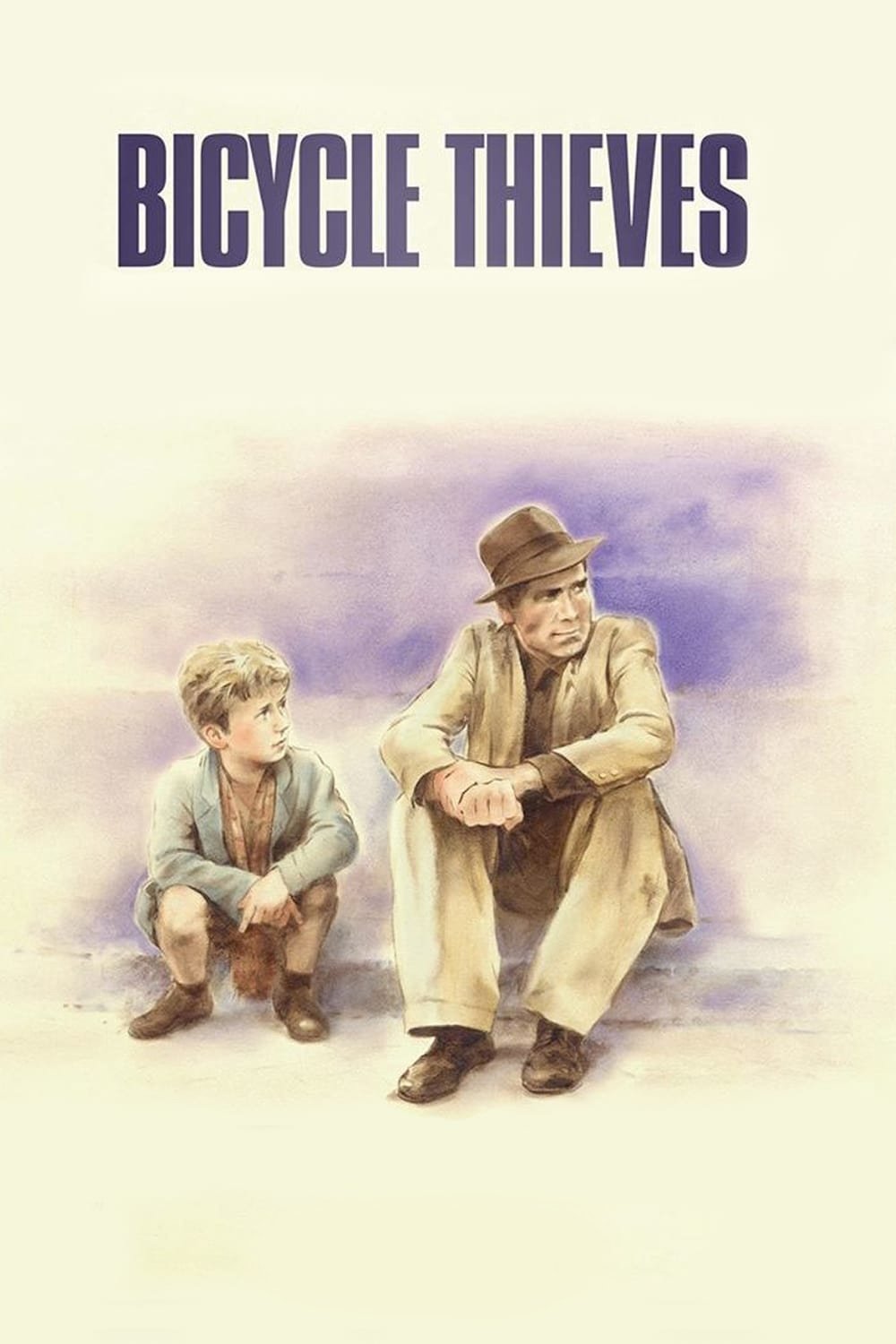
Plot Summary
Watching Bicycle Thieves has always left me with a blend of quiet awe and gnawing heartbreak. Directed by Vittorio De Sica, this landmark of Italian neorealism follows Antonio, an unemployed man in postwar Rome, whose livelihood hinges on a newly obtained bicycle. When the bicycle is stolen, he and his young son embark on a desperate search through the city’s labyrinthine streets. Even after decades and countless viewings, each scene still carries fresh urgency for me. The story is deceptively simple on the surface, yet every moment throbs with anxiety and a sense of loss that resonates far beyond the scope of its immediate setting.
I can’t give away the ending without diluting its power, but I do want to point out that the film, for all its visual poetry, never lets up on depicting the harsh realities its characters face. Spoiler alert: If you wish to avoid specifics, skip the next sentence. The last act builds to a decision that I continue to wrestle with in my own mind, long after watching—one that reveals as much about societal pressures as it does about Antonio’s character. Even when I know what’s coming, I feel as tense in the film’s shadowy alleys as if I were searching alongside Antonio and his son.
Rather than spinning its story around flashy twists or melodrama, I find that Bicycle Thieves draws out its drama from the tiny moments of human connection—fraught conversations, silent glances, the exhaustion etched into faces—or the near-misses that stretch Antonio’s hope ever thinner. From my perspective, these cumulative fragments of daily struggle make the story feel both epic and intimate with a realism that’s rare even today.
Key Themes & Analysis
For me, the most haunting aspect of Bicycle Thieves is its exploration of dignity in the face of poverty and the quiet devastation of systemic indifference. As I watch Antonio traverse his city, desperate to keep working, I see a broader indictment of the social structures that leave honest people scrambling for scraps. The film offers a powerful portrait of postwar disillusionment, and as I interpret De Sica’s framing, each shot seems carefully composed to underscore the harsh contrast between personal hope and a world unwilling (or unable) to help.
What stands out to me most is the way De Sica uses his camera to amplify these themes. The film almost never pulls away from Antonio and his son; I feel engulfed by their situation because the city swallows them whole. The streets of Rome become a character in themselves, indifferent yet suffused with traces of others just like Antonio. At times, the camera lingers on faces in the crowd, bearing witness to collective hardship instead of just a single family’s tragedy.
From a performance standpoint, I am continually struck by Lamberto Maggiorani’s work as Antonio. His raw, understated agony doesn’t feel like “acting” at all, possibly because Maggiorani wasn’t a professional actor. His desperation is etched into every gesture, every pleading look. I’ve realized on repeat viewings that an actor can accomplish more in a brief, silent moment than an overwrought monologue. The young actor as Antonio’s son, Enzo Staiola, is equally remarkable. He brings vulnerability and stubbornness in equal measure; their father-son dynamic feels as authentic as any I have seen.
As for directing, De Sica’s choices ground every moment in reality. There are no artifice or easy answers—just the relentless passage of time as Antonio’s hope diminishes. From my perspective, what elevates this film beyond social critique is the universality of its emotional resonance. I felt, and still feel, as though I am seeing poverty, pride, parental love, and frustration distilled into a series of aching, unforgettable moments.
The cinematography stands out for its quiet innovations as well. The use of non-actors and natural light gives the film an almost documentary feel. The Rome of 1948—its mud, its market hustle, its glaring sunlight—does not look dressed for a camera. It looks lived-in, half-repaired, and bustling with lives on the edge. There is a tension between hope and despair expressed in the visuals: wide shots that dwarf the characters threaten to swallow them, while close-ups force me to reckon with their vulnerability head-on. I find the absence of sentimentality just as moving as any overt emotional manipulation might have been.
Above all, the theme I keep returning to—and the one I most want to impress on new viewers—is the film’s insistence that each act of survival comes with a cost. Bicycle Thieves does not indulge in wish-fulfillment. It asks, again and again, what a person will sacrifice to provide for loved ones—and how society, for all its piety and respectability, might look the other way.
My Thoughts on the Historical & Social Context
If you had asked me when I first encountered Bicycle Thieves why it lingered so stubbornly in my imagination, I would have pointed to its impeccable craftsmanship. Now, with a clearer sense of the world that shaped it, I realize that its resonance cuts deeper. The era in which De Sica created the film was itself reeling from uncertainty. Italy, battered and economically devastated after World War II, was a nation rebuilding not just cities but identities, livelihoods, and even faith in authority.
In my view, the story’s relentless focus on Antonio’s small, almost mundane desperation amplifies its social critique. When I consider the unemployment and social fragmentation that plagued Italy in the late 1940s, the theft of a single bicycle acquires monumental significance. It becomes a battle over the right to dignity, the right to work, and the challenge of remaining humane when survival is at stake. Antonio’s struggles seem less like exceptions and more like the fabric of everyday life for thousands in postwar Europe.
What’s extraordinary to me is how this film, while rooted in a particular moment of Italian history, feels achingly modern. Watching it today, I see echoes of its challenges all around: families living paycheck to paycheck, public systems that fail the vulnerable, the humiliation that comes with being powerless. These are not problems consigned to one time or place. I believe De Sica’s achievement is to force the audience—including me—to see the invisible: the tragedy in the ordinary, the ripple effects of deprivation, and the possibility of both compassion and despair in equal measure. Bicycle Thieves mattered in 1948 because it grasped the emergency of its era—but it matters to me now because its story is, heartbreakingly, still so easy to recognize.
Fact Check: Behind the Scenes & Real History
Digging into the circumstances that shaped Bicycle Thieves, I have found a treasure trove of details that deepen my appreciation. First—and perhaps most astonishing to me—the film’s lead actor, Lamberto Maggiorani, was actually a factory worker (not a trained performer) when he was cast as Antonio. De Sica believed that non-professional actors could best capture the quiet authenticity he craved. The reality is that Maggiorani’s experience mirrored that of his character—he too struggled financially, lending the role a lived-in truth that no amount of rehearsal could have conjured.
I’m also fascinated by the shooting techniques De Sica employed. Eschewing studio lots, the cast and crew wandered through the real streets of Rome, sometimes drawing crowds of curious bystanders. This choice gives the film its raw, documentary-like feeling and marked a significant departure from polished studio productions of the time. The city’s unfiltered energy seeps into every scene, grounding the story in a world that feels authentic and immediate to me as a viewer.
One detail I didn’t realize until researching for this review is that the movie’s source material—Luigi Bartolini’s novel—actually takes a much more cynical stance. The film diverges from the book in key ways; De Sica and screenwriter Cesare Zavattini emphasized hope, family, and understated tragedy, transforming a bitter, almost satirical story about a lonely, embittered artist into a universal fable about everyday heroism and heartbreak. This conscious shift in adaptation fascinates me; it underlines just how deliberate De Sica was in crafting a film meant to move audiences across political and cultural divides.
Why You Should Watch It
- For its vivid portrayal of desperation and resilience, which I find more gripping than any contrived suspense thriller.
- The performances from non-professional actors evoke extraordinary authenticity, making every emotion and relationship feel genuine.
- Its social and political commentary remains profoundly timely, offering a lens through which to understand ongoing struggles with poverty, dignity, and survival.
Review Conclusion
Sitting with my thoughts after a recent rewatch, I’m struck yet again by how Bicycle Thieves refuses to fade from memory. The film’s artistry—rooted in real streets, real faces, and real heartbreak—holds me in a state of reflection and empathy. Its relevance persists; its message stings. I recognize traces of Antonio in every parent hoping for a break, every worker hustling to stay afloat, and every child clinging to trust. De Sica’s masterwork not only shaped cinema but continues to shape the way I see the world and its overlooked tragedies.
The depth of human experience it captures, the stark poetry of its imagery, and the ferocity of its quiet critique make Bicycle Thieves a film I return to for both solace and a reminder of what’s at stake in our ordinary lives. I can’t imagine giving it less than a 5/5 star rating. This is essential cinema in every sense of the word.
Related Reviews
- Umberto D. (1952) – I’m consistently drawn back to Umberto D., another De Sica film, because of its raw yet compassionate focus on the daily challenges of Italy’s working poor. Its minimalistic style, focus on elderly vulnerability, and blend of quiet sorrow with fleeting hope make it a soul sibling to Bicycle Thieves.
- Paisa (1946) – Watching Paisa, directed by Roberto Rossellini, gave me a new vantage point on the Italian neorealist project. Its episodic structure, varied styles, and unvarnished look at war’s devastation create a patchwork of stories that intersect thematically with the search for humanity and dignity I admire in Bicycle Thieves.
- The 400 Blows (1959) – What has always struck me about this French New Wave classic is its unfiltered portrayal of youth adrift in an uncaring society. Like Bicycle Thieves, it pairs unsentimental realism with deeply moving moments, reminding me how universal childhood alienation can be.
- Tokyo Story (1953) – Whenever I reflect on familial struggle and quiet heartbreak, Ozu’s Tokyo Story comes to mind. Its understated approach, emphasis on generational disconnect, and lingering shots evoke the same emotional clarity and sense of loss I felt watching De Sica’s masterpiece.
If you want to explore this film beyond basic facts, you may also be interested in how modern audiences respond to it today or whether its story was inspired by real events.
🎬 Check out today's best-selling movies on Amazon!
View Deals on Amazon