
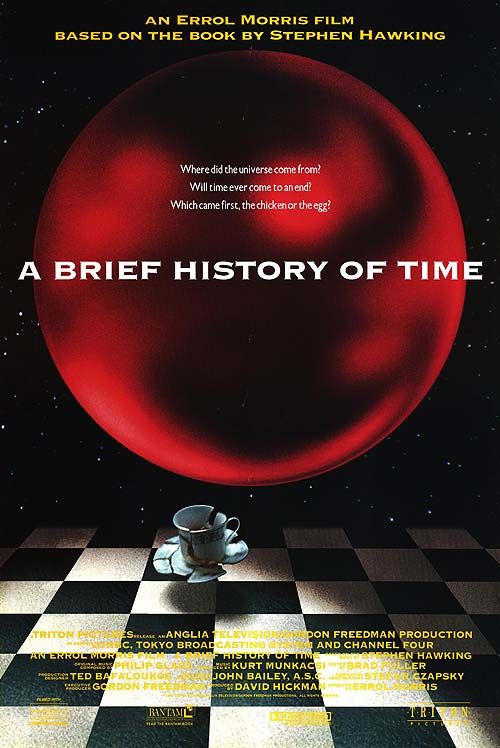
Few science documentaries can claim the balance of intellectual ambition and human warmth that A Brief History of Time achieves. Directed by the visionary Errol Morris, this 1991 documentary blends biography and scientific exploration in a genre-defining work that illuminates the life and mind of famed physicist Stephen Hawking. Blending the personal with the scientific, Morris constructs an immersive journey into the universe as told through Hawking’s eyes, inviting both science enthusiasts and casual viewers to engage with sweeping cosmological questions. The film masterfully interlaces talking-head interviews, stylized reenactments, and intricate visuals to explore not only Hawking’s revolutionary theories but also the spirit of inquiry that drove him to change our understanding of the cosmos.
Plot Summary
A Brief History of Time is more than a documentary; it’s an ambitious attempt to make the incomprehensible feel close and personal. Loosely structured around Hawking’s landmark book of the same name, the film chronicles the scientist’s journey from childhood prodigy to one of the most brilliant minds of the 20th century. Audiences are taken from Hawking’s formative years in post-war England—marked by curiosity, family support, and eccentricity—through his academic ascent, culminating in his cosmological breakthroughs.
The narrative weaves together two main threads: Hawking’s personal life and his scientific pursuits. Interviews with family, friends, and colleagues provide insight into his early struggles, the impact of his ALS diagnosis, and his extraordinary resilience. At the same time, Morris employs innovative graphics and striking visual metaphors to help decode weighty subjects like black holes, the origin of the universe, and time itself, making them accessible to viewers unacquainted with advanced physics.
Central to the documentary is Hawking’s own voice—literally and figuratively. His distinct computerized speech narrates passages from his book and provides direct commentary, lending authenticity and intimacy to the exploration of his groundbreaking theories. While the film touches on the major milestones of Hawking’s life and introduces philosophical questions about fate, the universe, and human existence, it eschews a conventional, linear structure, instead creating a mosaic that reflects the complexity of both the man and his ideas.
Spoiler Warning: While the documentary does delve into Hawking’s personal challenges and scientific victories, it does not rest on dramatic twists or revelations. Instead, the intellectual revelations and personal anecdotes build gradually, resulting in a rich and multifaceted portrait.
Key Themes & Analysis
At its core, A Brief History of Time is an examination of humanity’s quest to comprehend the universe, filtered through the lens of a singularly brilliant mind. Several key themes emerge:
- The Pursuit of Knowledge: Both the narrative structure and interview segments reinforce the insatiable curiosity that defines Hawking’s approach to science. The film invites viewers to share in the wonder and awe that drives physicists to unravel the deepest mysteries of existence.
- Resilience and the Human Spirit: Hawking’s battle with ALS is presented not as a tragedy, but as an ever-present challenge that he meets with humor, tenacity, and innovation. Morris juxtaposes Hawking’s physical limitations with the boundless reach of his mind, underlining the triumph of intellect and will over adversity.
- Time and Existence: The philosophical exploration of time, especially the questions of where the universe comes from, where it’s going, and the nature of beginnings and endings, pervade the film. These grand topics are given a human scale through Hawking’s reflections on mortality and legacy.
The cinematography, credited to John Bailey and Stefan Czapsky, is both understated and deeply evocative. Morris relies on stylized imagery—pendulum clocks, swirling galaxies, shafts of light through darkened rooms—to visually echo the themes of relativity, infinity, and the arrow of time. These arresting visuals, combined with the ethereal, haunting score by experimental composer Philip Glass, create a dreamlike atmosphere that underscores the film’s meditative quality.
Errol Morris’s direction is marked by intellectual rigor and emotional sensitivity. He resists the urge to oversimplify, yet never loses touch with the viewer’s perspective. The recurring use of direct address, archival family footage, and carefully staged interviews allow Morris to build a mosaic-like narrative, one that is as much about the search for meaning as it is about objective fact.
The acting in A Brief History of Time primarily comes through its interviews and the deeply personal contributions of Hawking’s intimates—mother Isobel, sister Mary, former colleagues and mentors, and scientific contemporaries like Roger Penrose. These subjects anchor abstract concepts in real emotion, and their memories construct a multi-dimensional portrait of Hawking as a son, friend, and scholar. The film’s reenactments are subtle, used sparingly to evoke rather than dramatize, allowing viewers to connect Hawking’s personal moments with his broader theories.
Ultimately, the documentary’s greatest strength lies in its ability to balance intellectual exploration with biography. By humanizing complex theories and blending personal stories with epic scientific inquiry, Morris creates a film that honors both Hawking’s work and his remarkable life.
Why You Should Watch It
- A Rare Blend of Science and Humanity: The film doesn’t just explain physics—it brings out the emotional and philosophical stakes of Hawking’s work, making advanced science relatable and meaningful to all audiences.
- Innovative Visual Storytelling: Through Errol Morris’s distinctive visual style and Philip Glass’s mesmerizing score, the documentary creates an immersive experience, making abstract scientific concepts coherent and engaging.
- Portrait of an Icon: Beyond his intellect, viewers witness Hawking’s wit, resolve, and personality, making this not merely a documentary about science, but also a moving character study of one of the most influential thinkers of our time.
Review Conclusion
A Brief History of Time stands as a landmark achievement in both documentary filmmaking and science communication. Errol Morris, through a unique blend of stylization and sensitivity, crafts a film that is at once intellectually invigorating and emotionally resonant. The documentary invites audiences to marvel at the mysteries of the universe through the lens of Stephen Hawking’s quest, offering insight not only into theoretical astrophysics but also the indomitable spirit of its subject.
Whether you are a student of science, a lover of cinema, or a curious mind seeking inspiration, this film offers a rare and rewarding cinematic experience. Engaging, thought-provoking, and deeply human, A Brief History of Time expands the boundaries of what a documentary can achieve.
Star Rating: 4.5/5
🎬 Check out today's best-selling movies on Amazon!
View Deals on Amazon