
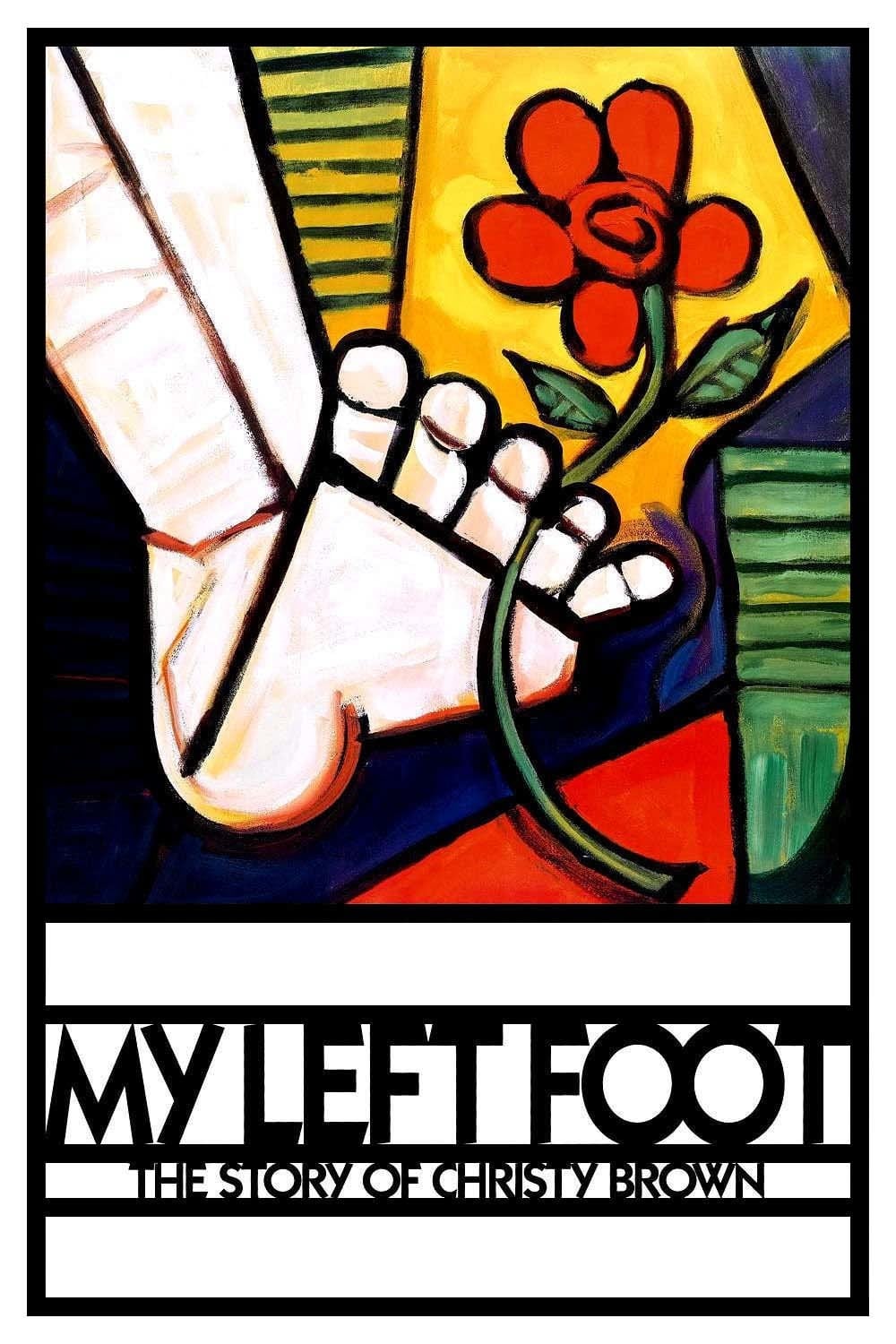
Plot Summary
My first introduction to My Left Foot came decades after its initial release, and yet I felt immediately transported to the raw, working-class streets of 1940s and 1950s Dublin. The film, directed by Jim Sheridan, strikes me as far more than a straightforward biography or family drama. It immerses me in the world and psyche of Christy Brown, a man born with cerebral palsy who discovers his voice—and his art—through the only limb he can fully control, his left foot. Watching the narrative unfold, I was drawn into the daily lives, hardships, and small victories of the Brown family, all filtered through the fiercely perceptive and rebellious eyes of Christy.
There’s a deeply human quality in the way the plot progresses: for every struggle, there’s a moment of humor or warmth, mostly conjured through Christy’s relationships—especially with his formidable mother. As someone who is typically wary of sentimental treatments of disability, I found the film’s storytelling both unsparing and dignified. The script never tips into mawkishness; rather, it celebrates Christy’s stubborn vitality.
Without delving into major spoilers, I’ll say that the journey is unpredictable. Christy’s battles—first to make himself understood, then to communicate through art and writing—are full of frustrating setbacks and subtle triumphs. His story is never one of mere victimhood. If you’re here to see a classic “overcoming the odds” tale, you’re in for something richer and less polished. There are flashes of anger, jealousy, even self-destruction—portrayed so honestly that I felt deeply invested in every challenge he faced. If you intend to avoid knowing Christy’s final fate or the ultimate culmination of his artistic journey, now is the time to skip the rest of this review.
Key Themes & Analysis
What has stayed with me most, long after watching My Left Foot, are its turbulent themes of resilience, dignity, and outsider perspective. I found myself continually impressed by how the film refuses to turn Christy into any sort of saint. He is irascible, stubborn, sometimes downright difficult. And yet, it’s precisely that refusal to simplify him that gives the story its emotional authenticity. The humanity here is messy, real, and, above all, unsentimental.
I was utterly taken by Daniel Day-Lewis’s performance. He doesn’t just play Christy Brown; he fully inhabits him, right down to every physical tic and slurred syllable. It’s an inhabitation so immersive and vulnerable that at times I forgot I was watching an able-bodied actor. Day-Lewis’s deep research and commitment to accuracy radiate off the screen. I can’t overstate how rare it is to see disability portrayed without either pity or applause—simply as the state of someone’s life.
The cinematography, composed by Jack Conroy, supports this intimacy superbly. I noticed how the camera often keeps close to Christy’s eye level, grounding me in his physically restricted world. The home, with its jostle of siblings and kerosene-lit warmth, feels lived in, never idealized. Sheridan’s direction allows for long, patient takes—scenes breathe and live, never hurrying the emotions.
Another thread I kept returning to was class. The Brown family’s poverty—ten children, a father struggling to make ends meet, a mother eternally sewing, scraping, improvising—is not just a backdrop but a living element of Christy’s growth. The film’s depiction of economic struggle is unflinching. It asks us to see how art, survival, rebellion, and family loyalty intersect under immense pressure.
Art becomes a lifeline—both for Christy and the wider Brown family. I felt the weight of every brushstroke and word, seeing how Christy’s creative drive both liberates and isolates him. Moments of humor and awkward romance, particularly with his mentors, pepper the narrative and keep it grounded in the ordinary mess of growing up.
Above all, My Left Foot is a meditation on voice and agency. I couldn’t help but reflect on how rare it was—especially in the 1980s or even today—to see a story that trusts a nonverbal, multiply-marginalized character with central narrative control. The film’s refusal to “fix” or simplify Christy echoes in every creative choice.
My Thoughts on the Historical & Social Context
I’m always struck by how a movie’s era shapes not just its production values, but the risks it dares to take. My Left Foot arrived at a transitional moment in British and Irish cinema. In the late 1980s, stories centering “ordinary” working-class lives—especially those outside of London or Hollywood—were only just beginning to claim international attention. Ireland was itself changing in the wake of economic struggles, political turmoil, and a resurgence of interest in its diaspora and internal history. Sheridan’s film, to my mind, embodies this cultural introspection.
When it was made, narratives about disability still overwhelmingly centered on “inspirational” tropes. Watching the film now, I’m instinctively wary of that territory, but what makes My Left Foot feel fresh—even radical—is how determinedly it roots Christy’s experience not in medical diagnosis but in the fabric of family, poverty, and creativity. I saw how much Christy’s sense of belonging and alienation stemmed from social structures, not just his impairment.
It also prompts challenging questions about the gaze—whose story is allowed to be told, and by whom. I was keenly aware of both the progress represented by this film and the debates it sparked about representation that continue into the present day. As someone who reads films with an eye on disability rights, I see My Left Foot as a significant—if imperfect—step toward narratives that recognize disability as lived reality and not simple metaphor.
Many viewers in 1989 might have seen Christy as a distant, almost mythical figure, but I find his portrayal resonates even more now in an era actively questioning representation, voice, and the boundaries of so-called “normalcy.” The questions raised by the film—about art, agency, and belonging—feel as sharp to me today as they must have in the late 1980s, if not more so.
Fact Check: Behind the Scenes & Real History
Diving into the film’s creative journey, I found a treasure trove of details that deepen my respect for the finished product. First, Daniel Day-Lewis famously remained in character even when not filming—demanding to be fed and wheeled around the set as Christy Brown was. Crew members reportedly found this commitment both impressive and taxing, but the result is a performance of astonishing integrity.
Another detail I discovered sits at the heart of the film’s authenticity: many of the scenes involving Christy’s family meals were shot with actual Irish working-class families to capture the feeling of lively domestic chaos. This attention to lived experience is not merely aesthetic; it infuses the film with a tactile sense of reality that I rarely see in period biopics.
The real Christy Brown’s life, as I learned through further reading, was at once more unstable and more complex than the film depicts—especially later in his adulthood. Early drafts of the screenplay were reportedly much darker, confronting issues such as institutionalization and addiction. Sheridan made deliberate choices to focus on Christy’s relationship with his mother and his emergence as an artist, rather than emphasizing his later struggles. This creative condensation provides a more uplifting trajectory but also invites renewed discussion about how biopics choose their truths.
Why You Should Watch It
- Daniel Day-Lewis’s transformative, Oscar-winning performance provides a masterclass in physical and emotional acting, unlike almost anything I’ve witnessed onscreen.
- The film tells a story of disability and family resilience free from sentimentality, making it both bracing and genuinely moving.
- Its historical and social texture—melding Irish identity, poverty, and the search for belonging—feels both rooted in its era and enduringly relevant today.
Review Conclusion
Experiencing My Left Foot has shifted my sense of what biography, and art about disability, can accomplish. Rather than offering a simple tale of triumph, it challenges me to see how dignity, frustration, love, and art can coexist within one volatile, sometimes exasperating, always fiercely alive individual. Day-Lewis’s performance is an achievement matched by hardly any other in contemporary cinema, and Sheridan’s direction never lets the film drift from its core of emotional honesty. This is a film I return to for its potent mixture of anger, humor, and grace—qualities that I find missing from lesser, more polished dramas.
For anyone seeking a movie that doesn’t just recount suffering or success but depicts the untidy, complex fullness of a singular life, this is it. After several viewings, I would confidently place it at 4.5 out of 5 stars, reserving that rare extra half-star for its willingness to challenge, unsettle, and move me in equal measure.
Related Reviews: Films You Might Also Enjoy
- A Beautiful Mind (2001): Though it centers on a mathematician’s battle with schizophrenia rather than physical disability, I see a meaningful connection in how both films probe the tension between genius, suffering, and social misunderstanding—all within a respectful, nuanced biographical framework.
- The Diving Bell and the Butterfly (2007): I’ve rarely been so moved by a film’s radical use of point of view. Like My Left Foot, it puts the audience in the sensory, emotional, and isolated world of a protagonist with severe physical limitations, using innovative cinematography and voiceover to ask what creative expression really means.
- The Sessions (2012): If you were drawn by the unvarnished portrayal of romantic and sexual longing in Sheridan’s film, I highly recommend this understated drama about a man living with polio who seeks intimacy and connection. Both films tackle taboo aspects of disability with humor, pain, and great humanity.
- Philomena (2013): Though its subject and genre are different—a Catholic woman’s search for her lost son—I find similar strengths in the film’s commitment to social realism, understated performances, and a blend of heartbreak and sly wit.
If you want to explore this film beyond basic facts, you may also be interested in how modern audiences respond to it today or whether its story was inspired by real events.
🎬 Check out today's best-selling movies on Amazon!
View Deals on Amazon