
Plot Summary
I remember the first time I encountered La Dolce Vita, I was instantly magnetized by its vibrant, restless energy and its audacious sweep across the decadent heart of Rome. Rather than following a traditional narrative, this film lured me into a series of vignettes orbiting Marcello Rubini, a charming but disillusioned gossip journalist whose journey through Italy’s high society left me questioning what it means to seek happiness in a world obsessed with spectacle. The film unspools as a collection of nights and mornings tangled in desire, parties, and fleeting conversations, all through Marcello’s weary but ever-hopeful gaze.
What struck me most in these opening moments is how director Federico Fellini uses Rome not as a static setting but as a living, breathing participant in the story. Marcello, played with haunted charisma by Marcello Mastroianni, drifts from one glamorous escapade to the next: gossiping with celebrities, trailing movie stars like Sylvia (Anita Ekberg), and searching for meaning amid the chaos. I found myself drawn into Marcello’s search—always on the cusp of fulfillment but never quite arriving. Each episode reflects his existential craving, his struggle to bridge the chasm between indulgence and authenticity.
Warning: The film’s true emotional depth emerges gradually, so while I won’t reveal its major climaxes, I believe the experience is richer the less you know going in. Suffice it to say, Marcello’s journey exposes him to the highest echelons of pleasure and the starkest moments of emptiness, drawing a jagged line between allure and alienation. The social whirl of Rome, with its mix of artists, aristocrats, faded intellectuals, and spiritual seekers, forms a surreal tapestry that left a lasting imprint on me, long after the credits rolled.
Key Themes & Analysis
What fascinates me most about La Dolce Vita is its restless interrogation of the search for meaning amid shimmering surfaces. To me, the film’s luxuriously languid pacing is not an indulgence but a deliberate mirror: it invites us to reflect on the seductions and disillusionments of modern life. Fellini’s camera captures a world where every gesture is performative, every conversation doubles as both revelation and mask. As I watched, I couldn’t help but sense the anxiety simmering beneath all the glamour.
Themes of alienation, religious longing, and the loss of innocence saturate every frame. I noticed how Marcello—caught between his creative aspirations and the seductions of success—embodies a broader, post-war European crisis of purpose. His encounters with both the sacred (a mysterious Madonna sighting, for example) and the profane (wild parties in decaying mansions) expose a longing for transcendence that feels especially resonant in an age of spiritual drift. Fellini juxtaposes sacred imagery against scenes of excess and hedonism, illustrating the tension between moral yearning and a society obsessed with appearances.
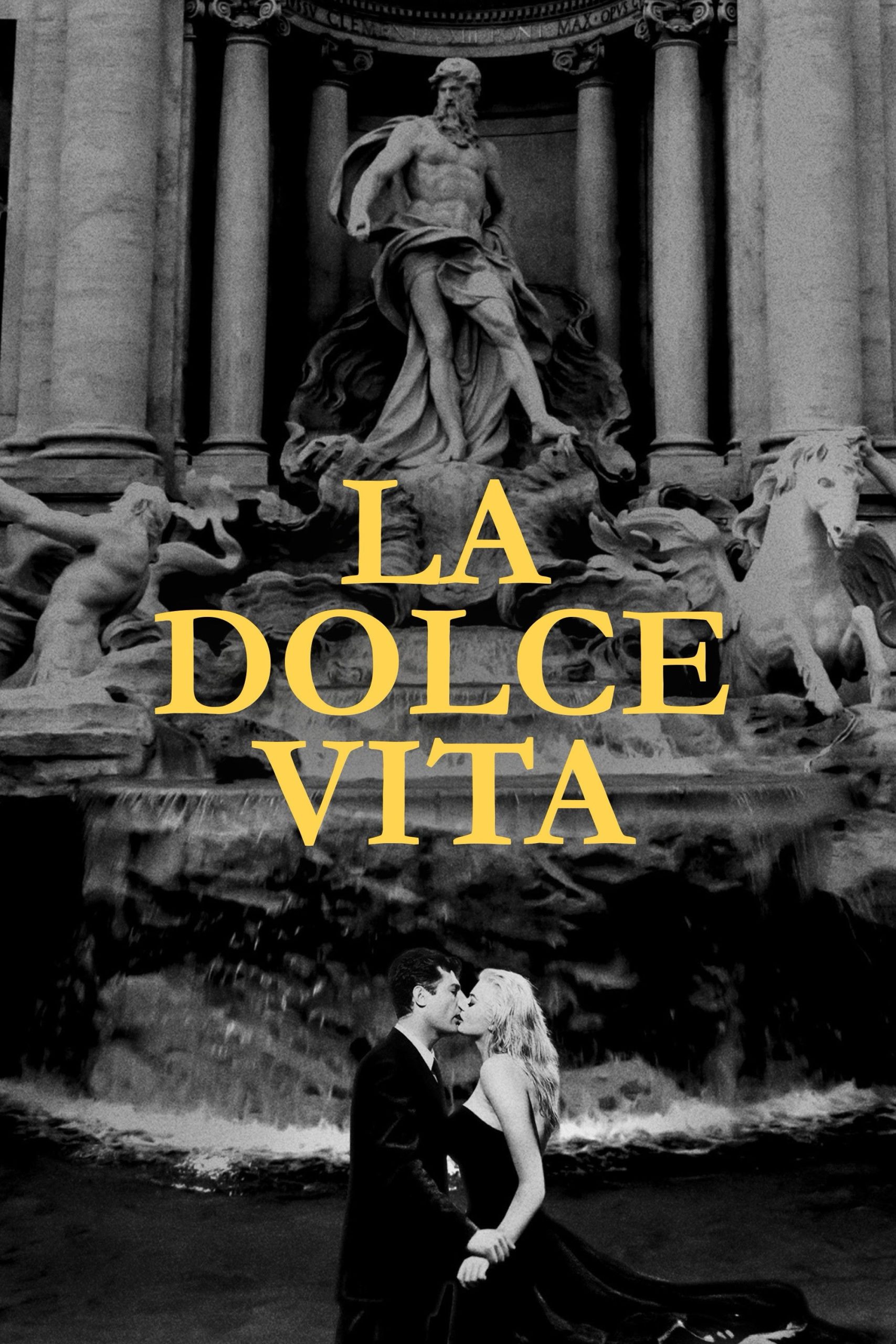
The film’s structure, fragmented yet deeply cohesive, mimics Marcello’s own fractured psyche. I recall the way certain scenes feel almost dreamlike—like the iconic sequence at the Trevi Fountain. Marcello and Sylvia’s moonlit escapade isn’t just beautiful; it’s a visual metaphor for unattainable desires and the illusory nature of pleasure. Each chapter presents a new angle on the emptiness at the heart of the modern Roman elite, from shallow flirtations and broken families to philosophical debates on ethics and creativity that ring hollow against the persistent night.
Cinematographically, the film is a masterclass in chiaroscuro lighting, languid camera movements, and haunting widescreen compositions. I found myself pausing to appreciate the way Fellini frames Marcello among ruins, neon-lit boulevards, and feverish parties—each tableau underscoring the chasm between civilization’s grandeur and human loneliness. The camera is a silent observer, sometimes judging, often complicit, always attentive to the shifting emotions and secret yearnings of its subjects.
Performance-wise, I remain in awe of Mastroianni’s ability to express both detachment and vulnerability, inviting my empathy even as he drifts through his own life. Anita Ekberg’s turn as Sylvia is magnetic, capturing both the innocence and destructive allure of celebrity. The supporting cast—especially Anouk Aimée as Maddalena and Yvonne Furneaux as Emma—brings a raw emotionality that grounds the film’s swirling surface pleasures in something mournful and real. The ensemble creates a gallery of characters lost in longing, searching for meaning above and beyond the “sweet life”.
My Thoughts on the Historical & Social Context
When I think about why La Dolce Vita became such a sensation in 1960, I see it as both a reflection and a prophecy for its era. Italy was emerging from wartime devastation, racing toward an economic boom that would redefine its cities, its class structure, and its popular imagination. The so-called “economic miracle” ushered in newfound prosperity, but also a wave of commercialism and conspicuous consumption that many found disorienting. This transformation is stitched into the film’s DNA. The parties, the celebrities, and the endless pursuit of pleasure are not just narrative choices—they are mirrors for a society recalibrating its values in the glare of modernization.
As I watched Marcello bounce from nightclub to driveway to salon, I couldn’t help but think about the existential drift that overtakes cultures in moments of rapid change. To me, Fellini’s Rome is not just a playground but a battleground for the soul—a place where old certainties, like faith, community, and tradition, are crumbling amid a tidal wave of new freedoms, new anxieties, and new temptations. The film’s sharp critique of the media and celebrity culture feels almost eerily prescient, as if foreseeing today’s digital-age obsessions with instant fame and endless spectacle.
What makes La Dolce Vita feel so enduringly relevant to me is its recognition that material abundance and social mobility, while intoxicating, leave fundamental questions of meaning unresolved. Fellini’s vision is both intoxicatingly sensual and profoundly skeptical; he seduces us with the possibility of “the sweet life,” only to show us how fragile and fleeting it really is. In an age increasingly shaped by mass media, curated personas, and spectacular diversions, I find myself returning to the film’s deeper, almost spiritual anxieties again and again. It’s a film that wonders—sometimes in awe, sometimes in despair—what we lose when we trade spiritual craving for surface satisfaction.
Fact Check: Behind the Scenes & Real History
There’s something endlessly fascinating to me about the real-life drama that circled the making of La Dolce Vita. For one, the casting process was famously tumultuous. Fellini wanted someone who could carry the contradictory layers of Marcello—both glamorous and crushed, cynical and yearning. Mastroianni, at first, seemed too reserved for such a role, but his subtlety ultimately became the film’s heartbeat. I learned that several actresses were considered for Sylvia before Anita Ekberg was cast. Her magnetic presence (and that famous Trevi Fountain scene, which was filmed on freezing January nights) became so iconic that it forever altered her career trajectory—even if Rome’s authorities initially balked at the extravagant use of such a national landmark.
Another detail I find compelling is the coining of the term “paparazzi”. The film introduces a character literally named Paparazzo, a relentless photographer shadowing celebrities and politicians through the city’s nightlife. Before the film, the word did not exist in Italian or English; after its riotous international release, “paparazzi” became a shorthand for celebrity photographers everywhere. It’s remarkable to realize how one piece of cinematic vocabulary could so perceptively capture the pitfalls of celebrity culture—and then leap from fiction into the world’s lexicon.
The film’s depictions of Rome’s high society drew heavily from real-life events and rumors circulating in postwar Italy. While Fellini famously blurred fiction and fantasy, many scandals and gossip items depicted on screen were inspired by contemporary headlines, from bold-faced parties to Vatican controversies. This melding of the authentic and the absurd gives the film its uniquely unsettling power; I constantly found myself wondering where reality ends and performance begins.
Why You Should Watch It
- It’s a masterclass in atmosphere and visual storytelling, a film whose imagery and style remain fresh, seductive, and influential over half a century later.
- The existential questions it raises—about happiness, authenticity, and belonging—are as timely today as they were in 1960, making it a work that grows richer with every viewing.
- Watching Marcello Mastroianni and the ensemble navigate fame, desire, and loss is an experience of rare emotional depth and complexity.
Review Conclusion
For me, La Dolce Vita isn’t just a film about Rome or high society or fleeting pleasure—it’s a film about us: our endless appetite for meaning and the way longing, restlessness, and self-invention shape the stories we tell ourselves. I’m captivated by Fellini’s refusal to judge or condone his characters, offering instead a compassionate but unsparing glimpse into both the beauty and the ache of being alive. Powerful performances, iconic visuals, and a willingness to ask life’s most uncomfortable questions make this a film I return to, always discovering something new. On my scale, I would give La Dolce Vita a resounding 4.5/5 stars—a near-masterpiece whose mysteries never quite exhaust themselves.
Related Reviews
- 8½ (1963, Federico Fellini): I see this as a spiritual companion to La Dolce Vita. Both films use self-reflexive storytelling and lush black-and-white imagery to dissect creative malaise and the nature of identity, with Mastroianni once again delivering a performance of existential unease.
- L’Avventura (1960, Michelangelo Antonioni): I connect Antonioni’s haunting exploration of alienation and unresolved longing in affluent society to Fellini’s own preoccupations. The film’s ambiguous tone and stunning visuals offer a similarly critical gaze on the emptiness beneath the surface of postwar prosperity.
- The Great Beauty (2013, Paolo Sorrentino): I found Sorrentino’s film to be a modern echo of La Dolce Vita. Through its dazzling parties and luxe Roman backdrop, it explores the sadness and search for meaning in a world obsessed with appearances and nostalgia—an essential watch if you want to see how Fellini’s legacy echoes today.
- Eyes Wide Shut (1999, Stanley Kubrick): While set a world away from Rome, Kubrick’s nightmarish odyssey through a morally dislocated high society shares the same blend of eroticism, alienation, and lyricism as Fellini’s masterpiece. I personally find both films speak to the yearning beneath the masks of privilege.
If you want to explore this film beyond basic facts, you may also be interested in how modern audiences respond to it today or whether its story was inspired by real events.
🎬 Check out today's best-selling movies on Amazon!
View Deals on Amazon