
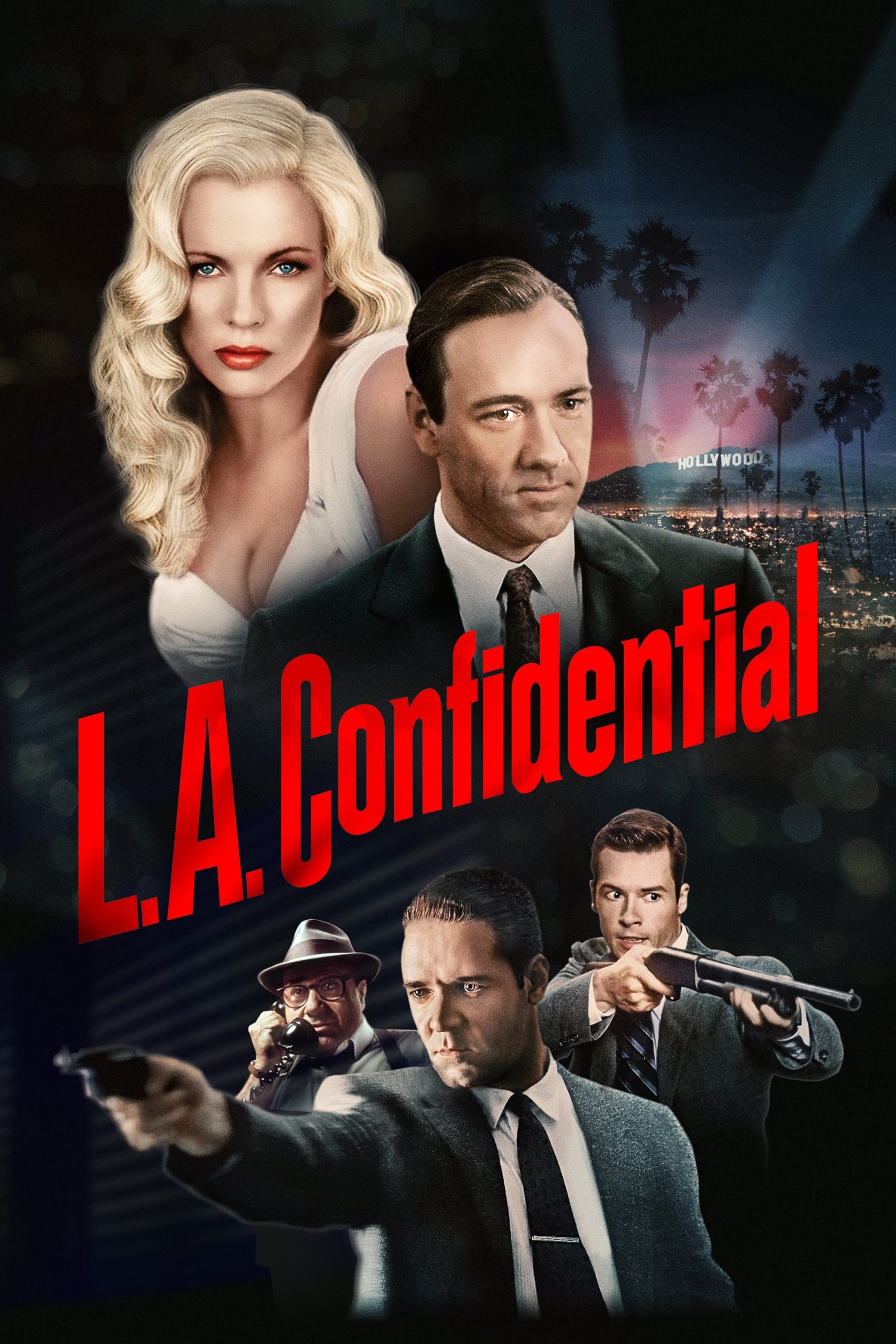
Plot Summary
I can still picture the first time I slipped into the world of mid-century Los Angeles as envisioned in L.A. Confidential. Curtis Hanson, a director I admire for his meticulous attention to character nuance, manages to immerse me in a smoky, labyrinthine atmosphere that sets the bar for the modern neo-noir crime thriller. The film traces the tangled lives of three very different LAPD officers—each caught in a web of intrigue, ambition, and deception. What makes the story thrive for me isn’t just the unraveling of corruption within the L.A.P.D., but the way it yanks at the frayed edges of morality and loyalty in a city obsessed with image and secrets.
Without plunging into heavy spoiler territory, the movie kicks off with a seemingly disconnected crime at the Nite Owl coffee shop—an eruption of violence that reverberates through every strata of Los Angeles. As I followed Bud White’s (Russell Crowe’s) raw vigilante rage, Ed Exley’s (Guy Pearce’s) cold intellectual ambition, and Jack Vincennes’ (Kevin Spacey’s) sly celebrity cop persona, I was drawn into a manhunt that touches everyone from struggling starlets to city kingpins. By the film’s midpoint, all the convoluted plot threads tightened into knots of tense alliances and devastating betrayals. That complexity always commands my attention. If you’re seeking a purely linear plot, consider this fair warning: L.A. Confidential rarely hands you anything in a neat package—its pleasures lie in teasing out the connections yourself.
For those who want a truly unfiltered experience, I’ll only say that the deeper the story delves, the more layers are peeled away, revealing the rot and glory beneath L.A.’s sun-baked surface. If you want the major reveals to hit as hard as they did for me, avoid spoilers at all costs—the final act left me breathless, reeling from the narrative audacity and emotional stakes cranked by Hanson and his cast.
Key Themes & Analysis
What struck me most about L.A. Confidential is how elegantly it grapples with the difference between image and substance—a theme that always feels relevant, but especially so in our current era. The city’s obsession with glamour is a shimmering facade for decay, bigotry, and ambition, and the film seems to delight in exposing the ways public virtue can mask private vice. Every detail, from Dante Spinotti’s golden-hued cinematography to the meticulous period-accurate costuming, amplifies that central contradiction. I remember being captivated by scenes bathed in champagne lighting, and then suddenly jarred by explosions of violence—the duality of L.A. rendered both beautiful and dangerous in every frame.
Directorially, Curtis Hanson’s touch is, to my mind, remarkably subtle. He trusts his actors enough to let silences hang, to permit glances and gestures to do as much storytelling as dialogue. The pacing is tight without ever feeling rushed—a slow build of tension that echoes the classic noirs, but finds modern resonance in its structure. The script (adapted by Hanson and Brian Helgeland from James Ellroy’s notoriously dense novel) deserves special praise. The dialogue crackles with wit and menace, reminiscent of both Chandler and Hammett, but with a late-90s self-awareness that pokes at the myth of the “heroic cop.”
Acting here feels like a miniature masterclass in restrained, character-driven performance. Russell Crowe brought a wounded brutality to Bud White that still lingers with me—his presence is as much about what he refuses to say as what he does. Guy Pearce’s Ed Exley fascinates me with his contradictions: so righteous as to be insufferable, but all too willing to bend the rules when the cause suits him. And then there’s Kevin Spacey’s portrayal of Jack Vincennes, loaded with suave charisma and world-weariness; his arc is as much about personal redemption as it is about solving the crime. I have to mention Kim Basinger as Lynn Bracken—a character who, for me, is everything the movie argues Los Angeles is: stunning, mysterious, damaged, and fiercely independent. Basinger’s performance, for which she won an Oscar, is so quietly powerful that she often communicates more in a slight change of expression than in any line of dialogue.
Beyond the performances, what I find consistently rewarding is how L.A. Confidential carves out space to examine complicity, masculinity, and the morality of justice. The film refuses to offer tidy answers or easy victories; instead, it shows that integrity—if it exists—has to be fought for constantly, often at great personal cost. That messiness, that refusal to make the right choice look simple, keeps me coming back to this movie instead of lesser imitations.
My Thoughts on the Cultural Impact & Legacy
Long after my first viewing, L.A. Confidential remains a film I measure other crime dramas against. It’s rare for any cinematic work to feel simultaneously modern and steeped in the old Hollywood mythos, but this film nails that balance for me. What’s lingered over the decades isn’t just the plot or performances, but how the film reignited discussions about the “neo-noir” genre, setting off a wave of gritty, intellectually challenging detective stories in its wake. Filmmakers from Christopher Nolan to Denis Villeneuve have cited it as a touchstone, and I see echoes of Hanson’s blend of style and cynicism everywhere from “Gone Baby Gone” to “Zodiac.”
As someone who cares deeply about how movies reflect the culture they come from, I’m continually inspired by how L.A. Confidential uses its post-WWII setting as a lens to view late-90s America’s anxieties about truth, corruption, and celebrity. Even as contemporary headlines swirl with revelations of institutional cover-ups, I find the film’s cautionary message—about the dangers of unchecked power and image-making—more topical now than ever. Personally, I credit this movie for deepening my appreciation of ambiguous antiheroes; it made me realize that sometimes the most honest stories are told in shades of gray rather than black and white.
If I were building a canon of films that shaped my understanding of what genre cinema could achieve, L.A. Confidential would unquestionably be among the foundational texts. My own standards for what a crime thriller could aspire to in mood, pacing, and thematic complexity were set improbably high by this film—few others measure up.
Fascinating Behind-the-Scenes Facts
What fascinates me about L.A. Confidential beyond its artistry is how much of its brilliance almost wasn’t. For instance, I discovered that the casting was a huge gamble: Russell Crowe and Guy Pearce, both relatively unknown Australians at the time, were chosen over bigger American stars. The studio worried that audiences wouldn’t accept unfamiliar faces in such complex roles, but Hanson’s absolute insistence proved prescient—these performances launched two iconic careers and made me a lifelong fan of both actors. It’s hard to imagine anyone else nailing Bud White’s simmering rage or Ed Exley’s cold calculation with the same balance of vulnerability and strength.
The technical hurdles were equally dramatic. One fact that sticks with me is how cinematographer Dante Spinotti recreated 1950s L.A. by combining real locations with intricate set builds and clever lighting techniques. Finding unspoiled streets was a challenge; much of the city had modernized beyond recognition. So the crew painstakingly dressed up parts of downtown and even used matte paintings and period-accurate props to evoke a lost era. Watching the seamless way the film moves between studio sets and period locations, I’m constantly in awe of the production design’s attention to detail.
Another production anecdote I love involves Kim Basinger. Her character, Lynn Bracken, is inspired by real-life Hollywood starlets, including Veronica Lake. Basinger worked closely with the hair and makeup team to perfect that vintage look, but she also insisted on finding emotional authenticity rather than simply playing a “femme fatale” cliché. That insistence gives her performance layers that still feel compelling and subversive today.
Why You Should Watch It
- If you crave smart, morally ambiguous storytelling that doesn’t insult your intelligence, this film’s narrative sophistication rewards multiple viewings.
- The ensemble cast delivers deeply layered performances, turning every character into a living paradox you can’t help but invest in.
- The visual and atmospheric richness—meticulously crafted period detail, haunting score, and razor-sharp dialogue—immerses you so completely that you’ll feel transported to a lost Los Angeles.
Review Conclusion
Every return trip I make to L.A. Confidential proves its reputation as a modern classic is no accident. Curtis Hanson’s direction, that intricately woven script, and a cast firing on all cylinders combine for a neo-noir that respects its ancestors but dares to do something new. I find its moral complexity and artistic ambition to be a rare blend—it’s as exhilarating to revisit for the umpteenth time as it was to discover it first. Very few crime films manage to be both elegiac and thrilling, both character-focused and plot-driven; this one is all of that, and more. My final take? If you care about film as an art form, this is a must-see. I give it a confident 5/5 stars.
Related Reviews
- Chinatown (1974): I’m always reminded of Roman Polanski’s iconic L.A. noir when I watch L.A. Confidential. Both films dissect the rot beneath Los Angeles’ glamour, intertwining personal ambition and systemic corruption. If you’re drawn to stories where cityscapes function as characters and the quest for truth becomes a trap, this is essential viewing.
- Zodiac (2007): David Fincher’s methodically obsessive look at detectives chasing the Zodiac killer echoes the same blend of procedural intensity and existential anxiety. Both films trade in moral ambiguity and feature protagonists whose quests for answers come at great personal cost, making them fascinating cinematic siblings.
- The Untouchables (1987): Brian De Palma’s stylized take on law enforcement in the Prohibition era is a thrilling counterpoint to L.A. Confidential’s vision of the 1950s. Corrupt institutions, iconic performances, and a palpable sense of period danger connect the two.
- Memento (2000): If what grabs you in L.A. Confidential is the fractured storytelling and unreliable narrators, Christopher Nolan’s nonlinear noir delivers a similarly heady blend of suspense and existential unraveling. Both films keep you guessing until the last reel.
For readers looking to go deeper, these perspectives may help place the film in a broader context.
🎬 Check out today's best-selling movies on Amazon!
View Deals on Amazon