
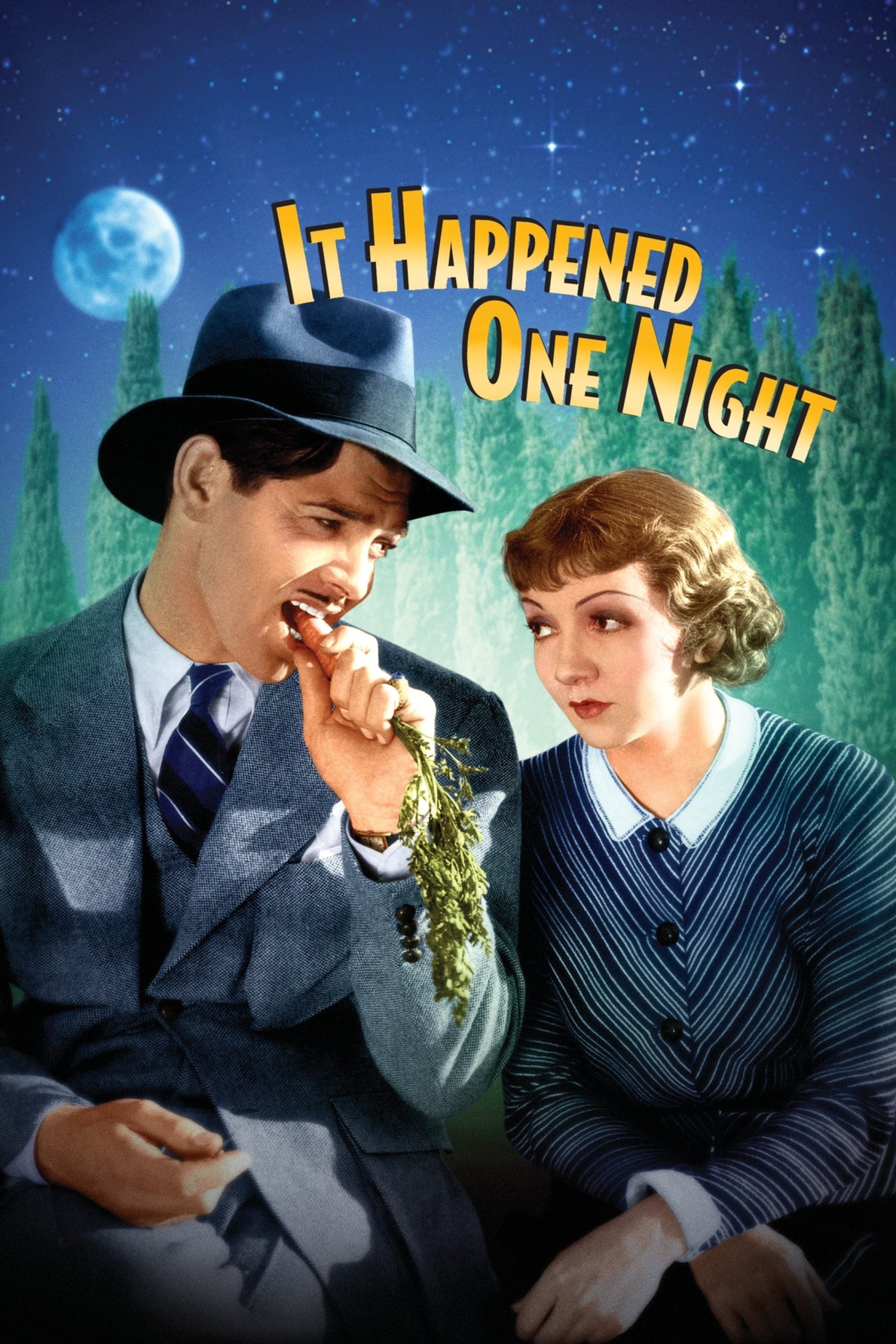
Plot Summary
When I first experienced It Happened One Night, I was transported into a whirlwind journey that felt as fresh now as it must have back in 1934. Directed by Frank Capra, a master of the romantic comedy genre, the film immediately immersed me in the story of Ellen “Ellie” Andrews, a spirited socialite rebelling against the suffocating confines of her privileged life. As she flees from her father’s control to reunite with her secret husband, the film quickly pairs her with Peter Warne, a quick-witted yet down-on-his-luck reporter. Their meeting, quite by chance on a cross-country bus ride, sets off a cross-country adventure favoring mishap and banter over melodrama.
Throughout their unexpected partnership, I watched as mutual antagonism slowly gave way to begrudging respect, trust, and, inevitably, an unforgettable romance. I don’t want to rob you of the film’s genuine surprises, so consider this a spoiler warning: while the destination is never quite in question for anyone familiar with the genre, I found the journey’s small character moments and the growing chemistry between the leads to be what truly carries the narrative forward. The story’s strength doesn’t come from what’s plotted on paper but from the delight in watching two opposites clash, challenge, and ultimately transform each other along an unpredictable American backdrop. The dialogue sparkles, the situations escalate with comedic timing, and every detour deepens both the characters and my investment in their fates.
Key Themes & Analysis
What struck me most watching It Happened One Night wasn’t just its clever construction of a romantic road movie, but the subtlety of its social commentary woven under the surface of its comedy. To my eyes, the film uses the journey motif to explore class divisions, gender expectations, and the emerging American idea of self-assertion. Ellie’s privileged upbringing contrasts with Peter’s scrappy resourcefulness, yet both find themselves vulnerable and reliant on each other’s skills. I appreciated how Capra employs this dynamic not as a mere opposites-attract cliché, but as an honest exploration of finding common ground in unlikely places.
The film’s cinematography surprised me with its inventiveness for the era. Capra and cinematographer Joseph Walker make superb use of confined spaces — the cramped bus, the roadside hotels, the open highways — not only to stage physical comedy, but to reflect how these characters are emotionally boxed in by society’s expectations. Several shots linger just long enough to let awkwardness or yearning play out, especially in the now-classic “Walls of Jericho” sequence, where a simple blanket partition becomes an emblem of both restraint and budding trust.
Delving into the directing and performances, I found Capra’s touch especially light, never forcing sentimentality but allowing moments to breathe. For me, it’s Claudette Colbert’s portrayal of Ellie that anchors the heart of the film. She embodies both willful stubbornness and underlying vulnerability, making what could have been a one-note heiress startlingly human. Clark Gable’s Peter, meanwhile, injects every scene with sardonic energy; his balance of charm and exasperation makes their back-and-forth endlessly satisfying. What drew me in wasn’t just their chemistry, but how each performance revealed layers of insecurity and self-discovery — the kind that still feels incisive and rare in romantic comedies today.
I was particularly fascinated by how Capra blends humor with sharp social observation. Ordinary Americans, fellow bus passengers, and roadside workers all play roles in shaping the central relationship and give the film a sense of authenticity and grounding. At several moments, the laughter serves to undermine social hierarchies or expose the fragility of pride, especially in the famous hitchhiking scene where Ellie’s approach upends Peter’s bravado. Watching these layers unfold, I felt the film’s enduring relevance in its willingness to disrupt — and gently mock — the very society it’s set within.
My Thoughts on the Cultural Impact & Legacy
Beyond the technicalities, I felt It Happened One Night pulsing with a creative confidence that few films, even today, so effortlessly display. As someone who has curated and critiqued classic cinema for years, this work stands out not only because it virtually created the template for the screwball romantic comedy, but because it set a gold standard for on-screen chemistry that has seldom been matched. I often find myself referencing Capra’s fluid sense of pacing and observational humor when considering what makes a “rom-com” truly lasting instead of disposable. This is not just another love story — it’s a snapshot of American hopes and insecurities during the Great Depression, disguised as laughter and banter.
What resonates with me on a personal level is how the film dares to be earnest but never sentimental, pointed in its critique but wonderfully humane. It’s no exaggeration to say that It Happened One Night’s influence can be seen in virtually every romantic comedy that followed — from “Roman Holiday” to “When Harry Met Sally” and beyond. The clever dialog, class-crossing romance, and “will they/won’t they” dynamic have since become staples, but here they feel alive, spontaneous, and full of risk. As a curator, this is the film I show to illustrate how Hollywood once balanced idealism with sharp character studies, giving me a sense of just how radical vulnerability on screen can be when wrapped in the guise of comedy.
I also consider its legacy in terms of awards and recognition. It Happened One Night was the first film to sweep the “Big Five” Academy Awards — Best Picture, Best Director, Best Actor, Best Actress, and Best Writing — a feat that remains exceedingly rare. For me, this achievement speaks not just to industry recognition, but to how strongly the film captured the moment’s collective imagination. Even now, as gender roles and class anxieties remain pertinent, I find new angles to appreciate Capra’s nuanced approach with every revisit. More than nostalgia, it offers an enduring lesson in storytelling, character complexity, and the subtle art of making audiences care without preaching or pandering.
Fascinating Behind-the-Scenes Facts
Digging into the film’s backstory always enhances my appreciation. One of the most intriguing discoveries for me was learning that Claudette Colbert was initially reluctant to accept the role of Ellie. She reportedly thought the film would flop, even telling friends it would be her “worst picture.” Astonishingly, she changed her mind after working with Capra — and went on to win the Oscar for her performance!
Another fact that sticks with me is how the now-iconic hitchhiking scene was rewritten on the spot. Clark Gable’s character originally attempted a flashy, “masculine” method to flag down cars, but the gag wasn’t working. According to production lore, Colbert herself suggested Ellie upend Peter by simply showing her leg to passing motorists — instantly both topical and subversive. This moment not only became one of the film’s most memorable but also a symbol of the film’s willingness to toy with the era’s gender norms.
I was also fascinated to learn about the film’s modest production. Shot on a shoestring budget and an extremely tight schedule, Capra and his cast worked at breakneck speed. Many scenes were filmed in sequence, lending the film an authenticity and organic chemistry that’s palpable onscreen. The sense of improvisation and immediacy, for me, is part of what gives It Happened One Night its timeless spontaneity.
Why You Should Watch It
- The sparkling dialogue and character banter set the standard for all romantic comedies that followed.
- The film’s seamless blending of comedy, social observation, and heartfelt emotion remains as sharp as ever.
- The on-screen chemistry between Claudette Colbert and Clark Gable is not just legendary — it’s electric and endlessly watchable.
Review Conclusion
Returning to It Happened One Night is like rediscovering the roots of modern romantic comedy and social satire, all in one elegant package. Each time I revisit it, I’m struck by its emotional clarity, playful boldness, and the way it trusts its audience to see beyond mere escapism. Capra’s innate understanding of both comedy and character, paired with the magnetic pairing of his leads, ensures this film still feels remarkably alive and relevant. Whether you’re a seasoned cinephile or exploring film history for the first time, this movie offers a rare blend of entertainment and depth. For me, it’s a near-perfect example of classic Hollywood at its most innovative and endearing. My rating: 5/5 stars.
Related Reviews
- The Philadelphia Story (1940) – I recommend this for its sparkling repartee, intricate romantic dynamics, and exploration of class, echoing the intelligent humor and social commentary of Capra’s film.
- Bringing Up Baby (1938) – This screwball comedy takes the opposites-attract motif and ramps up the madcap energy, making it a natural match for fans intrigued by “It Happened One Night’s” blending of chaos and charm.
- Roman Holiday (1953) – For those drawn to transformative road journeys and chemistry-laden pairs, Audrey Hepburn and Gregory Peck’s escapade offers a spiritual successor in both tone and romantic spirit.
- Sullivan’s Travels (1941) – Though thematically broader, this film shares Capra’s empathetic look at American life and uses a cross-country adventure to balance humor with deeper commentary.
For readers looking to go deeper, these perspectives may help place the film in a broader context.
🎬 Check out today's best-selling movies on Amazon!
View Deals on Amazon