
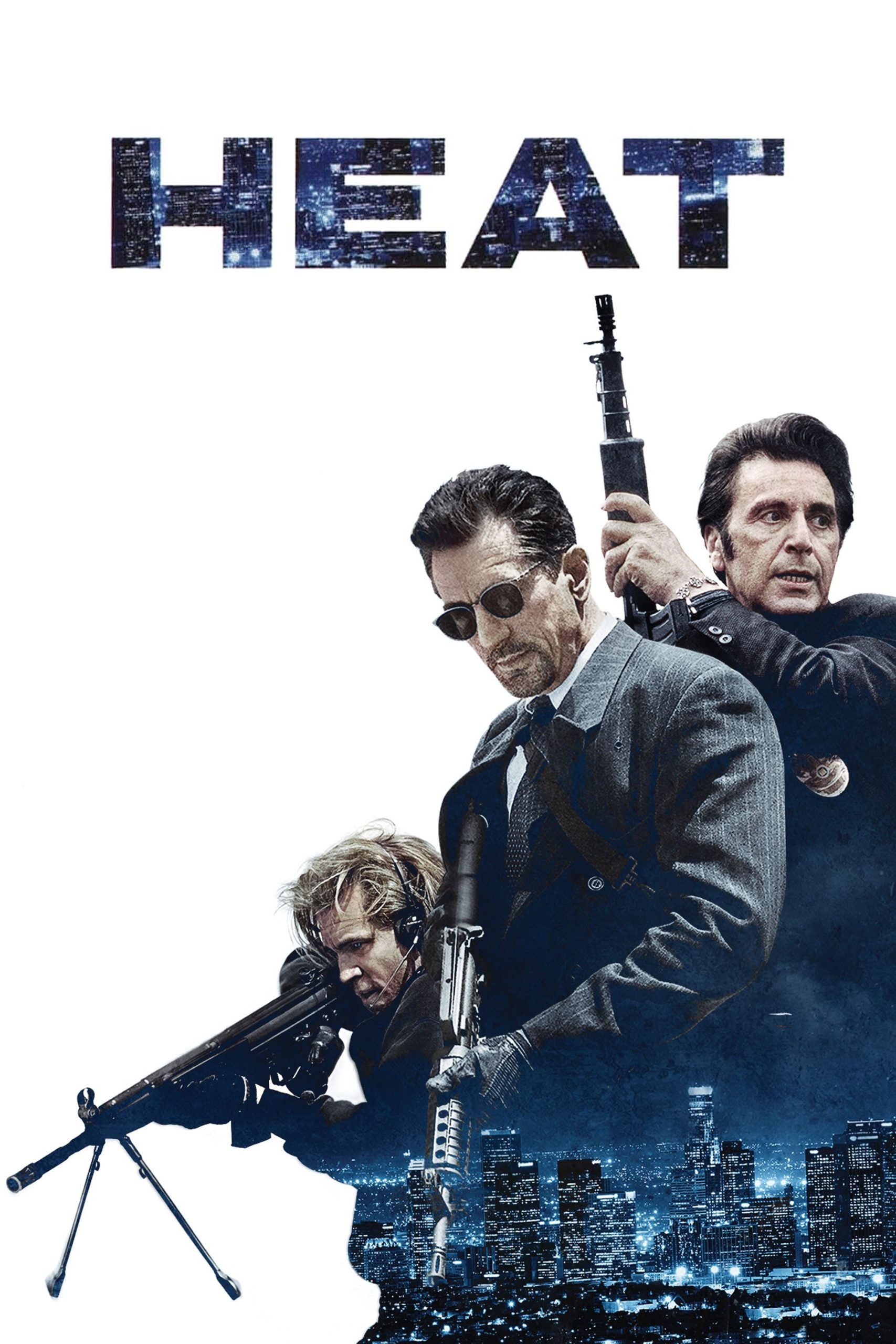
Plot Summary
From the very first moment I watched “Heat,” I felt submerged in a moody world of destiny and desperate men. Michael Mann, whose attention to detail and atmosphere I’ve admired for years, crafts a crime epic set in the urban sprawl of Los Angeles, where the boundaries between law and lawlessness blur in hauntingly real ways. Though I won’t spoil the film’s shattering final act for newcomers, I can confidently say that the film follows the intricate dance between Neil McCauley (Robert De Niro), a meticulous professional thief, and Vincent Hanna (Al Pacino), a relentless LAPD detective. Both men lead teams as tightly bonded as families and are driven by personal codes that paradoxically isolate them from ordinary life.
What I found especially gripping is how much of the film’s pulse comes from the rhythm of the city itself. Every location, whether it’s the shimmering nightscape of downtown, a diner at dawn, or the tense hush of a suburban neighborhood, is used by Mann to convey the tension and poetry of the criminal underworld. The plot unfolds with precision—heists, investigations, moments of eerie calm, and sudden violence intermingle, each escalating the stakes not just for the characters but for their souls. While much of the story tracks criminal activity and police response, it’s the moral mirror held up between De Niro’s and Pacino’s characters that drives the narrative.
Beyond the fluctuations of plot, I was drawn most to the quieter textures: late-night conversations between strangers that shed light on their interior lives, the haunted loneliness that shadows both hunter and hunted, and the sense that every choice—no matter how small—carries existential weight. If you’ve never seen “Heat,” I urge you to experience its meticulous build-up unspoiled; the way Mann slowly tightens the knot is, for me, a masterclass in long-form suspense storytelling.
Key Themes & Analysis
For me, “Heat” stands alone in the crime genre because it dwells less on the mechanics of crime, and much more on what crime reveals about character, obsession, and solitude. I see Mann using his camera not just to capture action but to probe at the edges of masculinity—what drives men to forge and destroy their own fates. The now-iconic diner scene between Pacino and De Niro is more than a face-off; it’s a moment of rare mutual recognition, a confession of burdens from two men divided only by the sides they’ve chosen. I’m always struck by how nuanced this encounter is: there’s no moral grandstanding, just two professionals articulating the costs of their chosen ways of life.
The film’s style is integral to its narrative force. Mann’s use of vast, impersonal LA landscapes—freeways lit like arteries, the silvery quiet of neighborhoods at night—magnifies the existential isolation I felt in every frame. The attention to realistic detail stands out: the bank heist sequence, choreographed with nerve-shredding clarity, was the first time I noticed how authentic sound design and practical effects could intensify the sense of danger and immersion far more than CGI ever could. He prefers chilly blues and stark whites, visual cues that echoed, in my mind, the characters’ cold detachment from the world around them.
What really separates “Heat” from other genre entries, to me, is its sympathy for its antiheroes. I found myself caring not only about whether the criminals would succeed or be caught, but also about what the pursuit was doing to both sides. Pacino rides a fine line between manic energy and exhaustion, showing a cop consumed by the chase but hollowed out at home. De Niro’s almost glacial restraint suggests a man who has walled himself off, but whose cracks are starting to show. The supporting cast adds shades to the story—Ashley Judd’s haunted partner, Val Kilmer’s tormented right-hand man, and Tom Sizemore’s tough but heartbreakingly vulnerable crew member. Mann casts every character as more than a function of plot; each one is riding similar undercurrents of fear, longing, and the urge to belong, even if only fleetingly.
Cinematographically, the film’s nocturnal palette became a signature for me—a vision of LA that is simultaneously hyper-real and dreamlike. I was jolted by how Mann captures action: handheld cameras impart panic, but wide shots present the aftermath with calm, dispassionate clarity, almost like crime scene photographs. He is willing to pause on quiet scenes, letting grief, joy, or indifference flicker across his actors’ faces. It’s this pacing—breathing between violence and reflection—that transforms “Heat” from a crime film into something closer to tragedy.
My Thoughts on the Cultural Impact & Legacy
Whenever I think about what “Heat” represents to me as a film lover and curator, it’s impossible not to acknowledge how it reshaped the template for both action films and ensemble dramas. I remember watching the first tense exchange between De Niro and Pacino and realizing I was witnessing movie history: two titans of their craft, interacting for the first time onscreen in a way that never felt like stunt casting, but rather as the organic meeting of mythic forces. It set a new standard for how deeply a crime saga could develop its characters, balancing intense action with moments of raw, bruised humanity.
The film’s influence on modern action cinema is impossible for me to miss. Directors from Christopher Nolan (who cited “Heat” as a direct inspiration for the tone of “The Dark Knight”) to Denis Villeneuve openly draw from Mann’s unusually existential approach to genre. Beyond technical prowess, it’s the existential loneliness and refusal to romanticize violence that echo loudest today—the way “Heat” lingers on the cost of ambition and obsession long after the action subsides. In my own experience, few works have so powerfully illustrated how a city can become the secret antagonist, as indifferent and sprawling as the people within it.
I also connect personally with Mann’s insistence on authentic detail—his work ethic has inspired my own efforts to examine films critically, to look for nuance beneath surface spectacle. “Heat” feels more like a lived-in novel than a Hollywood movie at times; it shaped my understanding of how great genre films can also interrogate the fragility of human desire and the inevitability of consequence. I often recommend this movie to viewers who want not just action, but a meditation on what it means to live on the margins—policeman and criminal alike. The legacy endures, for me, because the film’s questions about purpose and loss are timeless, just as compelling now as they were in 1995.
Fascinating Behind-the-Scenes Facts
Delving into the production history always deepened my appreciation for “Heat.” One fact that I find endlessly fascinating is the intense preparation required for the film’s central shootout. Mann insisted that the actors—all seasoned pros—train with real firearms under the guidance of former SAS and LAPD officers. This isn’t just trivia: I can feel the difference in the way the actors reload, move, and communicate with one another during the bank robbery scene. Their handling feels not just cinematic, but alarmingly real, and I read that the sequence’s cues have since become training material for actual law enforcement agencies.
Another personal favorite is the story behind the film’s casting. I learned that Mann originally intended the story as a TV pilot in the late ’70s, eventually repurposing it and drawing two legends—Pacino and De Niro—into their first shared dialogue scene. Mann orchestrated their scenes so that, even in the infamous diner conversation, multiple cameras captured their reactions in real time, preserving the unpredictability and tension of a first encounter. To me, that level of attention makes the moment organically electric, giving a sense that both actors were exploring each other’s rhythms as much as their characters were.
Finally, it’s hard not to love the anecdote that Los Angeles itself was scouted obsessively by Mann. For months, he and his team prowled the city at night, searching for distinctive corners and rooftops that had never been filmed before. This commitment to authenticity results in the rare crime movie that truly feels geographic, as if the city’s geography was written into the personalities and fates of its characters. These behind-the-scenes glimpses reinforce for me why “Heat” is as remarkable in reality as it is on screen.
Why You Should Watch It
- For its unmatched realism and emotional depth: I have yet to see another crime film that balances pulse-pounding action with such compassion and insight for its characters.
- For the iconic performances: Pacino and De Niro, surrounded by a pitch-perfect ensemble, create not just tension but an unforgettable study in contrasts.
- For its impact on modern filmmaking: Experiencing “Heat” is like witnessing the DNA of countless later movies, from urban thrillers to complex character dramas.
Review Conclusion
If I could recommend only one film from the ‘90s crime canon, “Heat” would be my emphatic choice. I revisit it often—not just for its masterful set pieces, but because it resonates with me as a philosophical exploration of loyalty, longing, and loss in the modern world. Every time, I walk away with a new perspective, noticing subtle shifts in the moral compass of its heroes and villains. For its rare blend of spectacle and substance, I rate “Heat” 5/5 stars. It’s a landmark, not just for fans of the genre, but for anyone who believes that cinema can capture the pain and poetry of what it means to be human.
Related Reviews
- Collateral (2004): Mann’s later film, set over the course of a single Los Angeles night, also interrogates fate, urban alienation, and the double lives people lead—elements that made “Heat” so compelling for me.
- The Insider (1999): Another Mann film, this time focusing more on institutional intrigue and internal conflict, but with the same deep-dive into characters’ moral ambiguity and a similarly immersive sense of place.
- The Town (2010): Ben Affleck’s Boston-set heist drama borrows Mann’s approach to character-driven action, showing how crime warps relationships and destinies, with an atmospheric, lived-in cityscape as backdrop.
- Sicario (2015): This Denis Villeneuve thriller stands out to me for its relentless tension and moral uncertainty, and its view of crime as a creeping existential threat mirrors the dread I felt throughout “Heat.”
- Thief (1981): Mann’s earlier work, starring James Caan, foreshadows many of the existential and stylistic themes he’d later perfect in “Heat.” Fans looking for roots and context will find “Thief” an illuminating companion piece.
For readers looking to go deeper, these perspectives may help place the film in a broader context.
🎬 Check out today's best-selling movies on Amazon!
View Deals on Amazon