
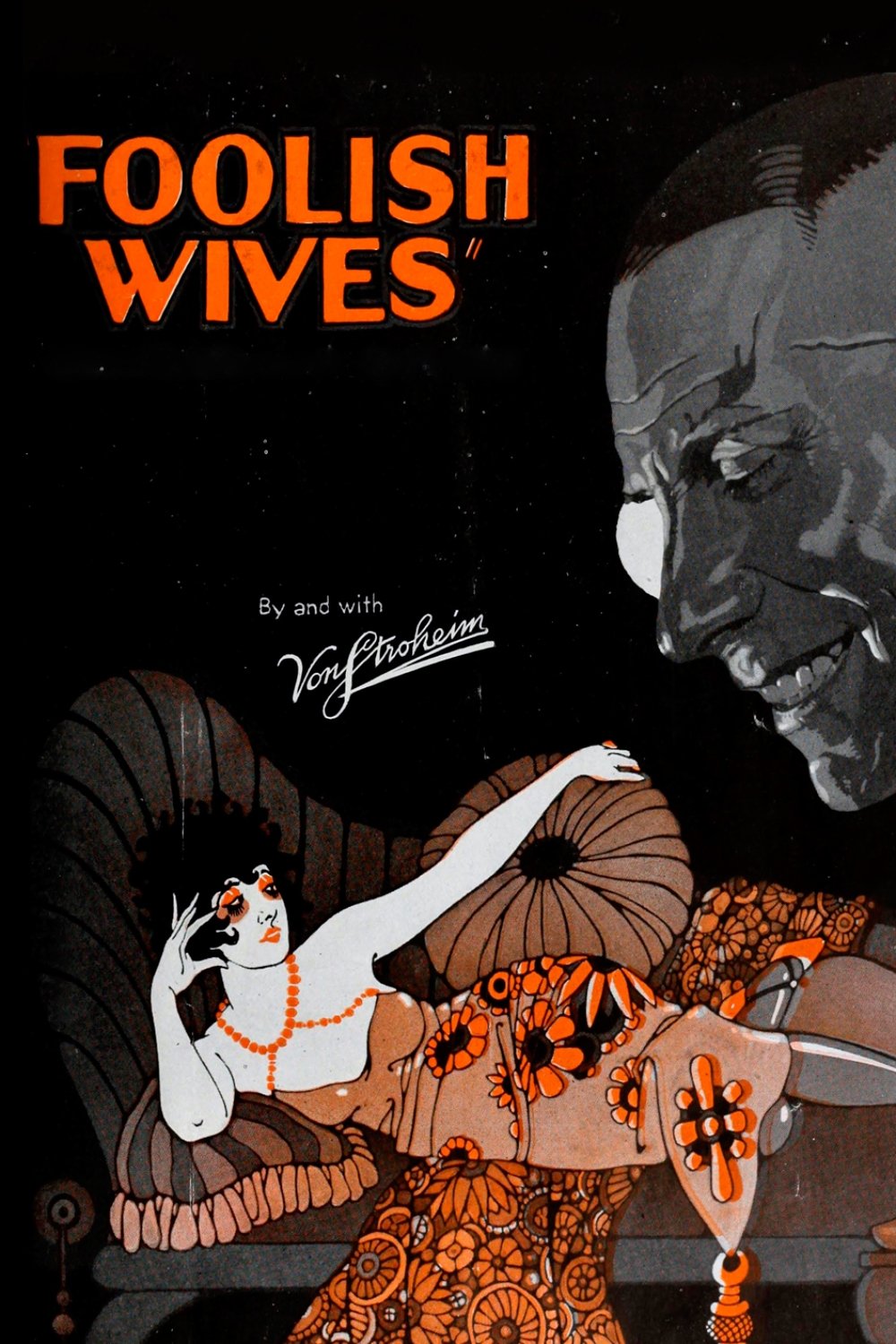
Plot Summary
To this day, I remember the sense of unease that settled over me as I first watched Foolish Wives. There’s something so captivating about Erich von Stroheim’s ability to flood the screen with luxury and danger at the same time. Presented as a psychological drama, the film follows the enigmatic figure of Count Sergius Karamzin—a man whose charm is matched only by his duplicity. Set against the decadence of Monte Carlo’s elite, I found myself drawn into a maze where privilege and predatory ambition intermingle. The Count is not the hero; he is an opportunist, preying on vulnerable women under the guise of nobility.
The central story, as I experienced it, revolves around Karamzin’s elaborate schemes targeting the wife of the newly appointed United States ambassador. While his calculated seduction unfolds, those around him come under his toxic influence, caught up in the deception and excess that suffuse every lavish casino, ball, and corridor. What struck me was how cleverly the narrative weaves its tension—not through brute violence, but through subtle gestures, lingering glances, and dangerous whispers exchanged in shadowy alcoves.
Von Stroheim’s meticulous detail makes each scene feel almost voyeuristic, as though I was peering into a world I wasn’t meant to see. The suspense doesn’t come in a sudden burst; it’s an insidious crescendo. While it’s tempting to reveal the shocking turns lurking in the third act, I’d rather let viewers discover it for themselves. (For those sensitive to spoilers, it’s best to watch without knowing the fate that awaits the Count and his victims—the film’s power lies largely in its fraught, slow-burning tension.)
Key Themes & Analysis
Every time I revisit Foolish Wives, I’m swept into its dark examination of identity and illusion. What resonates most for me is von Stroheim’s relentless focus on moral corruption among the wealthy. Rather than depicting Monte Carlo as a mere playground for the rich, the film peels back the layers, revealing the spiritual emptiness beneath the opulence. I couldn’t help but feel that every chandelier and costume was just a mask, hiding deep-rooted insecurity and depravity.
For me, the theme of deception—both of the self and others—is absolutely central. Karamzin isn’t merely conning those around him for monetary gain; he’s playing a part, seeking validation in a society that idolizes status and surface beauty. There’s a chilling universality in his actions. I found myself reflecting on how audiences, then and now, respond to such manipulative figures. Von Stroheim’s own performance blurs the line between actor and character—his piercing looks, subtle sneers, and precise body language make Karamzin one of silent cinema’s most memorable antiheroes.
The cinematography also left an indelible impression on me. Von Stroheim, known for his obsession with authenticity, demanded sets and costumes so lavish and detailed that the indulgence feels palpable on screen. The camera lingers on faces and fabrics, creating an oppressive intimacy; I could practically smell the perfume and tobacco wafting through the scenes. The lighting and composition amplify the claustrophobia, making the viewer complicit in the unfolding intrigue.
Directorially, von Stroheim innovates with his use of parallel action and slow pacing: it’s not about spectacle or speed, but about allowing the audience to squirm in their seats as truths are revealed. I was particularly taken by the film’s willingness to question its own morality. Rather than punishing Karamzin in straightforward, didactic ways, the story lingers in the uncomfortable spaces between condemnation and sympathy. The supporting cast, especially Mae Busch as the ambassador’s wife and Maude George as one of Karamzin’s alleged cousins, add texture and empathy to a story easily reduced to melodrama in lesser hands. Every eye roll, every uncertain hand movement, seemed loaded with secret meaning—something I rarely see rendered with such precision in silent cinema.
The haunting score (in modern presentations, as the film was originally silent) only adds to the immersion. I often felt that the music’s swelling crescendos mimicked the mounting inner chaos of the characters. I left each viewing with the unsettling conviction that in the world of Foolish Wives, no one is truly innocent, and every desire is tinged with risk.
My Thoughts on the Cultural Impact & Legacy
From my point of view, Foolish Wives stands as a landmark film not just for its technical brilliance, but for its raw, unflinching honesty about human vanity and vulnerability. When I reflect on early Hollywood, I see a landscape dominated by simpler morality tales or light comedies—works that reassured, rather than disturbed, their audiences. Yet here was von Stroheim in 1922, daring to craft something that almost feels modern in its anxieties. For me, that courage is what makes the film endure.
This movie forced Hollywood to confront the dark side of its own fantasies. I’m always struck by how its detailed world-building—and the discomfort it elicits—paved the way for more complex, morally ambivalent storytelling in the years that followed. Watching, I can’t forget how later filmmakers borrowed from this aesthetic—Orson Welles, Alfred Hitchcock, and Billy Wilder all seem to echo von Stroheim’s fascination with the tension between appearance and reality.
On a personal level, I cherish Foolish Wives as an act of cinematic rebellion. It reminds me that film can be both a mirror and a sledgehammer: exposing our worst impulses as well as critiquing the culture that enables them. What continues to resonate with me is the film’s refusal to offer easy answers—something that feels especially relevant in today’s age of black-and-white narratives.
Whether viewed as a proto-noir, a psychological thriller, or social satire, Foolish Wives remains a cornerstone of film history. Its legacy, for me, lies in its commitment to complexity, and in von Stroheim’s willingness to interrogate not just the characters’ choices, but the audience’s own voyeurism. That’s an influence I see in the best films that followed—ambitious works that understand the power of ambiguity and contradiction.
Fascinating Behind-the-Scenes Facts
One of the facts I’m most fascinated by is the sheer scale—and notoriety—of the film’s production. Von Stroheim insisted on constructing a full-scale replica of Monte Carlo on the Universal lot, even replicating the sewer system underneath the streets, so the actors’ footsteps would have the authentic, echoing sound he imagined. This set was so elaborate and costly that Universal used it for years after, including in other major productions.
Another production tidbit that I find especially intriguing is the movie’s original runtime was rumored to be close to seven hours—a length that astounded executives and nearly bankrupted the studio. Studio head Carl Laemmle demanded drastic cuts, which led to a complicated post-production process and significant tension between von Stroheim and Universal. The released version is considerably shorter, and fragments of the lost footage have become something of a holy grail for silent film enthusiasts like myself.
Lastly, I can’t help but marvel at how the making of Foolish Wives both established and tarnished von Stroheim’s reputation as “the man you love to hate.” His insistence on perfection led to clashes with the cast and crew, and many considered the endeavor both brilliant and borderline impossible. To me, these stories add yet another layer to the film’s mystique; much like the characters he portrayed, von Stroheim was both admired and feared in equal measure.
Why You Should Watch It
- It’s a masterclass in silent-era atmosphere and visual storytelling; I’ve rarely seen another film use space, light, and detail so evocatively.
- The morally complex characters and nuanced performances ensure you’ll be questioning motivations and sympathies long after the credits roll.
- Its influence on film history is unmistakable, so viewing it is an education in the origins of cinematic realism and noir sensibility.
Review Conclusion
Every time I watch Foolish Wives, I find myself astounded by how it manages to feel both rooted in the excesses of the 1920s and startlingly relevant. There’s a texture to every scene—a sense that beneath the glitter lies only uncertainty and dread. Von Stroheim’s direction, the haunting performances, and the film’s fearless commitment to moral complexity place it firmly among my personal pantheon of cinema. For those willing to surrender to its pacing and soak in every detail, this film is not only an unforgettable story—it’s a lesson in what film can aspire to be. I’d rate it an emphatic 4.5 out of 5 stars, with my only reservation being the missing footage that leaves some narrative threads unresolved. Yet, even in its incomplete form, Foolish Wives is essential viewing for anyone passionate about the art—and danger—of storytelling.
Related Reviews
- Sunrise: A Song of Two Humans (1927) – I recommend this masterpiece because it shares a haunting, expressionist visual style and explores the moral gray areas of human nature, much like Foolish Wives’ approach to its antihero and themes of temptation.
- The Last Command (1928) – This film, also starring Erich von Stroheim, captivates me for its portrait of lost grandeur and the tragic fall of a former aristocrat, echoing the emotional vulnerability and societal critique present in Foolish Wives.
- Morocco (1930) – I find the atmosphere of opulent social circles and fraught romantic interplay strikingly similar, and the film’s ambiguous take on desire and loyalty will speak to anyone drawn to von Stroheim’s relentless exploration of illusion and reality.
- La Règle du Jeu (The Rules of the Game, 1939) – What makes this a worthy companion is its satirical dissection of the upper class and its subtle, biting social commentary; Renoir’s work advances the kind of narrative complexity first showcased in Foolish Wives.
For readers looking to go deeper, these perspectives may help place the film in a broader context.
🎬 Check out today's best-selling movies on Amazon!
View Deals on Amazon