
Plot Summary
There’s nothing quite like settling into the world Denis Villeneuve creates in Blade Runner 2049, where every scene feels immersive and meticulously crafted, and I immediately sense the filmmaker’s guiding hand. The film, billed as science fiction and neo-noir, doesn’t so much begin as it seeps into your consciousness: I’m introduced to Officer K (played with understated brilliance by Ryan Gosling), a replicant tasked with hunting down his own kind. The Los Angeles of 2049 is bleak, windswept, and saturated in mood—technological marvels coexist with decay, and every frame pulses with a sense of longing.
As K pursues his mandate, he uncovers remnants of a mystery that threaten to overturn the delicate balance between humans and replicants—manufactured beings like himself. What I love about the story’s structure is that it doesn’t hurry. The pace feels deliberate, almost meditative, which gives me time to digest the implications of each new revelation. The deeper K delves, the clearer it becomes that his own identity—what he believes about his past, loyalties, and even his emotions—is utterly unreliable. Fans of the original Blade Runner will recognize familiar faces and themes, but here, Villeneuve and screenwriters Hampton Fancher and Michael Green expand on the philosophical framework in richly unexpected ways.
Warning: Mild Spoilers. K’s investigation eventually brings him into contact with the legendary Rick Deckard (Harrison Ford), whose reclusion and pain add startling emotional texture. At the same time, Luv (Sylvia Hoeks) emerges as a chillingly effective antagonist, her motivations as complex as the world she inhabits. While specific plot turns are best discovered organically, I can say with confidence that the narrative weaves a labyrinth of memory, desire, and existential doubt—all anchored by mesmerizing performances and haunting world-building.
Key Themes & Analysis
I don’t just view Blade Runner 2049 as a stunning visual showcase—I experience it as a probing philosophical quest. For me, the film’s main preoccupation is the nature of humanity and the tension between memory and identity. K’s story is a vessel for these questions: Am I defined by my past, or by what I choose to do? The film dares me to empathize with artificial intelligence, to step into the shoes (or synthetic skin) of characters who exist on the margins of society, built but not born. There’s a persistent ache in the way K searches for something real in a world of artifice.
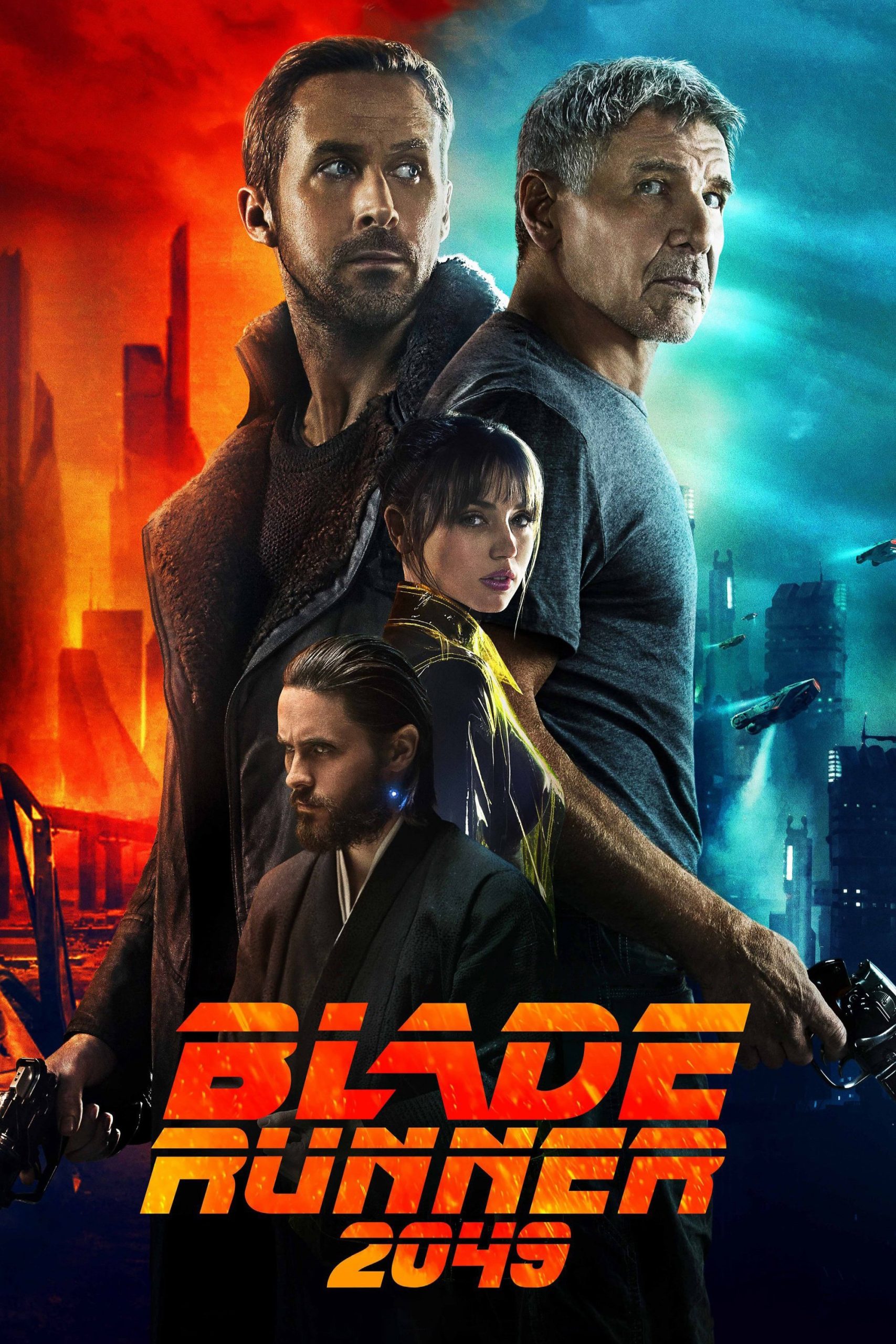
On a technical level, I find the cinematography absolutely breathtaking. Roger Deakins’s mastery is unstoppable here—the use of stark lighting, grand-scale urban vistas, and color palettes that shift from bleak blues to radioactive oranges left me awestruck. Every frame feels like a painting, loaded with subtext, inviting me to contemplate not just what I see, but what it means. There’s one scene set against a ravaged, dust-choked landscape that sticks with me long after the credits roll; it’s a visual poem about loss and ruin.
Villeneuve’s direction is another highlight. His approach is less about spectacle and more about creating atmosphere and introspection. I’ve often noticed how he uses silence just as effectively as sound; when dialogue does come, the words feel chosen for maximum impact. The ambient score (credited to Hans Zimmer and Benjamin Wallfisch) seeps under my skin; it pulses and drones, making the silences even more profound.
As for the acting, I cannot overstate Gosling’s achievement. He brings a restrained vulnerability that is all the more powerful for its absence of melodrama. His eyes communicate as much as his words. Ford’s return as Deckard feels authentic and hard-earned; there’s a weathered sadness to him that resonates on multiple levels. I also can’t look past Ana de Armas’s performance as Joi—her presence offers an unexpectedly poignant meditation on love and digital connection. Hoeks’s Luv is, for me, one of the most haunting antagonists in recent memory, her every move a study in suppressed violence and ambition.
Beyond individual moments or technical flourishes, I find Blade Runner 2049 most compelling in its ethical ambiguity. Villeneuve doesn’t offer easy answers—he trusts me to sit with discomfort and form my own judgments about power, responsibility, and the cost of survival. The film ultimately asks: What does it mean to be real—to feel, to regret, to hope? That question lingers, unresolved, in my mind.
My Thoughts on the Historical & Social Context
When I reflect on the historical moment that gave rise to Blade Runner 2049, I’m struck by how much anxiety and possibility defined the cultural landscape of the late 2010s. Social conversations about artificial intelligence, surveillance, and automation had become not just talking points but genuine sources of hope and fear. The emergence of smart homes, algorithmic decision-making, and “deepfake” technology brought old questions about the boundaries of human versus machine to the surface in urgent new ways. It was a time when headlines speculated not just on technological progress but on what we were losing as individuals and as a society.
I felt this tension deeply as I watched the film. K’s world is one where people have ceded control to corporate interests, environmental collapse has reduced cities to shadows, and meaningful human connection feels increasingly rare. I interpret this as a reflection of contemporary fears about alienation and the erosion of “realness”—whether in our relationships, our work, or the information we consume. Blade Runner 2049 doesn’t just update cyberpunk tropes; it refracts the concerns of 2017 through a visually stunning prism.
On another level, I notice how questions of identity, belonging, and social stratification ground the film in the pressing debates of the era: immigration, citizenship, discrimination, and what it means to matter in a hyper-connected world. Replicants are denied rights, reduced to function, and robbed of personhood. Watching this, I can’t help but draw parallels to how real-world societies have treated marginalized groups—excluding them from full participation, yet relying on their labor and presence. This film challenged me to rethink what empathy really means in an age where the boundaries between human and non-human, authentic and synthetic, are blurring fast.
Even now, years later, Blade Runner 2049 feels eerily prescient. Our world seems more fragmented and uncertain than ever, and the movie’s central dilemma—how to hold onto dignity and hope in the face of existential threat—resonates even more powerfully. As I see it, that’s what gives Villeneuve’s work such lasting impact: his vision feels both timely and timeless, rooted in real historical anxieties but destined to outlive them.
Fact Check: Behind the Scenes & Real History
I’ve often found that what happens behind the camera can be just as fascinating as what we see on screen. With Blade Runner 2049, several details stand out to me for their ingenuity and relevance.
First, the casting of Rick Deckard was hardly a given. While Harrison Ford famously played the character in the 1982 original, there was legitimate uncertainty about whether he would return. Interviews reveal that Ford was initially reluctant, needing assurance that the story had enough substance and purpose to merit revisiting such an iconic role. I saw echoes of that tension in Ford’s performance—he plays Deckard as a man burdened by legacy, mirroring the actor’s own sense of responsibility to the material and to fans.
Second, the production designers faced the challenge of updating a beloved but dated aesthetic. Rather than replicate the original’s look beat-for-beat, Villeneuve’s team consulted futurists and architects to reimagine what L.A. might genuinely feel like three decades later. The result? A lived-in, simultaneously alien and familiar cityscape brimming with new forms of advertising, architecture, and decay. For me, this attention to historical evolution—not just futuristic spectacle—gives the universe a rare plausibility.
One technical innovation that continually impresses me is the seamless integration of practical effects with digital augmentation. Instead of relying solely on CGI, the filmmakers built massive physical sets (such as the towering Wallace Corporation interiors) and then complemented these with visual effects. The infamous “Joi multiplication” scene involved complex layers of choreography, lighting, and technical wizardry to merge digital and practical performance into one persuasive illusion. To me, these choices convey a genuine care for cinematic craftsmanship—a desire to create spaces that actors can touch and audiences can believe in.
As for historical accuracy, it’s clear that Blade Runner 2049, like its predecessor, isn’t meant to depict any literal past or present—it’s a speculative vision through and through. Still, its depiction of urban unease, environmental collapse, and corporate dominance couldn’t feel more pointed. I often wonder how future generations will watch this film: as a warning, a prophecy, or a record of our own hopes and fears in the early 21st century.
Why You Should Watch It
- A visually stunning cinematic experience that offers some of the most memorable imagery of modern science fiction, elevating mood and setting to an art form.
- Deep philosophical questions about consciousness and humanity that linger in your mind, encouraging thoughtful introspection about what it really means to be alive.
- Exceptional performances from a stellar cast, with Gosling and Ford bringing subtlety and gravitas, and supporting roles elevating every interaction.
Review Conclusion
Blade Runner 2049 is, in my eyes, a rare achievement—a sequel that not only honors its origin but stakes its own claim as an artistic landmark. I found myself seduced by its visuals, haunted by its questions, and invigorated by its ambition. It’s not a film for everyone; the deliberate pacing and existential undertones might frustrate those seeking traditional action beats. But when I look back, what endures is a sense of wonder and a renewed curiosity about the limits (and possibilities) of sentience, hope, and memory. On my personal scale, I’d rate it 4.5 out of 5—near perfect, achingly beautiful, and utterly unforgettable.
Related Reviews
- Arrival (2016) – Directed by Denis Villeneuve, like Blade Runner 2049, this film uses speculative science fiction not for spectacle but as a deeply emotional meditation on communication, determinism, and loss. If you were moved by the introspective, philosophical dilemmas in Blade Runner 2049, Arrival’s haunting atmosphere and moral ambiguity will echo those feelings.
- Children of Men (2006) – Alfonso Cuarón’s dystopian world-building and his focus on hope amid societal collapse make this film a natural companion. The visual bleakness and humanist core resonate powerfully with the themes of identity, survival, and existential threat showcased in Blade Runner 2049.
- Her (2013) – Spike Jonze’s vision of near-future love and AI can feel like the spiritual sibling to Blade Runner 2049’s exploration of artificial intimacy and emotional loneliness. Both films left me questioning what separates human desire from algorithmic response, and what it means to feel connected in an increasingly synthetic world.
- Ex Machina (2014) – For those captivated by ethical quandaries and the aesthetics of high-concept science fiction, Ex Machina’s cerebral narrative and minimalist design provide a gripping study in power, freedom, and the boundaries of consciousness, much like the finer points tackled in Blade Runner 2049.
If you want to explore this film beyond basic facts, you may also be interested in how modern audiences respond to it today or whether its story was inspired by real events.
🎬 Check out today's best-selling movies on Amazon!
View Deals on Amazon