
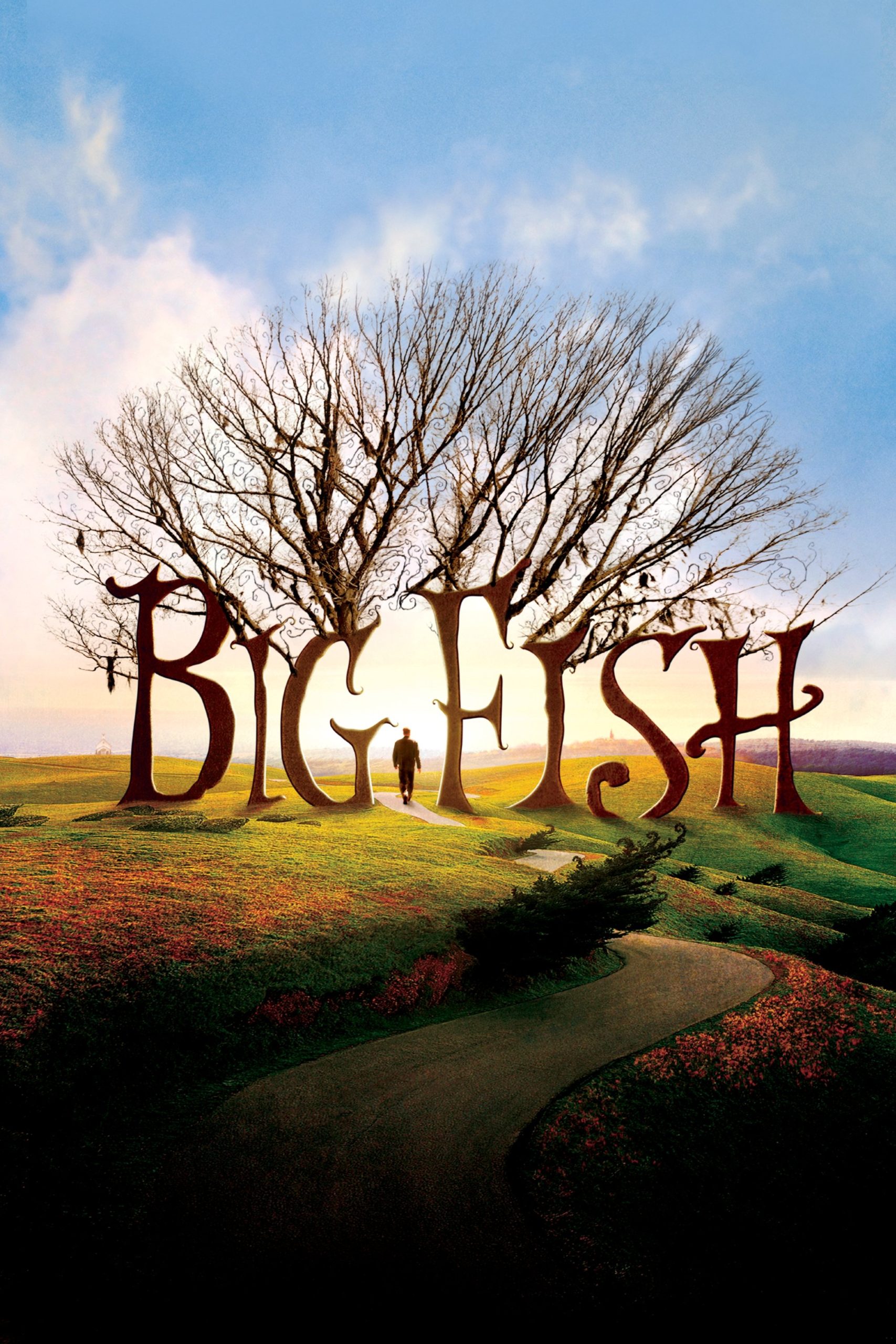
Plot Summary
I’ll never forget the strange sense of yearning I felt when I first encountered Tim Burton’s 2003 masterpiece, a film that dances somewhere between southern gothic folklore and surreal fairy tale. For me, watching “Big Fish” always meant wading knee-deep into the wild, winding river of family stories—the kind that grow taller and more tangled with every retelling. Without straying into spoiler territory, I can say that the film is framed around a strained relationship between an ailing father, Edward Bloom, and his skeptical son, Will. Edward is a master storyteller, constantly spinning fabulous yarns about his youth, while Will seeks the mundane reality behind the myths. For me, the journey is less about a linear chronology and more about the swirl of invention and memory, as Edward’s fables—replete with giants, werewolves, and witches—play out in vivid Technicolor against the plain backdrop of a hospital room.
What I find especially moving is how Burton alternates between the fantastical flashbacks and the present-day family drama, gradually stewing the question: Are these tall tales a shield, a legacy, or a last-ditch attempt at connection? Each narrative twist builds a mythic America filled with heartbreak and hope. If you intend to watch the film with a clean slate, I’d caution you to tread carefully as the story does unravel secrets in its final act, unspooling the reality that lies beneath the spectacle of Edward’s storytelling. For me, the plot is less a traditional arc and more a magical migration between fiction and truth, challenging me to ask what’s really worth holding onto: the facts, or the feeling behind them?
Key Themes & Analysis
Whenever I revisit “Big Fish,” what lingers most are its deep thematic undercurrents—the nature of storytelling, the desire for connection, and the blurry borders between myth and memory. I’m always caught off guard by how Burton’s direction invites me to see nostalgia as both a comfort and a kind of self-invention. Every frame is lush with saturated color, and every fantastical moment is meticulously crafted to reinforce the theme that life’s meaning is often found in the stories we choose to tell.
“Big Fish” isn’t just a chronicle of one man’s improbable adventures. For me, it’s an invitation to wrestle with how we all curate our own histories, choosing which moments to embellish and which to let recede. There’s a tension, breathtakingly rendered in Danny Elfman’s haunting score and Philippe Rousselot’s evocative cinematography, between what’s real and what’s wished for. Burton uses whimsical visual motifs—such as the town of Spectre, a verdant utopia seemingly plucked from dream logic—to make the viewer feel the same tug of the extraordinary that Edward feels in his narrations.
Beyond the technical prowess, the performances are what anchor these themes. I found Ewan McGregor’s younger Edward to be irrepressibly earnest, carrying a twinkle that never lets the sentimentality tip into self-parody. Albert Finney’s older Edward, meanwhile, radiates a stubborn optimism I can’t help but warm to, even as he frustrates his son (and me, as a viewer) with his refusal to be pinned down by facts. Jessica Lange’s Sandra Bloom carries the emotional ballast of the story, grounding the myth with a kind of silent, knowing love. Billy Crudup, as Will, is the skeptic’s voice—his performance resonates with anyone who’s ever craved a straight answer, even as he learns why fairy tales matter. In every rewatch, I find something new in their interplay; a shared glance, a quirk of the mouth, a moment that feels at once impossibly big and heartbreakingly small.
On a more philosophical level, the film’s structure asks me to consider how we all mythologize our lives. The act of storytelling here becomes an act of survival and transcendence. I keep coming back to the way Burton weaves together visual spectacle and emotional intimacy—his use of lighting and color to echo the fantastical elements of Edward’s tales, and his willingness to linger on quiet, painful moments in Will’s reality. It’s a film that, to me, rewards both awe and introspection, blurring the lines between spectacle and sincerity.
My Thoughts on the Cultural Impact & Legacy
Years after my first viewing, “Big Fish” remains one of those films I can’t shake from my memory. I’m drawn not just to its visual style, but to how it challenges what it means to live a meaningful life—through stories, relationships, and imagination. Culturally, the film arrived at a time when audiences were especially hungry for narrative complexity and emotional authenticity. In a decade famous for self-aware cynicism, “Big Fish” doubled down on sincerity without embarrassment, asking its audience to believe, if only for two hours, in the possibility of magic lurking within the ordinary. For me as a curator, it was a revelation—proof that fantasy and emotional rawness could coexist, that films didn’t have to sacrifice heart for wit.
Its impact on contemporary cinema is subtle but immense. I see echoes of “Big Fish” wherever filmmakers blend magical realism with family drama—in everything from indie darlings to streaming-era prestige TV. I often point out how Burton’s deeply personal vision, fusing the gothic with the folkloric, has left a lasting imprint on how stories about fathers and sons are told on screen. The way the film respects the act of invention, of translating pain into parable, continues to inspire me when I look for works that prize emotional veracity over surface-level grit.
What makes this film still resonate with me today is simple: it gives dignity to the outlandish, and finds grace in the exaggerated tales we cling to about ourselves and our loved ones. Whenever I need to remind myself why I care so much about movies—their power to comfort, to provoke, to connect—I think of “Big Fish.” It’s a testament to how art shapes memory, and how memory, in turn, becomes its own form of art. That, for me, is why the film endures as a touchstone, not just of Tim Burton’s career, but of my own ongoing love affair with cinema.
Fascinating Behind-the-Scenes Facts
Digging into the film’s production always reveals details that enrich my appreciation for what I see on screen. The first thing that fascinates me is the film’s casting journey. The role of Edward Bloom almost went to Jack Nicholson, but after lengthy negotiations failed, Albert Finney took over, infusing the character with a burly warmth and gravitas that I now can’t imagine any other actor matching. Oddly enough, Ewan McGregor, who plays the young Edward, was not Burton’s immediate first choice either. I’ve always been struck by the synergy between Finney and McGregor—they never met on set, yet somehow, their performances create a single, cohesive character across decades.
Another tidbit that stands out for me is the location work. The film’s distinct look owes much to its shooting in the Deep South, mostly in Alabama. The fictional town of Spectre was so convincingly realized that its set remained standing for years, becoming a minor pilgrimage site for fans who wanted to walk through Burton’s dreamscape in real life. I find it oddly poetic that, like Edward’s stories, the movie’s world persisted beyond the final cut, blurring boundaries between fiction and tangible reality.
And then there’s the technical magic. Rather than relying heavily on CGI, Burton insisted on a wealth of practical effects—wire work for the giant, in-camera tricks for height distortion, and hand-built sets for the fantasy sequences. This old-school craftsmanship gives the film a warmth and physical presence that stands apart from the digital excesses of the early 2000s. Whenever I watch the film, I’m reminded that magic, in cinema and in life, often emerges from ingenuity rather than artifice.
Why You Should Watch It
- It’s a deeply personal meditation on family, memory, and the power of myth—something I rarely see treated with such warmth and sincerity.
- The visual storytelling is rich with creativity, blending southern gothic beauty and magical realism in a way that showcases Tim Burton at his most hopeful.
- Every performance—especially by Albert Finney, Ewan McGregor, and Jessica Lange—delivers nuanced, emotionally charged work that anchors the film’s flightier moments.
Review Conclusion
Whenever someone asks me why “Big Fish” matters, I always find myself searching for words as vivid and intricate as the film itself. Burton’s direction brings together heart, invention, and visual splendor with an unashamed belief in stories as both defense and deliverance. The movie doesn’t just tell fantastical tales; it shows how memory, love, and imagination can make the extraordinary out of the ordinary. For anyone who has ever been moved by the magic and messiness of family stories, this film is an essential experience. On my scale, it stands tall at 4.5 out of 5 stars.
Related Reviews
- The Shape of Water – Guillermo del Toro’s film shares “Big Fish’s” devotion to magical realism and unlikely romance, all set within the confines of a visually striking world where fantasy reflects the inner realities of its characters.
- Life of Pi – Like “Big Fish,” this film explores the tension between myth and truth, following a protagonist who must reconcile his own improbable adventures with the demands of reality and family legacy.
- Pan’s Labyrinth – While darker in tone, this film directly draws on folklore and the transformative power of storytelling, offering a parallel in its blend of the grim and the wondrous.
- About Time – This romantic drama examines family ties, memory, and the beauty of everyday moments with a gentle, emotionally honest sensibility reminiscent of “Big Fish.”
For readers looking to go deeper, these perspectives may help place the film in a broader context.
🎬 Check out today's best-selling movies on Amazon!
View Deals on Amazon