
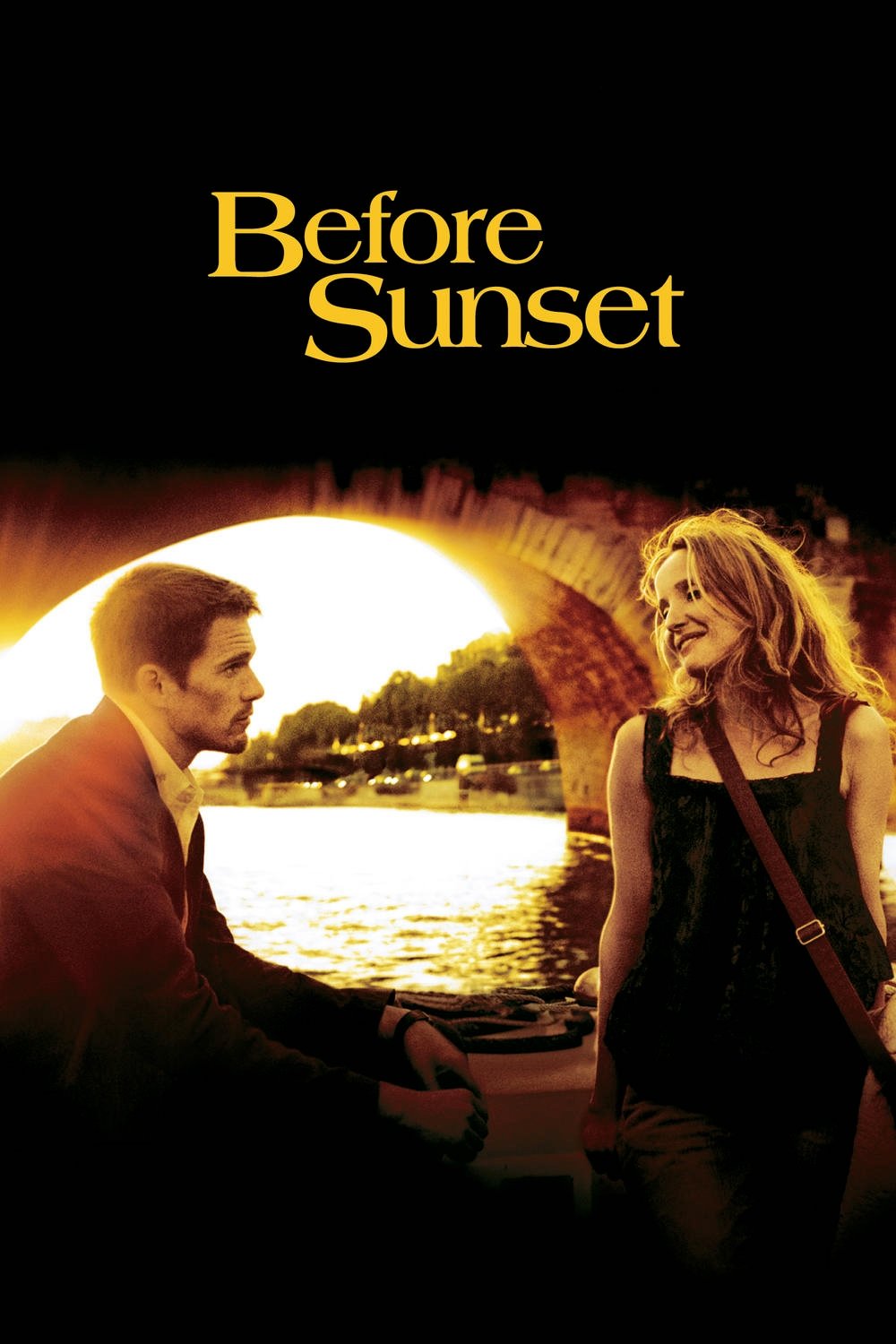
Plot Summary
I remember watching Before Sunset for the very first time and feeling like time itself had paused just for these two characters to catch up with each other—and perhaps for me, the viewer, to catch up with my own heart. Richard Linklater, who is so good at finding poetry in everyday moments, creates a kind of cinematic eavesdropping here, letting us watch Jesse and Celine meet again in the midst of Paris, nine years after their fateful encounter in Vienna.
The film’s narrative unfolds in what almost feels like real time. Jesse, now an author on a book tour, is about to leave Paris after signing his latest novel, when Celine appears from the crowd. What follows is a fluid, meandering conversation as they stroll through Parisian streets, ride a boat, and settle into a quiet café. Linklater’s camera stays close, favoring long, unbroken takes that made me feel as if I were walking alongside them. Their conversation is laid bare—filled with unspoken longing, gentle teasing, and the weight of everything that went unsaid for nearly a decade.
Without delving into any major spoilers, what resonated deepest for me was the palpable tension between nostalgia and regret—the sense that missed chances are haunting the present moment’s possibility. The entire film, really, centers not on plot but on what might happen. Will they finally be honest about what they felt? Is there still hope for a second chance? The beauty of Before Sunset is that it doesn’t feel the need to rush. Instead, it rewards patience, rewarding those willing to listen as the silences between the words gradually reveal more than the dialogue itself ever could. If you’re reading without wanting plot spoilers, rest assured: the journey matters as much as the destination—if not more.
Key Themes & Analysis
What continues to amaze me about Before Sunset is its insistence on authenticity over spectacle. The film operates as a masterclass in writing and performance, stripped of melodrama but saturated with meaning. In my view, Linklater’s direction is quietly audacious—he trusts his actors, his script, and his audience enough to let scenes linger and breaths stretch out between sentences. When I watch this film, I don’t see traditional movie storytelling; I see a filmmaker obsessed by the peculiar rhythms of real human connection, in all their awkward glory.
Thematically, I find myself most drawn to the film’s ideas about time and memory. The conversations between Jesse and Celine are haunted by what could have been, by roads not taken, by opportunities lost to indecision. Yet their dialogue is also woven with wit and hope; even as they revisit old wounds, they reveal small triumphs and adapted beliefs. For me, there’s almost an existential ache here—a struggle between cherishing the past and allowing oneself to live again, to embrace the hiccuping promises of the present.
Cinematically, Linklater’s choice to use prolonged tracking shots elevates the film beyond a typical romantic drama. The camera moves with the characters, never breaking the spell. These unbroken takes force me, as a viewer, to sit with the honesty of the moment—no quick edits for emotional escape. I’m particularly struck by how Julie Delpy and Ethan Hawke breathe life into their roles. Their performances feel unscripted, improvisational, with every hesitation, every smile, every glance imbued with shared history. As much as Linklater’s hand guides the film, it’s the tangible chemistry between these two actors that makes the dialogue crackle with intimacy.
The screenplay, co-written by Linklater, Delpy, and Hawke, is another point of fascination for me. The lines sound less like written dialogue and more like confessions whispered late at night. Their conversations spiral around topics as wide as love, disappointment, political disillusionment, and artistic aspiration. What stands out, from my perspective, is the script’s refusal to present easy answers; instead, it captures how adults try in vain to reconcile old dreams with present-day compromises. Rarely do I see romance on-screen with so much room for uncertainty. That ambiguity—where hope and doubt coexist, never fully resolved—feels profoundly authentic to real relationships.
Emotionally, I experience the film as an interrogation of what it means to have a “soulmate”. Is it passion, proximity, shared ideals, or just the romantic residue of a youthful fling? Watching Jesse and Celine grapple with these questions, I can’t help but reflect on my own life—the nooks and crannies where youthful plans and adult realities collide. The brilliance of Before Sunset, to me, is in its refusal to mythologize love, focusing instead on its messy, imperfect persistence across time.
My Thoughts on the Cultural Impact & Legacy
The ripple effect that Before Sunset has had within world cinema is hard for me to overstate. The film’s quiet insistence on conversation as action felt almost revolutionary in an era more dominated by spectacle than substance. Its presence continues to linger for me—not just as a “sequel,” but as a work that redefined what romantic cinema could achieve. It’s rare for an American romance to embrace so much ambiguity and complexity, and I believe this paved the way for more adult, thoughtful love stories that followed.
From a cultural perspective, I see Before Sunset as the antithesis of formulaic, consumer-tested romance movies. Instead, it spoke directly to a generation (and still does) that craves meaningful connection and bravely acknowledges that sometimes love isn’t enough—or at least, not easy. The way Linklater, Delpy, and Hawke revisit these characters at different points in life asserts that stories, and the people within them, evolve with us.
On a personal level, the film matters to me because it daringly trusts the intelligence and emotional maturity of its audience. I’m continually moved by how it prompts viewers to scrutinize their own memories, missed connections, and maybe forgone loves. The vulnerability and honesty of its approach made me rethink the potential of dialogue-driven cinema. For me, Before Sunset became a touchstone—a reminder that films can be as ephemeral and unfinished as the moments they portray. I’ve found myself returning to this film and sharing it whenever I want to articulate something more nuanced, more truthful, than most romances are bold enough to admit.
In shaping its genre, Before Sunset inspired a conversation about time, memory, and what it means to be truly seen by another person. I don’t often encounter stories that allow their characters and audience to age together, confronting the inevitability of change without ever losing hope. That is why, for me, its legacy is lasting and deeply personal.
Fascinating Behind-the-Scenes Facts
I’ve always been captivated by the way this film was made—so much so that learning about the production only deepened my appreciation. For one thing, I discovered that the film’s script was collaborative: Linklater, Delpy, and Hawke co-wrote the screenplay, drawing upon their own lives to create dialogue that feels utterly lived-in. That sense of “realness” isn’t accidental; it’s the result of countless hours spent refining, improvising, and shaping the words into confessions that ring painfully true.
Another aspect that fascinated me is the film’s technical ambition. The long tracking shots—particularly the famous walk through Paris—weren’t just artistic choices, but logistical challenges. I read how the crew had to block entire city streets, time their setups perfectly to natural light, and choreograph background interaction so it appeared seamless. These sequences required immense discipline from the actors, who needed to maintain the momentum of an uninterrupted conversation—sometimes for up to ten minutes at a stretch, with very little margin for error. That risk was palpable, and it’s a big part of why the film feels so urgent and alive.
One detail that still delights me: the scene set in Shakespeare and Company, the iconic Parisian bookstore, was filmed in the real location. I learned that the store’s history as a gathering place for expatriate writers sharply echoes the film’s literary undertones. That decision to ground the story in authentic surroundings makes every moment feel more textured, more layered. These facts aren’t just trivia to me—they’re reminders that great films are often built on intimate, intentional choices that ripple through every frame.
Why You Should Watch It
- The film offers an uncommonly honest portrayal of romantic connection, driven by raw, unscripted performances from Julie Delpy and Ethan Hawke.
- Richard Linklater’s direction creates an immersive, real-time experience that blurs the boundary between viewer and participant, making the emotions on-screen feel immediate and unguarded.
- Its focus on conversation, memory, and the complexities of adult desire make it a singular entry in both the romance and indie film genres—perfect for anyone who craves stories with depth and emotional ambiguity.
Review Conclusion
I seldom encounter a film as disarmingly intimate as Before Sunset. Every decision, from the writing to the cinematography to the carefully curated Parisian backdrops, draws me deeper into the bittersweet dance of hope and longing that is Jesse and Celine’s story. What stays with me isn’t simply whether they find resolution, but how openly the film invites me to witness two souls wrestling with the impossible mathematics of timing and desire. If you cherish movies that prioritize truthful emotional exploration over easy answers, this is a film I cannot recommend more highly. My rating: 5/5 stars.
Related Reviews
- Lost in Translation (2003) — I recommend this film because, like Before Sunset, it captures fleeting yet profound human connections against a beautifully cinematic backdrop. Both films use dialogue, silence, and setting to examine loneliness and longing, making them kindred spirits in the realm of adult, introspective romance.
- In the Mood for Love (2000) — Wong Kar-wai’s masterpiece shares Before Sunset’s subtlety, focusing on restrained desire and the intimate details that define relationships. Lovers of Linklater’s contemplative approach will find similar value in Kar-wai’s evocative visual language and emotional resonance.
- Past Lives (2023) — For those compelled by the idea of fate, memory, and romantic what-ifs, Past Lives offers a contemporary look at how missed chances linger across decades. Its realistic performances and bittersweet story make it thematically aligned with Linklater’s film.
- Once (2007) — This understated Irish love story uses music and naturalistic style to explore connection and longing between two artists. Viewers who cherished Before Sunset’s focus on collaboration and artistic yearning will find this film equally heartfelt.
For readers looking to go deeper, these perspectives may help place the film in a broader context.
🎬 Check out today's best-selling movies on Amazon!
View Deals on Amazon