
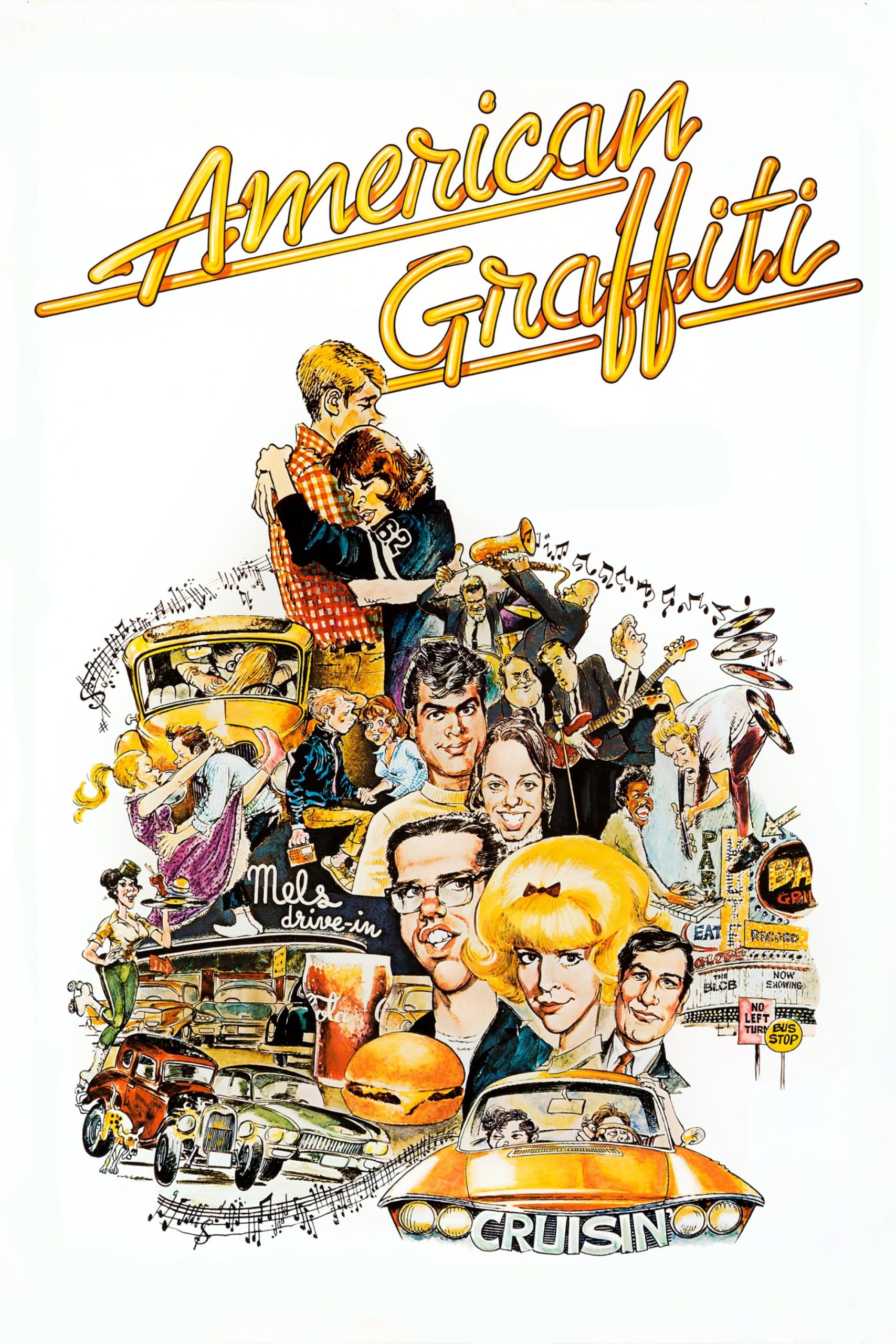
The enduring power of nostalgia finds one of its earliest and most vivid cinematic expressions in “American Graffiti,” George Lucas’s coming-of-age comedy-drama that has become a benchmark in both 1970s American filmmaking and youth-centric storytelling. Premiering in 1973, this unique blend of humor, pathos, and rock ’n’ roll reverie put Lucas on the map long before his “Star Wars” saga, yet it stands entirely apart—a film deeply rooted in a specific time and place while capturing universal experiences of youth, change, and yearning. As one of the most influential films of the 1970s, “American Graffiti” also helped to crystallize the “nostalgia film” as a genre, echoing in countless works that followed. Its relatable characters, evocative atmosphere, and era-defining soundtrack create an irresistible invitation to viewers longing for a window into early 1960s America.
Plot Summary
“American Graffiti” unfolds over the course of a single night in 1962, capturing the world of small-town teenagers on the brink of adulthood. The story is set in Modesto, California, where recent high school graduates face a crossroads in their lives. The core ensemble consists of four young men—Curt (Richard Dreyfuss), Steve (Ron Howard), John (Paul Le Mat), and Terry (Charles Martin Smith)—each confronting personal dilemmas about their futures. Their stories intertwine against the backdrop of glimmering neon-lit diners, cruising down the main drag, and the omnipresence of hit tunes pouring from car radios.
Curt is torn between leaving home for college and staying in his familiar surroundings, plagued by doubts about the life that lies ahead. Steve, more resolved about his plans, struggles with leaving his girlfriend Laurie (Cindy Williams), who is equally unsettled by their impending separation. John, the local drag-racing legend, finds his identity challenged over one tumultuous evening when a young girl named Carol (Mackenzie Phillips) unexpectedly becomes his companion. Meanwhile, Terry, nicknamed “The Toad,” embarks on his own hilarious misadventures after being entrusted with Steve’s prized car, intent on impressing a new acquaintance, Debbie (Candy Clark).
The film artfully captures the feelings of anticipation, anxiety, and rebellion that often accompany the transition from adolescence to adulthood. Each character must make crucial decisions as the warm glow of youth fades into the uncertainty of morning, reflecting on what they are leaving behind and imagining what their future might hold.
Warning: Minor spoilers below! As dawn breaks, choices are made, hearts are tested, and identities are forged, with a bittersweet postscript reminding viewers that life takes many unexpected turns—both joyous and tragic. The ending lingers long after the credits roll, cementing “American Graffiti” as more than just a light-hearted romp; it’s a poignant reflection on time’s relentless passage and the memories we carry forward.
Key Themes & Analysis
On the surface, “American Graffiti” is a lively immersion in teenage antics and late-night cruising, but beneath the vivid colors and playful energy lie several deeper themes that resonate just as powerfully today. At its core, the film examines the bittersweet transition from youth to adulthood, exploring the tension between nostalgia for the past and apprehension about the future. Each character’s journey reflects a different aspect of this universal rite of passage—be it longing for freedom, the urge to belong, or the pain of letting go.
Nostalgia is not merely a backdrop but essentially the film’s protagonist. George Lucas draws on his own hometown memories to recreate the vibrant yet innocent world of early 1960s America—a world just on the cusp of revolutionary social, cultural, and political changes. The ever-present soundtrack is as crucial as any character, with wall-to-wall hits from Chuck Berry, Buddy Holly, and The Beach Boys, punctuating every scene and grounding the film in its era. These songs serve as both a celebration of youth and a prelude to a future that will, inevitably, be very different.
Lucas’s direction is especially notable for its structure: the narrative weaves together several plotlines over a single night, building an almost episodic tapestry of experiences. The nocturnal setting, awash in neon hues and the throbbing pulse of car engines, gives the film an atmospheric glow, the cinematography by Jan D’Alquen and Ron Eveslage appropriately dreamy, shot primarily on location. The use of long tracking shots, fluid camera movements, and tight, intimate framing lends authenticity to the intimate conversations and larger-than-life adventures alike.
Acting is one of the film’s secret weapons. Richard Dreyfuss brings an earnest vulnerability to Curt, whose searching gaze forms the philosophical center of the movie. Ron Howard, then best known for “The Andy Griffith Show,” balances Steve’s bravado with an undercurrent of doubt. Paul Le Mat’s John Milner personifies cool, wielding a tough exterior that slowly crumbles as the night wears on, while Charles Martin Smith delivers comedic timing and emotional honesty as the awkward but endearing Toad. Standout supporting performances from Cindy Williams, Harrison Ford (in an early role as the slick Bob Falfa), and Candy Clark further enrich the film’s ensemble-driven approach.
Unlike many coming-of-age films that follow a linear structure, “American Graffiti” offers a more diffuse, collage-like experience. Its narrative style mirrors the restless, searching energy of adolescence itself. The film lingers over stolen glances, parking lot confessions, and the simple act of driving nowhere in particular because, for one fleeting moment, there is nowhere else to be. This approach makes the film’s world feel immediate and authentic, inviting viewers not just to watch but almost to live within its summer night reverie.
Why You Should Watch It
- Witness a Masterclass in Ensemble Storytelling: “American Graffiti” achieves a seamless blend of characters and stories, offering multiple perspectives on the universal themes of growing up and moving on.
- Iconic Soundtrack and Vivid Atmosphere: With its era-defining music and authentic period detail, the film immerses audiences in the mood and spirit of early ’60s America.
- Historical and Cultural Impact: Understanding why “American Graffiti” sparked the nostalgia film movement and influenced countless filmmakers provides invaluable insight for cinema lovers of all ages.
Review Conclusion
“American Graffiti” stands as an essential entry in American cinema, a loving tribute to youth, memory, and the passage of time that transcends its period setting. George Lucas’s evocative direction, combined with memorable performances, sharply observed writing, and a soundtrack that refuses to fade into the background, creates a film teeming with energy, soul, and wit. Whether experienced as a nostalgic journey or a fresh discovery, the film’s honesty and craftsmanship are undeniable. For anyone interested in the evolution of the coming-of-age genre or simply appreciative of expertly layered storytelling, “American Graffiti” is richly rewarding—a heartfelt time capsule worth revisiting again and again. Rating: 4.5/5 stars.
🎬 Check out today's best-selling movies on Amazon!
View Deals on Amazon