
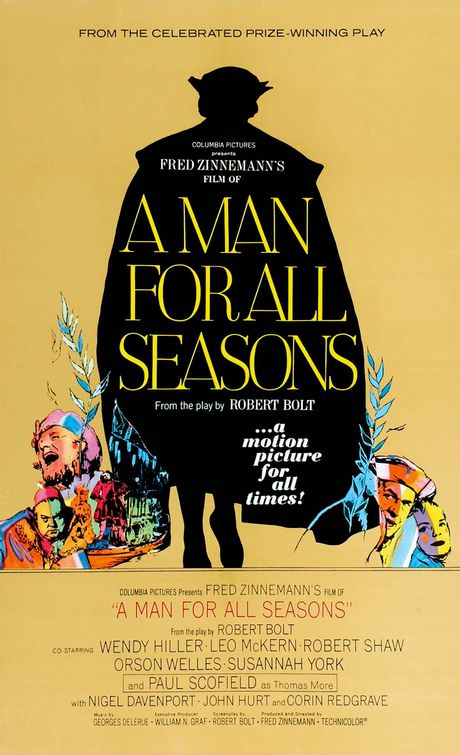
The world of historical drama is filled with grand tales of ambition, conscience, and the relentless pursuit of principle. Among these, few films capture the gravity of moral conviction quite like the 1966 film “A Man for All Seasons,” directed by Fred Zinnemann. Zinnemann, renowned for his mastery in character-driven storytelling, crafts a gripping court drama rooted in English history that balances philosophical rigor with cinematic elegance. Blending the tenets of legal thriller and period biopic, this adaptation of Robert Bolt’s acclaimed stage play stands as a testament to moral courage and the burdens of personal integrity amidst the powers of monarchy and state.
Plot Summary
Set in the turbulent early 16th-century England during the reign of King Henry VIII, “A Man for All Seasons” follows the story of Sir Thomas More, the Lord Chancellor of England, as he navigates the treacherous political waters occasioned by the King’s desire to annul his marriage to Catherine of Aragon. Henry’s quest for a male heir and papal sanction puts him at odds with tradition and Church doctrine, setting the stage for English society’s seismic religious and political shift. At the center of this maelstrom is Thomas More, a man of legal brilliance, profound wit, and unshakeable morals.
More is portrayed as a deeply religious and principled man, loyal both to the law and to his faith. When the King fails to receive the Church’s blessing for an annulment, he breaks from Rome and establishes himself as Supreme Head of the Church of England, pressuring all public figures to affirm their loyalty to this new order. More’s steadfast refusal to sign the Oath of Supremacy—despite the pressure from friends, family, and the political elite—becomes the film’s central conflict. The chess match that ensues, full of courtroom debates, clandestine conversations, and philosophical quandaries, pits the sanctity of conscience against the coercive power of the state.
Without delving into specific spoilers, it suffices to say that “A Man for All Seasons” traces the personal and public consequences of More’s stance: the growing isolation, familial strain, and mounting schemes by those eager to see him bend—or break. Zinnemann’s film, while inevitably colored by its theatrical origins, delivers immersive set pieces that bring this ideological contest to life, investing the proceedings with both urgency and gravitas.
Key Themes & Analysis
At its core, “A Man for All Seasons” explores the enduring conflict between individual conscience and institutional authority. The ethical struggle faced by Sir Thomas More is not only a matter of personal faith, but a meditation on the responsibilities and perils of holding to one’s beliefs under duress. The film raises powerful questions: To whom do we owe our allegiance when law, power, and faith collide? Is silence itself an act of defiance?
Director Fred Zinnemann crafts a world both austere and richly detailed, imbuing the narrative with a solemnity befitting its historical setting. The cinematography, helmed by Ted Moore, elegantly captures the somber beauty of the English countryside and the shadowy grandeur of court interiors. The use of natural lighting and muted color palettes, alongside meticulously crafted costumes and sets, grounds the story in an authentic atmosphere of Tudor England.
Casting is impeccable. Paul Scofield’s performance as Sir Thomas More is justly revered—his layered portrayal radiates intelligence, warmth, and quiet tenacity. Every line delivered by Scofield is charged with gravitas, yet also tinged with humor and humanity. The supporting cast—featuring Wendy Hiller as Alice More, Robert Shaw as the mercurial Henry VIII, and Orson Welles in an imposing turn as Cardinal Wolsey—add dimension and texture to the political intrigue. Leo McKern, John Hurt, and Nigel Davenport further enliven the world, with each embodying the competing self-interests of the realm.
The screenplay, adapted by Robert Bolt from his own play, balances eloquent dialogue with philosophical weight. Rather than falling into static oratory, the film’s exchanges are tense and charged, reflecting both the personal and existential stakes. Bolt’s script interrogates the nuances of silence, complicity, and the cost of dissent in an era where the word of the King is law.
The deliberate pacing of the narrative—eschewing melodrama for contemplation—allows the ethical quandaries to breathe, while Zinnemann’s direction ensures the film never loses momentum. Every gesture and glance is designed to deepen the viewer’s understanding of the ideological battlefield on which More stands.
Why You Should Watch It
- A fascinating, thought-provoking examination of moral integrity against political pressure, relevant to both history aficionados and modern audiences.
- Exceptional performances led by Paul Scofield, whose Oscar-winning turn as Thomas More is a masterclass in understated power and emotional depth.
- Stunning authenticity in set design, costumes, and cinematography, immersing viewers in the grandeur and dangers of Tudor-era England.
Review Conclusion
“A Man for All Seasons” endures not only as a high watermark of historical drama but also as a searing portrait of conviction in the face of overwhelming power. Fred Zinnemann’s direction, buoyed by sublime performances and a razor-sharp script, crafts a film that invites reflection and admiration in equal measure. For audiences seeking a work that is intellectually rigorous and emotionally resonant, this classic remains as stirring now as when it premiered. Combining cinematic craftsmanship with timeless themes, it is a must-see for anyone interested in the intricacies of conscience, law, and the indefatigable spirit of humanity.
Rating: 5/5 stars
🎬 Check out today's best-selling movies on Amazon!
View Deals on Amazon