
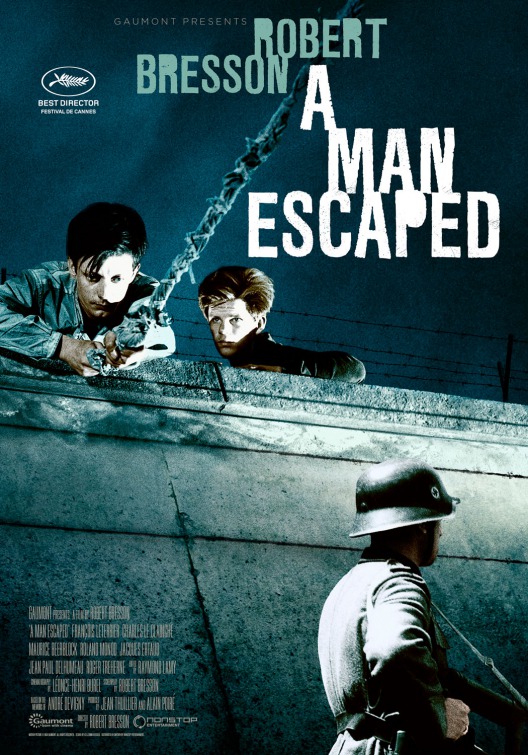
Few cinematic experiences encapsulate nail-biting suspense and minimalist storytelling as masterfully as Robert Bresson’s A Man Escaped. Released in 1956, this classic French film stands as a compelling entry in the war drama and prison break genres. With Bresson’s signature use of non-professional actors and a rigorous focus on realism, the film transcends its simple premise, transforming a true story of wartime escape into an existential journey. For viewers interested in the mechanics of hope and perseverance, A Man Escaped offers one of the purest examples in world cinema.
Plot Summary
The film centers on Fontaine, a member of the French Resistance who is captured by German forces during the Nazi occupation of France. Imprisoned within the cold, forbidding walls of Lyon’s Montluc prison, Fontaine’s world is reduced to a tiny cell, guarded corridors, and fleeting contact with other inmates. From the outset, his determination to escape occupies every waking moment, manifesting as quiet observation and meticulous planning rather than dramatic outbursts.
Unlike many escape films driven by conventional action, A Man Escaped is almost meditative in its pacing. The narrative follows Fontaine’s routines—scraping at door panels, crafting tools from whatever he can find, and communicating in coded taps with distant neighbors. The camera lingers on minute actions: a pinched wire, the movement of borrowed spoon, the careful study of hinges and locks. As the story progresses, Fontaine is joined by a younger cellmate, Jost, whose loyalties are uncertain, injecting a fresh dimension of tension into Fontaine’s plans.
Spoiler Warning: The plot’s slow build leads to an edge-of-your-seat sequence as Fontaine’s preparations culminate in a daring attempt at freedom. For those wishing to experience the film without knowing the outcome, it is enough to say that the final act is both nerve-racking and deeply moving, rewarding viewers who have followed Fontaine’s psychological and physical journey from the first frame.
Key Themes & Analysis
A Man Escaped operates on multiple thematic levels. Superficially, it is an escape thriller, but beneath the surface, it delves into questions of faith, fate, and individual resistance. Bresson’s Catholic background informs the film, imbuing Fontaine’s journey with spiritual overtones—the idea of salvation, the soul’s struggle against confinement, and the transformative power of hope and discipline under oppressive forces.
The film’s realism is enhanced by Bresson’s decision to cast largely non-professional actors. François Leterrier, as Fontaine, delivers a performance defined by restraint, communicating anxiety and determination through the smallest gestures and sustained silences. The lack of melodrama strips the narrative to its essentials: man’s will to be free against seemingly insurmountable odds.
Bresson’s cinematography is meticulous and unadorned. He avoids visual flourishes, instead favoring tight close-ups, careful framing, and an obsessive focus on hands and tools. The austere setting—bare stone, wooden beds, creaking doors—becomes a character in itself. Each sound, from distant gunshots to the squeak of a door hinge, is heightened by the film’s sparse score and long stretches of ambient silence. Bresson’s style is intentionally anti-theatrical, aiming for a sense of authenticity rarely seen in Hollywood productions of the era.
Narratively, the tension arises not from uncertainty about the outcome but from the painstaking details of the process. Fontaine’s voiceover narration, adapted from the memoirs of André Devigny (upon whom the story is based), guides the audience through his logic and emotions. This narration creates an unusual bond between protagonist and viewer, turning us into silent accomplices in his plot.
The experience of watching A Man Escaped can be seen as a meditation on patience. The film rejects spectacle in favor of internal suspense; it asks viewers to share in the incremental victories, the heartbreak of minor setbacks, and the ever-present fear of discovery. It is as much about the psychology of imprisonment as the mechanics of escape.
Why You Should Watch It
- Masterclass in Tension and Minimalism: The film’s use of sound, silence, and detailed pacing creates an atmosphere of constant, mounting suspense without resorting to clichés or overblown emotional cues.
- Profound Exploration of Faith and Human Will: Through its stripped-down storytelling and introspective narration, the movie invites viewers to contemplate deep philosophical questions about resistance, hope, and spiritual endurance in the face of oppression.
- Influence on Cinema and Pristine Craftsmanship: As one of Robert Bresson’s definitive works, A Man Escaped has influenced generations of filmmakers and remains a landmark in the art of film direction, celebrated for its authenticity and innovative approach to cinematic storytelling.
Review Conclusion
A Man Escaped endures as a timeless example of how cinema can elevate the simplest stories into profound studies of character and human spirit. Bresson’s sparse yet resonant style transforms a true account of escape into an immersive experience that fuses suspense with philosophical reflection. The film’s performances, particularly by François Leterrier, ache with understatement, while the meticulous attention to detail and sound remind us how much can be achieved with careful restraint and artistic conviction. For anyone exploring the roots of modern cinematic language or yearning for a truly immersive study of perseverance and hope, this film remains essential viewing. Atmospheric, quietly intense, and philosophically rich, A Man Escaped earns a stellar rating of 4.5 out of 5 stars.
🎬 Check out today's best-selling movies on Amazon!
View Deals on Amazon