
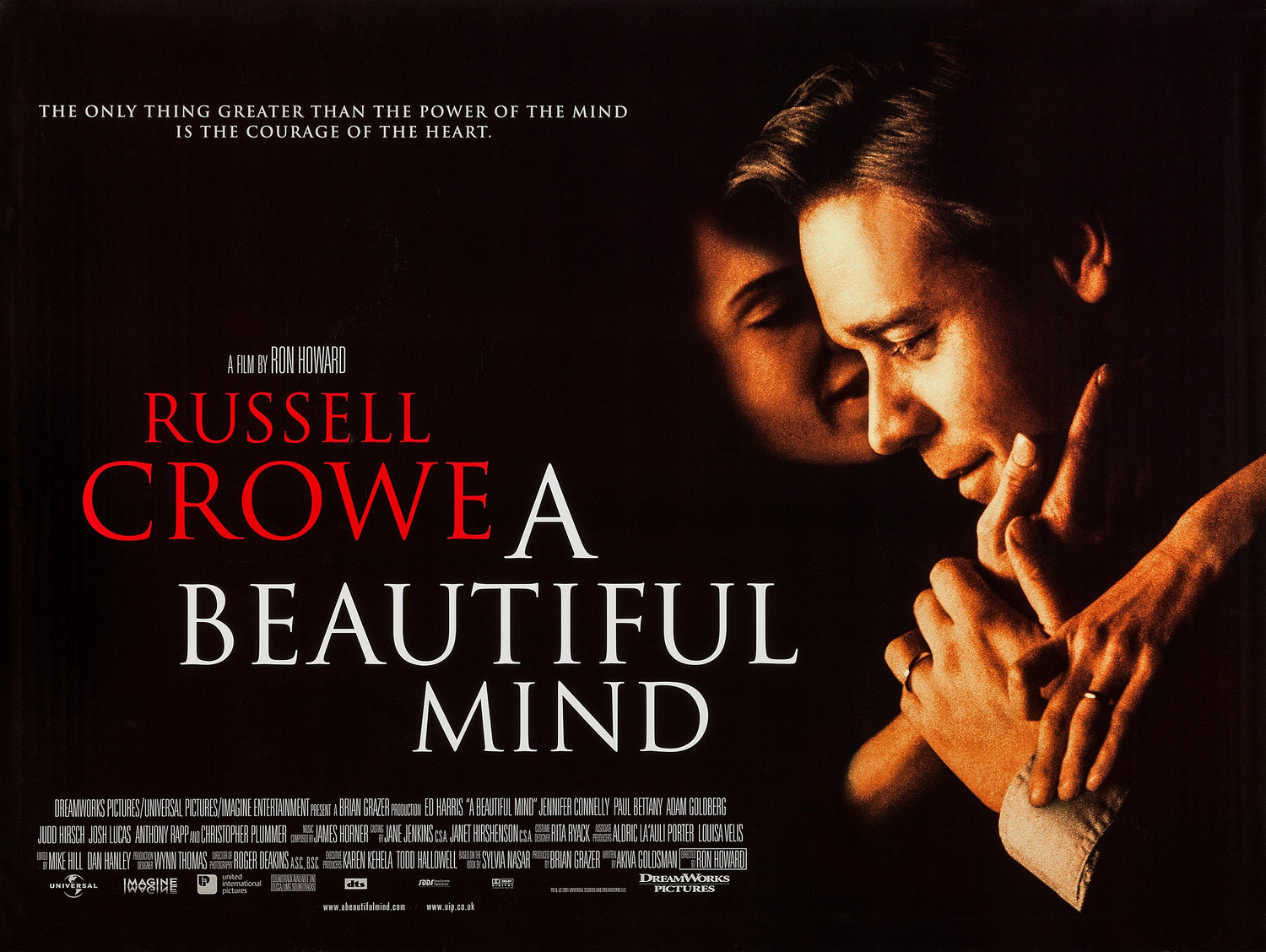
Few films manage to bridge the gap between psychological intensity and mainstream appeal as effectively as “A Beautiful Mind.” Directed by Ron Howard and released in 2001, this acclaimed drama biopic draws viewers deep into the fascinating and turbulent life of Nobel Laureate John Nash. Seamlessly blending elements of biographical storytelling with gripping psychological drama, Howard’s direction and a stellar lead performance captivate not only cinephiles but also audiences seeking a thought-provoking experience. “A Beautiful Mind” stands apart as one of the early 21st century’s most profound explorations of genius, mental health, and the irrepressible resilience of the human spirit.
Plot Summary
Set primarily in the mid-20th century, “A Beautiful Mind” chronicles the journey of John Forbes Nash Jr., a brilliant but socially awkward mathematician whose path leads him from a prestigious Princeton University graduate student to one of the most renowned thinkers of his generation. The film opens with Nash’s arrival at Princeton, where his unconventional demeanor stands out among his classmates. Driven by the need to develop a truly original idea, Nash finds himself obsessed with making a game-changing contribution to mathematics.
His breakthrough comes in the form of a revolutionary theory that redefines economic thought, earning him recognition in his field and a position at MIT. Nash’s personal and professional life seems to flourish: he enjoys camaraderie with ex-roommate Charles, mentors eager students, and begins a romance with the smart and compassionate Alicia, whom he eventually marries. However, as Nash’s career progresses, his life takes an unsettling turn. He is drawn into a covert government assignment, decoding hidden messages and conspiracies—a pursuit demanding secrecy and constant vigilance.
As Nash becomes increasingly consumed by these clandestine endeavors, the line between reality and delusion blurs. His behaviors grow erratic, straining his relationships and jeopardizing his career. The film navigates Nash’s profound internal struggle as he comes to terms with his mental health challenges, notably schizophrenia. Despite tremendous odds, Nash endeavors to reclaim his sense of self, aided by Alicia’s unwavering support and his own remarkable intellect.
Warning: Minor spoilers ahead. The latter part of “A Beautiful Mind” follows Nash’s arduous journey toward recovery and his unyielding pursuit to find meaning and stability amid a mind at odds with itself. The story ultimately celebrates resilience, love, and the pursuit of understanding beyond scientific equations.
Key Themes & Analysis
“A Beautiful Mind” delves deep into themes of genius, identity, and the elusive boundary between reality and illusion. At its core, the film examines how extraordinary intellect can be both a gift and a burden. John Nash’s singular brilliance is the source of both his greatest achievements and his most challenging struggles. The narrative invites viewers to question what constitutes reality when the most reliable narrator is also the most unreliable observer of his own experience.
Director Ron Howard masterfully cultivates tension and empathy through carefully orchestrated cinematography and pacing. Cinematographer Roger Deakins employs light, shadow, and camera angles to visually represent Nash’s shifting perceptions, drawing the audience into his perspective. Scenes that initially appear ordinary take on new significance as Nash’s world unravels, making viewers question what is real alongside the protagonist.
Howard’s direction excels in balancing the film’s emotional heft with its intellectual subject matter. He resists excessive sentimentality, allowing the evolving relationship between John and Alicia to unfold naturally and with authenticity. This dynamic serves as the emotional anchor of the film, grounding Nash’s turbulent journey with palpable humanity.
The acting performances in “A Beautiful Mind” are uniformly outstanding, with Russell Crowe delivering one of the most nuanced embodiments of mental illness on screen. Crowe avoids caricature, infusing Nash with vulnerability, eccentricity, and understated dignity. Jennifer Connelly is equally compelling as Alicia, capturing the combination of frustration, determination, and unconditional love required to support her husband. Supporting actors, including Ed Harris and Paul Bettany, enrich the narrative with memorable, multifaceted performances.
The film’s script, adapted by Akiva Goldsman from Sylvia Nasar’s biography, distills complex ideas without dumbing them down. It demystifies Nash’s mathematical genius through elegantly visualized explanations while never shying away from the disorienting reality of schizophrenia. That duality—the beauty and the terror, the math and the madness—is what makes the film resonate long after the credits roll.
Why You Should Watch It
- Extraordinary Performances: Russell Crowe and Jennifer Connelly deliver unforgettable, award-winning portrayals that bring John and Alicia Nash to life with authenticity and sensitivity.
- Thoughtful Exploration of Mental Health: The film offers a nuanced and compassionate look at schizophrenia, helping to break down stigma and encourage empathy.
- Inspirational True Story: “A Beautiful Mind” is not just an account of mathematical achievement, but a stirring tribute to resilience, love, and the triumph of the human spirit against overwhelming odds.
Review Conclusion
“A Beautiful Mind” stands as a finely crafted biographical drama that manages to entertain, educate, and inspire in equal measure. Ron Howard’s deft direction, combined with luminous performances by Crowe and Connelly, results in a film that is as emotionally stirring as it is intellectually engaging. The thoughtful handling of mental illness elevates it beyond a conventional biopic, prompting important conversations about the nature of genius, the struggle for self-acceptance, and the power of support and understanding.
Whether you’re interested in psychological thrillers, character-driven dramas, or true stories of perseverance, “A Beautiful Mind” is a must-see. The film’s approach to storytelling—complex but never confusing, dramatic but never manipulative—cements its place as a modern cinematic classic.
Rating: 4.5/5
🎬 Check out today's best-selling movies on Amazon!
View Deals on Amazon